16 Candidates Submitted for Mobile County District Court Judge Vacancy
The Mobile County Judicial Commission reviews 16 applicants for the District Court seat vacated when Jay York moved to circuit court.
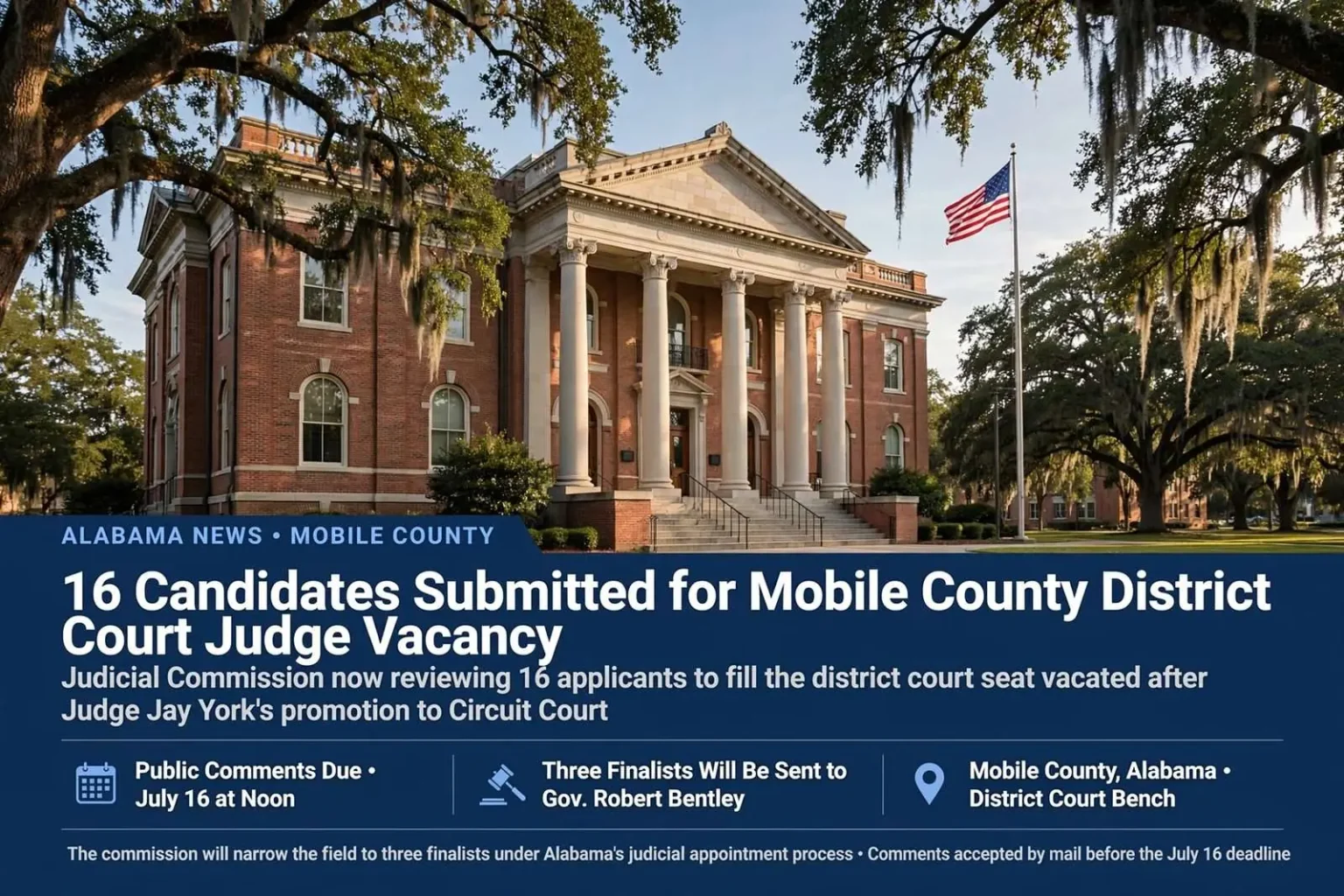
Sixteen people are in the running to fill a Mobile County District Court judgeship left vacant when Judge Jay York was elevated to the circuit bench. York was appointed last month to the Mobile County Circuit Court seat vacated by Judge Joseph “Rusty” Johnston, who went on medical leave in February and retired two months later. The shuffle has left a seat on the district bench open, and the process of filling it is now formally underway.
The Mobile County Judicial Commission is considering applications from a pool that spans much of the local legal community. The sixteen applicants are Jeffrey U. Beaverstock, Edward C. Blount Jr., J. Randall Crane, Rudene B. Crowe, Marcus T. Foxx, Lars T. Granade, Brandy B. Hambright, Ronald A. Herrington Jr., Carol C. Little, Edward T. March, James T. Patterson, Jill P. Phillips, Wanda B. Rahman, Cindy W. Powell, Derrick Williams and George M. Zoghby.
The list reflects the breadth of practice found among Mobile’s lawyers and sitting judges, and the size of the pool signals the level of interest a countywide judgeship draws. Judicial appointments in Alabama are politically significant positions, and the district bench in particular is where most residents encounter the court system directly, whether through traffic cases, misdemeanor charges or small civil disputes.
How the Public Can Weigh In
Members of the public may submit comments on the candidates to the commission through noon on July 16. The panel has emphasized that comments are kept confidential, but it will not consider anonymous submissions, a rule designed to let the commission hear candid assessments while ensuring that every input has a named source behind it.
Comments may be submitted by mail to the commission’s members, whose contact information the panel has published. That outreach channel is an unusual degree of openness in the appointment process, and it gives residents, attorneys and community leaders a formal way to bring information about the candidates to the people who will decide which names advance.
The confidentiality rule serves a practical purpose. Lawyers, court staff and others who have worked with the applicants often have valuable insight but may be reluctant to share it publicly if they appear in one of the local courts on a regular basis. By keeping submissions out of public view while refusing anonymous ones, the commission tries to gather frank information without opening the door to untraceable attacks.
What Happens Next
The commission will narrow the field to three names and forward them to Gov. Robert Bentley, who will choose York’s successor. That structure — a screening commission that investigates and interviews applicants, then sends a short list to the governor — is how Alabama fills judicial vacancies between elections, and it puts enormous weight on the commission’s early work.
For the applicants, the vetting process typically involves detailed questionnaires about their practice histories, background checks and interviews with the commission. The panel’s job is to sort a list of sixteen working lawyers and judges into a slate of three finalists, each of whom the governor can consider in depth. Whoever is selected will take the bench facing an election cycle on the horizon, as appointed judges must eventually stand before voters to keep the seat.
The vacancy itself traces back through two moves. Johnston, a longtime circuit judge, went on medical leave in February and retired two months later, creating the circuit seat. York’s appointment to that circuit bench opened the district court position that these sixteen candidates are now pursuing. Judicial seats rarely open this way by design, and each move ripples down the roster of the county’s courts.
What the District Court Does
The Mobile County District Court is one of the busiest courts in southwest Alabama. Its judges handle misdemeanor criminal cases, preliminary hearings in felony matters, traffic citations, small claims and civil cases up to the district court’s jurisdictional limit. For thousands of residents each year, a district courtroom is the first and sometimes only place they see the judicial system at work.
District judges also carry heavy dockets on the criminal side, because every felony prosecution passes through their courtrooms at the preliminary hearing stage. That work determines whether cases advance to the circuit court’s grand jury process, making the district bench a critical filter in the local justice system. Civil divisions handle landlord-tenant disputes, debt collection matters and small claims filings that touch ordinary households across the county.
Because the docket is so broad, the job rewards a particular mix of experience: comfort moving quickly through high-volume calendars, patience with self-represented litigants who appear without lawyers, and a steady hand on the bench in emotionally charged criminal matters. The sixteen applicants come from backgrounds that include private practice, prosecution and existing judicial service, giving the commission a wide range of resumes to weigh as it builds its short list.
A Community Watching the Bench
Judicial appointments draw particular attention in Mobile County, where the courts sit at the center of public life in a metro area that serves as the economic hub of the Gulf Coast. The judge who fills this seat will serve alongside colleagues handling everything from domestic relations to major felony dockets, and the choice will shape the county’s judiciary for years, since judges who win election to the bench tend to serve multiple terms.
The July 16 deadline for public comments marks the point where the process moves from gathering applications to active evaluation. After that noon cutoff, the commission’s members will turn fully to the work of comparing candidates, reviewing whatever information has been submitted by the public, and scheduling the interviews and deliberations that end with three names going to the governor’s office.
For the applicants themselves, the wait that follows can be long. Nominees often learn little about their standing until the governor makes a choice, and many who apply are not selected but remain active in local legal circles, sometimes returning to the bench in later cycles. Serving on a judicial commission’s short list is itself a mark of professional standing that follows a lawyer through a career.
Residents who want a voice in the process have a clear window and a clear channel: written comments, sent by mail to the commission members whose contact information has been published, arriving before the July 16 noon deadline. Once the commission settles on its three finalists, the pace quickens, and Mobile County will learn who will take the seat Jay York left behind when he moved up to the circuit bench.
The Path That Led Here
The chain of events that created this vacancy began earlier in the year, when Judge Joseph “Rusty” Johnston went on medical leave in February. His retirement followed two months later, leaving a hole in the circuit court’s roster. The governor moved to fill the circuit seat first, appointing Judge Jay York, whose elevation then set the district court vacancy in motion and opened the door for this new round of applications.
That sequencing matters because each appointment reshapes the assignments across both courts. Circuit judges preside over felony trials, major civil litigation and the county’s most complex dockets, and moving a district judge up means the district court must replace not just a name but a body of experience. The commission’s job is to find a candidate who can step into a full district court calendar with as little disruption as possible.
Appointments of this kind are governed by Alabama’s judicial vacancy framework, which steps in whenever a judgeship opens between elections. Rather than leaving seats empty until the next vote, the state relies on local judicial commissions to screen applicants and present a governor with a vetted short list. The design is meant to balance local input with statewide executive authority, and it is the process now playing out in Mobile County.
Reading the Applicant Pool
The sixteen names on the list include lawyers and judges whose careers span decades of service in Mobile’s courts. Long-tenured practitioners who have argued cases in front of nearly every sitting judge share the pool with prosecutors who have handled felony dockets and attorneys whose practices center on the civil divisions where much of the district court’s volume originates.
Diversity of background is part of what commissions weigh when building a bench that reflects the community it serves. Mobile County is Alabama’s second-most-populous county, and its district court serves residents from downtown Mobile to the county’s growing suburbs. The judge chosen from this list will inherit a docket that reflects all of it — criminal arraignments, evictions, small claims disputes and the steady traffic of preliminary hearings.
Whoever is appointed will also join a judiciary that works closely with the district attorney’s office, the defense bar, probation services and the county’s law enforcement agencies. District judges are often the first to test how new procedures, treatment programs and technology changes play out in practice, because so many cases make their first courtroom stop at the district level before moving up the system.
With the July 16 comment deadline approaching, the commission’s members have set the stage for the most consequential phase of the process: choosing three names from sixteen, and sending them to the governor’s desk for a decision that will put a new judge on the Mobile County District Court bench.