$165K Bond Set for Teen Charged in Prichard Shooting Death on I-165
Tremaine Johnson, 19, faces murder charges in the shooting death of Shemeka Stabler, found in a car on I-165 in Prichard.
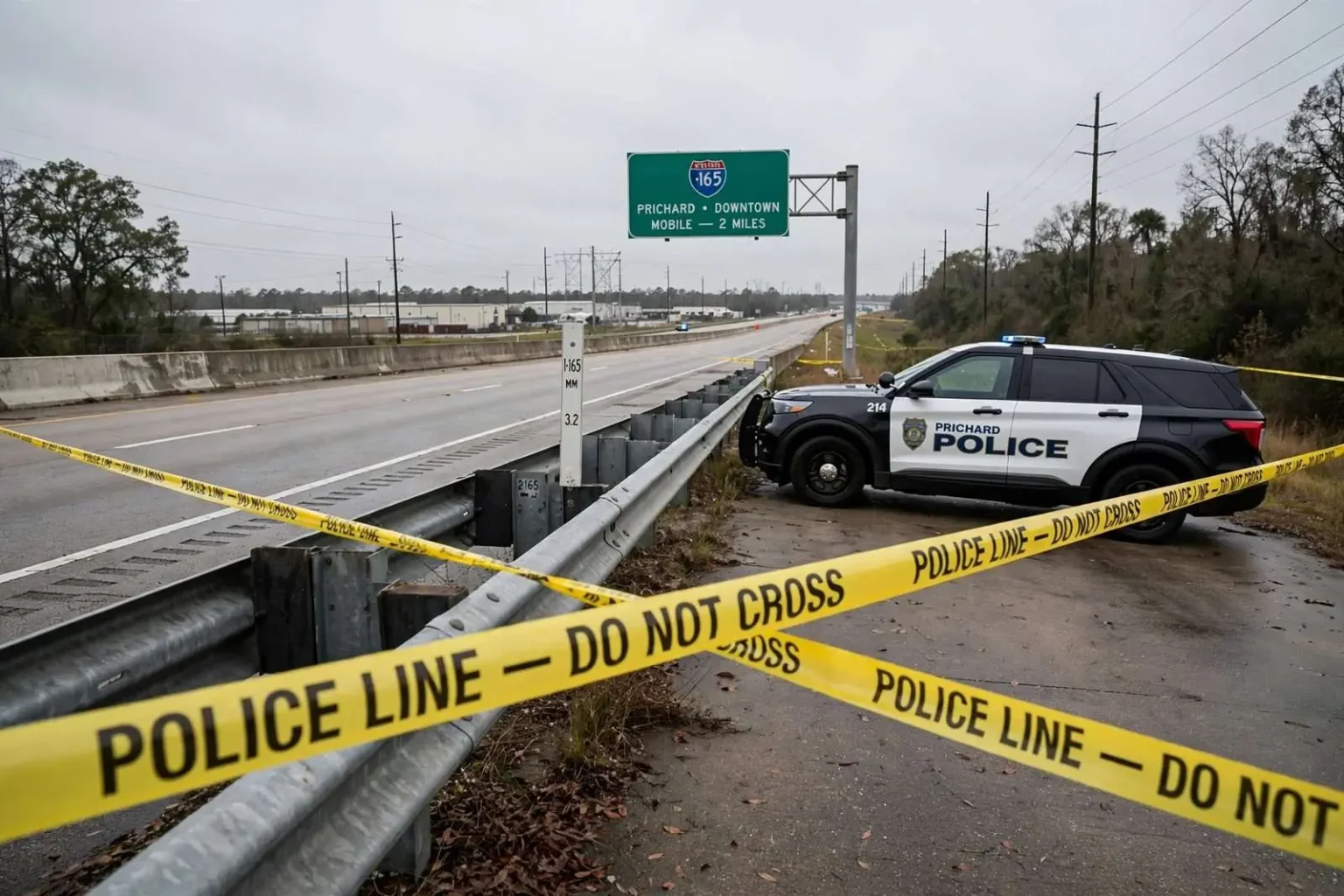
A judge has set bond totaling $165,000 for a 19-year-old man accused of killing a woman whose body was found inside a car along Interstate 165 in Prichard, as prosecutors begin assembling a murder case rooted in what investigators describe as a cycle of retaliation between two families.
Tremaine Johnson is charged with murder in the death of Shemeka Stabler, who was found shot inside a vehicle on I-165 earlier this week. The bond breaks down to $150,000 on the murder count and $15,000 on a charge of shooting into an occupied vehicle.
Investigators describe the shooting as retaliation for another deadly shooting earlier in the month. In that earlier incident, police said Johnson’s brother, Tyvontae Johnson, shot and killed Stabler’s friend, Jasmine Fields, and wounded Stabler as well. Tyvontae Johnson then took his own life, according to police.
The case now returns to the court system as prosecutors prepare the murder charge against the younger Johnson, whose arrest came after a week of investigation into how the young woman’s body came to be discovered on the side of a interstate spur that cuts through the heart of Prichard.
The Discovery on I-165
Interstate 165 is a short but vital spur that connects downtown Mobile to Prichard, lifting traffic over the neighborhoods of the city’s southern edge before terminating into local streets. It is the kind of roadway where a stopped vehicle draws immediate attention, and when a car was found along the interstate with Shemeka Stabler shot inside, it set off the investigation that led to Tremaine Johnson’s arrest.
Stabler had been wounded weeks earlier in the same spasm of violence that killed her friend, Jasmine Fields, according to police. Her death — found shot inside a vehicle in broad view of one of the area’s busiest commuter routes — drew fresh attention to a chain of events that investigators say began with the earlier shooting and ended with two deaths, one arrest and one suicide.
The charge of shooting into an occupied vehicle, filed alongside the murder count, is an Alabama offense typically used when gunfire is directed at a car with someone inside, whether or not the shooter is charged with harming the occupants. Here it accompanies the murder charge, and the bond schedule — $150,000 on the more serious count, $15,000 on the other — reflects the court’s ranking of the two allegations.
A Cycle of Retaliation
According to police, the violence that ended with Stabler’s death began earlier in the month, when Tyvontae Johnson shot and killed Jasmine Fields and wounded Stabler. The two young women were friends, and the attack left one dead and the other recovering from her wounds.
Then, police said, Tyvontae Johnson took his own life. That left investigators, and the community, to reckon with a case in which the suspected shooter in the first attack was dead and the questions about retaliation had only begun.
Investigators concluded that the killing of Stabler was retaliation for the earlier shooting — an act of revenge for the death of Fields, carried out by the brother of the man police hold responsible for the original attack. The allegation, if proven, would make the case one of the clearest examples this year of how quickly disputes on the streets of the Gulf Coast can escalate from a single shooting into a chain of deaths spanning weeks.
Prichard and the Violence in Its Streets
Prichard, a city of roughly 20,000 just north of Mobile, has struggled for years with gun violence that police there say is driven disproportionately by disputes that escalate into retaliation. The city sits at the northern end of I-165, the spur that ties it to Mobile’s downtown, and its neighborhoods have absorbed economic disinvestment that city officials have worked for years to reverse.
Prichard police investigate homicides alongside the Mobile County District Attorney’s Office, and cases like this one — where the suspected shooter in one killing is dead and another young man stands accused in a second — strain the resources of a small department. The arrest of Tremaine Johnson came within days of Stabler’s body being found, an pace that officials credited to cooperation between investigators and members of the community.
The deaths of two young women weeks apart, tied together by investigators into a single retaliatory chain, have renewed attention to the cost of street violence in the small city. Community leaders have repeatedly called for interventions that reach young men before disputes turn deadly, and cases like this one become the reference point for those appeals.
The Charges and the Bond
Murder in Alabama carries a sentence range that runs from 20 years to life, with the potential for harsher penalties when a firearm is used and when the killing is found to be especially culpable. The charge of shooting into an occupied vehicle is a Class B felony, punishable by up to 20 years, and is frequently filed alongside more serious counts when a car is riddled with gunfire.
The $165,000 total bond set by the judge gives the 19-year-old a path to release before trial if he can post it, but the murder component alone — $150,000 — would require significant assets or a bail bondsman’s fee. Defendants charged with murder in Alabama are not automatically denied bond, but the amount set typically reflects both the seriousness of the offense and the court’s assessment of the risk of flight.
The bond decision is one of the first formal steps in a case that will now move through the Mobile County court system. Johnson’s initial appearance and preliminary hearing are the next milestones, where prosecutors must show enough evidence to justify holding him for grand jury consideration.
What Comes Next in the Case
Prosecutors preparing the murder charge will assemble the evidence gathered in the week since Stabler’s body was found — forensic work from the vehicle on I-165, witness statements, and the investigative record connecting the killing to the earlier attack that claimed Jasmine Fields’ life.
The unusual shape of the case — a suspect dead by his own hand, an alleged retaliatory killing, and a 19-year-old now charged with murder — presents distinctive challenges for the court system. The evidence tying the two incidents together will be central to the state’s case, and defense attorneys are expected to scrutinize the basis for connecting the younger Johnson to the earlier shooting cycle.
For the families of Shemeka Stabler and Jasmine Fields, the case now moves into a court process that will unfold over months. Officials have not announced additional arrests, and investigators have not said whether they believe anyone else was involved in the shooting on I-165.
As in every criminal case, the charges against Tremaine Johnson are accusations, and he is presumed innocent unless and until proven guilty in a court of law.
Retaliation and the Cost of Street Disputes
The pattern investigators describe in this case — a killing answered by a killing — has become a defining feature of gun violence in communities across the Gulf Coast. Police departments in Mobile, Prichard and beyond have repeatedly warned that a growing share of their homicides begin not with random encounters but with disputes between people who know one another, followed by acts of revenge that draw more victims into the cycle.
Interruption efforts, from community outreach workers to targeted policing, have sought to break that pattern by reaching participants in a dispute before retaliation occurs. But when the retaliation comes within weeks of the original attack, as investigators allege happened here, the window for intervention is narrow, and the result is a case file that holds two homicide victims, one defendant and one suspected shooter who never faced a courtroom.
Tyvontae Johnson’s death by suicide, according to police, closed one avenue of accountability for the death of Jasmine Fields and the wounding of Shemeka Stabler. His brother’s arrest opens another, but it also leaves a tangle of questions about evidence, motive and responsibility that prosecutors and defense lawyers will sort out over the coming months.
How the Court Process Will Unfold
After a bond is set, a defendant charged with murder in Alabama typically faces a preliminary hearing in district court, where the state must present enough evidence to establish probable cause. If the judge finds it, the case is bound over to a grand jury, which votes on whether to return an indictment. Only then does the case proceed to circuit court for trial.
Along the way, both sides will engage in discovery, exchanging the evidence each intends to rely on. The defense may challenge the strength of the connection between the defendant and the crime scene, the reliability of witness identifications, or the forensic conclusions drawn from the vehicle found on I-165. Plea negotiations, which resolve the vast majority of criminal cases, remain possible at any stage.
The timeline for a murder case in Mobile County routinely runs a year or more from arrest to trial, and appeals can extend the process further. For the families involved, that means the questions raised by Stabler’s death — and the full account of how the retaliation cycle unfolded — will remain open for a long time.
A Community reckoning With Two Losses
Beneath the legal process, the case represents a double loss for the community: two young women — Jasmine Fields and Shemeka Stabler — dead within weeks of each other, and a young man now facing the prospect of decades in prison. The 19-year-old defendant, by the time any trial concludes, will have spent much of his early adulthood inside the criminal justice system.
Prichard officials have said the city’s future depends on breaking these cycles before they claim more lives, pairing enforcement with economic development and youth programs aimed at giving young residents alternatives. Each high-profile case tests that commitment, and each retaliatory killing reinforces the argument that enforcement alone cannot stop the pattern.
For now, the courts will do their work. The bond is set, the charges are filed, and the investigation has been handed from the detectives who worked the scene on I-165 to the prosecutors who will carry the case to trial. Whether justice, in the end, answers the deaths of Shemeka Stabler and Jasmine Fields will be decided in a Mobile County courtroom — and in the community’s own efforts to ensure the next dispute ends differently.