
18th Annual Festival of Flowers Brings Grand Floral Spectacle to Mobile
The 18th Annual Festival of Flowers returned to Providence Hospital in Mobile with vast floral exhibits, gardens and family-friendly attractions.
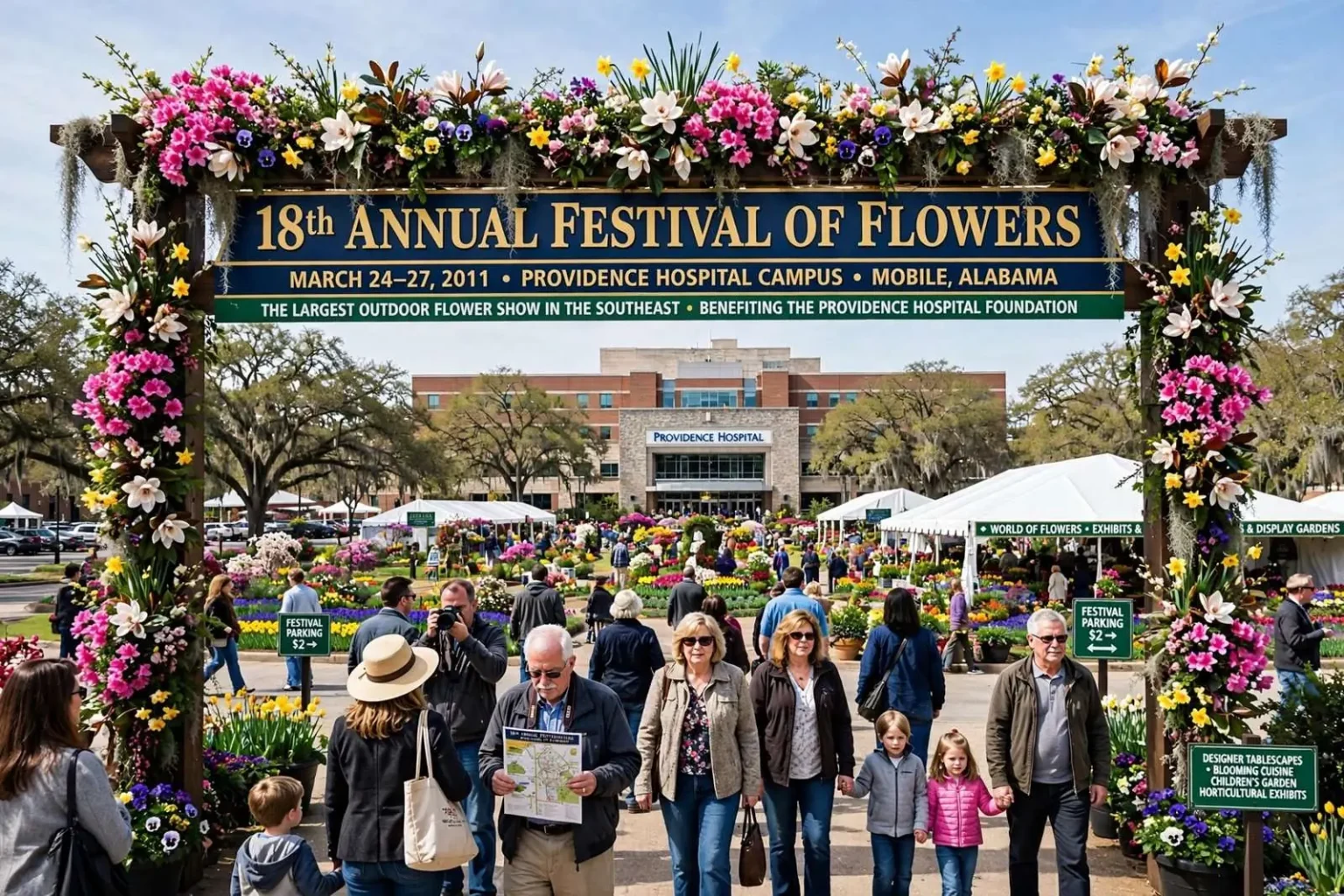
The 18th Annual Festival of Flowers was set to return to the Providence Hospital campus in Mobile in late March 2011, promising what organizers called the largest outdoor flower show in the Southeast. After sixteen previous editions, the event had grown into one of the signature spring traditions on the Gulf Coast, transforming a working hospital campus into a sprawling garden destination for four days each year.
For Mobile, a city already famous for its azaleas and its weeks-long Mardi Gras season, the festival extended the celebration of spring into a new register. Where Mardi Gras fills the streets downtown, the Festival of Flowers filled the grounds of a west Mobile hospital with exhibits, gardens, and crowds, drawing visitors from across the region during a month many locals consider the city’s most beautiful.
A Gulf Coast Tradition
Over the course of 16 previous years, the Festival of Flowers had drawn an estimated 150,000 visitors to its grand floral displays and life-sized garden installations. That cumulative attendance made it far more than a garden-club outing; it ranked among the most-attended recurring special events in the Mobile area and a meaningful driver of spring visitation for hotels, restaurants, and garden retailers across the city.
The festival was acknowledged as the premier flower and garden event on the greater Gulf Coast, a distinction earned not just through scale but through timing. It took place each spring during what many consider Mobile’s most beautiful month, when trees leaf out and flowering plants reach their peak — the stretch of the calendar when the city’s famous oaks, azaleas, and gardens are at their showiest and the weather still tolerable before the deep heat of summer arrives.
The setting was itself a large part of the attraction. Spread across more than 300,000 square feet of exhibits arranged under tents and open sky on the Providence Hospital campus at 6801 Airport Boulevard, the multi-day event offered a feast for the senses designed to enchant, entertain, and educate attendees of all ages. Airport Boulevard runs west from central Mobile toward the city’s major retail and medical corridors, putting the campus within easy reach of residents across the metro area and of travelers arriving off Interstate 65 and the other highways that converge on the city.
Providence Hospital’s involvement gave the festival an unusual institutional home. Hospital campuses rarely host events of this scale, and the partnership reflected a mutual interest: the hospital gained a signature community event that drew tens of thousands onto its grounds, while the festival gained space, parking, and an anchor beneficiary in the Providence Hospital Foundation. All proceeds from the Festival of Flowers benefited the foundation, directing ticket revenue toward the hospital’s charitable mission.
Exhibits and Attractions
The 2011 edition featured an extensive lineup of attractions, including floral and horticultural exhibits, designer tablescapes, a World of Flowers showcase, professionally landscaped gardens, and Blooming Cuisine culinary demonstrations. The variety was deliberate: organizers structured the festival so that a serious gardener, a casual admirer, and a family looking for a day out could each build a different visit from the same grounds.
The designer tablescapes had become one of the event’s most photographed traditions, pairing elaborate floral centerpieces with themed table settings conceived by regional designers and florists. Horticultural exhibits gave nurseries, growers, and garden societies a showcase for new varieties and display gardens, while the World of Flowers presentation gathered blooms into large-scale themed installations that changed from year to year.
A photography contest invited shutterbugs to capture the beauty on display, turning attendees themselves into contributors to the festival’s visual record. Garden events of this kind rely heavily on amateur photographers to spread their imagery, and the contest gave visitors a reason to linger at every installation with a camera in hand.
Featured artist Justin Gaffrey brought his distinctive work to the festival grounds. Gaffrey, a Santa Rosa Beach, Florida-based painter known for heavily textured, sculptural applications of paint that give his floral and coastal scenes an almost three-dimensional surface, had built a regional following along the Gulf Coast, and his presence linked the flower show to the broader Gulf Coast arts scene.
The Mobile Museum of Art hosted a dedicated children’s venue, making the event a family-friendly outing rather than an adults-only cultural affair. The museum, located in Mobile’s Municipal Park, has long been one of the city’s leading cultural institutions, and its involvement extended the festival’s educational reach — introducing children to art and nature together at an age when both impressions tend to stick.
Educational programming has been a quiet backbone of the festival throughout its history. Flower shows of this scale typically pair their displays with demonstrations and talks from horticulture professionals, master gardeners, and landscape designers, giving attendees practical takeaways — what grows on the Gulf Coast, how to plant it, and how to keep it alive through the region’s long growing season and occasional hard freezes.
The culinary component, Blooming Cuisine, added another layer to the day. Cooking demonstrations woven through a garden festival tie the exhibit halls to the region’s food culture, and they gave visitors a reason to stay on the grounds for hours rather than an hour, spreading crowds across the day and supporting the festival’s rhythm of continuous programming.
Admission and Details
The festival ran Thursday through Sunday, with hours from 9 a.m. to 5 p.m. on weekdays and Saturdays, and 10 a.m. to 5 p.m. on Sundays. The four-day format spread attendance across a long weekend, allowing organizers to accommodate school groups and seniors on the quieter early days while capturing the largest crowds on Saturday.
Day passes were priced at $10, with multi-day passes also available for visitors planning to return. Children age 12 and under were admitted free, a policy that reinforced the event’s family orientation and kept the cost of an outing manageable for households bringing several children. On-site parking was available for $2, a modest fee by the standards of major regional events and one that simplified logistics on a campus where thousands of vehicles needed a place to go.
For comparison’s sake, the pricing placed the festival well below the cost of comparable ticketed events in larger Southeastern cities while still generating meaningful support for the Providence Hospital Foundation. At roughly 150,000 cumulative visitors across the event’s first sixteen years, even modest admission and parking fees translated into a significant annual contribution to the hospital’s charitable programs.
What the Festival Means for Mobile
Events like the Festival of Flowers play an outsized role in how Mobile presents itself to the region. The city’s national reputation rests heavily on Mardi Gras and its colonial history, but its calendar of spring cultural events — garden shows, art walks, and historic home tours — markets a different side of the city to visitors from along the Gulf Coast, from New Orleans to the Florida Panhandle.
The festival also served the local green industry. Nurseries, landscapers, garden designers, and florists across south Alabama and northwest Florida depend on spring buying seasons, and a well-attended show that showcases plants suited to the Gulf Coast climate functions as both marketplace and classroom for the region’s gardening public.
By its 18th year, the festival had also become a measuring stick for late-March weather in Mobile. Outdoor tent events live and die by spring conditions, and locals had learned to treat a Festival of Flowers weekend as an invitation to get outside during the narrow window when the Gulf Coast offers mild temperatures and peak blooms at the same time.
Organizers’ claim of the largest outdoor flower show in the Southeast reflected the event’s unusual format as much as its footprint. Many major flower shows are held indoors in convention centers; building the exhibition across 300,000 square feet under tents and open sky allowed for full-scale, life-sized garden installations — walkable landscapes with trees, sod, water features, and mature plantings — that indoor shows cannot easily replicate.
For attendees planning a visit, the practical draw was straightforward: a single $10 admission covered access to a program that would otherwise require trips to multiple venues across the city — a botanical garden, an art museum, a design show, and a cooking demonstration. For families with young children admitted free, the calculus made the festival one of the most affordable full-day cultural outings on Mobile’s spring calendar.
The 2011 edition arrived at a moment when Mobile’s westward growth had made the Airport Boulevard corridor one of the city’s busiest, and the Providence Hospital campus had become a familiar landmark for a generation of residents who had watched the surrounding area fill in with retail, offices, and medical facilities. Hosting the city’s premier garden event there underscored how thoroughly the festival had grown from a hospital auxiliary project into a genuine regional attraction.
As in previous years, the combination of scale, charity, and springtime made the festival a fixture that residents planned around. Gardeners circled the dates months in advance for first look at new plant varieties; designers and photographers came for the tablescapes and contest; and thousands of others came simply to spend a spring day in the most beautiful setting south Alabama could assemble under a canopy of white tents.
With all proceeds flowing to the Providence Hospital Foundation, every pass purchased — every $10 day ticket, every multi-day pass, every $2 parking fee — doubled as a donation to the hospital’s work in the community. That pairing of spectacle and mission is what allowed a flower show on a hospital lawn to sustain itself for eighteen years and to earn its place as the premier flower and garden event on the greater Gulf Coast.


