2022 Mobile Chili Cook-off returns to downtown Canal Street
The 2022 Mobile Chili Cookoff returns to Canal Street on March 12 to benefit the American Cancer Society's Road to Recovery program.
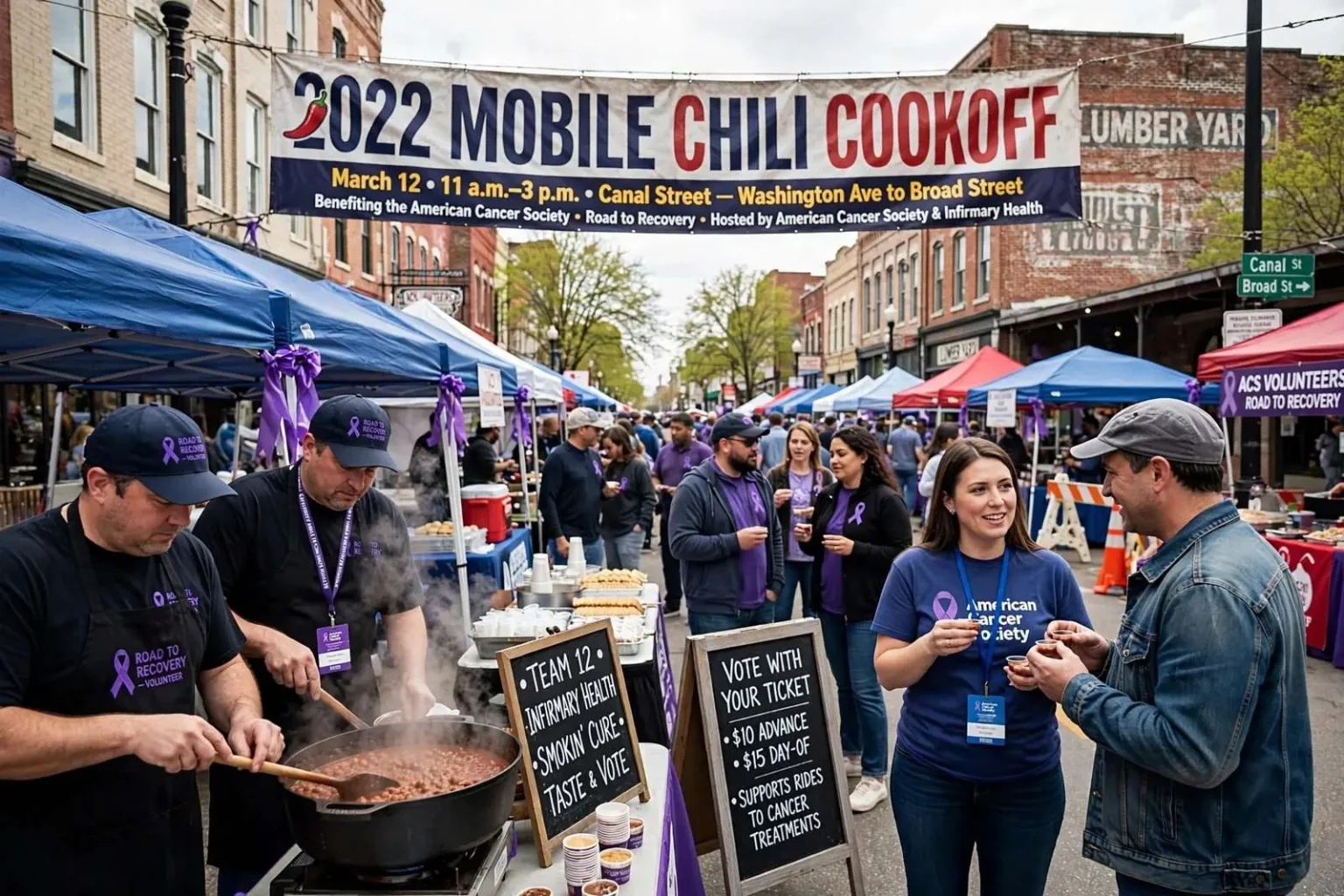
MOBILE, Ala. — The 2022 Mobile Chili Cookoff, hosted by the American Cancer Society and Infirmary Health, returns to Canal Street — between Washington Avenue and Broad Street — on March 12 from 11 a.m. to 3 p.m. The four-hour event transforms a block of downtown Mobile into a campground of cook teams, tasting cups and live competition, all in the name of raising money for the American Cancer Society’s Road to Recovery program, which helps cancer patients get rides to treatments and doctor appointments.
Advance tickets are $10, and day-of tickets will be available for $15, an early-bird incentive that has become part of the event’s rhythm. Attendees sample chili from competing teams and vote with their tickets, while judges sort out the official winners. The cookoff lands in the stretch of early spring when downtown Mobile is already accustomed to crowds, coming in the weeks after Mardi Gras parades have wound down but before the city’s spring festival season fully arrives.
Money that pays for rides
The Road to Recovery program sits at the center of the event’s purpose. The program coordinates volunteer drivers who give cancer patients rides to and from their treatments — chemotherapy and radiation schedules that can demand multiple trips a week for months at a time. For patients who no longer drive, who are too sick to sit behind a wheel after treatment, or whose families cannot leave work for weekday appointments, a volunteer ride is often the only reliable way to keep a treatment schedule on track.
That need is especially real across the Gulf Coast, where many patients live in rural parts of Mobile, Baldwin, Washington and Clarke counties, far from the treatment centers concentrated in downtown Mobile and along the area’s medical corridors. Missing treatments because a ride fell through can compromise outcomes, which is why the American Cancer Society treats transportation as a core service rather than a convenience. Money raised at the cookoff helps underwrite the program’s coordination and the network of volunteers who make it work.
From two men and a pot to a downtown tradition
The fundraiser’s origin story remains one of the most quoted parts of its identity: it began in 1989 behind the Lumber Yard restaurant with two men and a pot of chili, raising $550 that first year. From that modest start, the event has grown steadily since 2006 and has brought in more than $2 million to support the American Cancer Society’s mission — a total that has made the Mobile cookoff one of the signature local fundraisers on the Gulf Coast calendar.
The growth trajectory reflects more than the appeal of competition chili. Local businesses, hospitals, construction firms and civic groups have long treated cookoff team slots as a way to rally employees and clients around a cause, and the event has benefited from Mobile’s deep culture of benefit fundraising, honed by generations of Mardi Gras societies, bowls and balls that put a premium on organizing for charity. Each year’s teams arrive with themes, decorations and handoff ceremonies for trophies, turning the block of Canal Street into part fair, part tailgate.
Infirmary Health’s role as co-host ties the event to the region’s largest nongovernmental health care system, which has anchored medical care in Mobile for well over a century. For a health system whose founding mission predates many of the treatment options available to today’s cancer patients, supporting a program that removes transportation barriers is a natural fit, and Infirmary staff and affiliates are perennial participants in the day’s cooking and volunteering. The partnership also puts physician and clinical volunteers on the street alongside patients and families, a reminder of how much of cancer care happens outside hospital walls.
A block of downtown with a job to do
Canal Street sits on the northern edge of downtown Mobile, running between Washington Avenue and Broad Street through a district of historic neighborhoods and warehouses that has seen steady reinvestment. Closing the block for the afternoon puts the cookoff within easy reach of the central business district, the hospitals on the eastern side of downtown and the neighborhoods of north Mobile. Attendees who park nearby find themselves within walking distance of the route, and the four-hour window — 11 a.m. to 3 p.m. — makes the event an easy lunch-hour outing for downtown workers.
For the American Cancer Society, events like the cookoff do double duty: they raise the money that funds programs such as Road to Recovery, and they keep the organization’s services visible to families who may need them years before they think to ask. The society’s work in Alabama ranges from research advocacy to lodging and support programs for patients and caregivers, all of it dependent on community fundraising of the kind Mobile has sustained for more than three decades.
What ticket buyers and teams should know
The pricing structure rewards planning. A $10 advance ticket saves five dollars off the $15 day-of price, and for families or office groups buying in bulk, the difference adds up quickly. Attendees can sample widely without committing to a full plate from any single team, and volunteers staff the gates, the tasting lines and the serving stations, most of them drawn from the same companies and organizations that field the cook teams.
Team competition follows a pattern familiar from cook-offs across the South. Entries are judged on texture, taste and consistency, with public tasting votes feeding into the day’s awards. Corporate teams spend weeks refining recipes and building booths, while hospital departments and trade groups treat the cooking as a team-building exercise with a charitable payoff. Weather is always the wild card for a March event on the Gulf Coast, but a half-day format gives organizers flexibility to run the competition efficiently even when clouds roll through.
Parking in the surrounding blocks is the main logistical note for attendees, since Canal Street itself closes for the event. Downtown’s grid means multiple approaches by way of St. Louis, Spring Hill and Government streets, and the district’s walkability lets attendees pair the cookoff with an afternoon along Dauphin Street or the waterfront parks a short distance south.
Why the milestone matters
More than $2 million raised since 1989 is the headline number, but the significance is easier to see at the level of a single appointment. Every ride funded means a patient who makes a scheduled infusion, keeps a radiation slot or gets to a follow-up visit on time. Over three-plus decades, the cookoff’s steady accumulation of $10 and $15 tickets has quietly built one of the more durable funding streams for patient support in Mobile, one pot of chili at a time. Organizers expect the 2022 edition to add to that total when the teams line up on Canal Street on March 12.
Chili cook-offs hold a particular place in Southern fundraising, and Mobile’s iteration shares DNA with the cook-off circuit that runs through Texas and the broader Gulf region. The format is simple enough for a neighborhood church fundraiser but scales easily to a downtown street: teams pay entry fees, attendees buy tasting tickets, and the competitive pretense — whose pot is best — supplies the energy that keeps people circulating for hours. What distinguishes the Mobile event is its longevity and its singular focus; rather than splitting proceeds across several causes, three decades of cook-offs have funneled support toward cancer patients year after year.
The volunteer dimension of Road to Recovery deserves particular attention, because the program’s economics only work through people willing to drive. Volunteers use their own vehicles, set their own availability and often build standing relationships with the patients they carry, learning the rhythm of a treatment schedule over months of rides. Drivers frequently describe the role as equal parts transportation and companionship — a familiar face on an uncertain day. Every new driver the program recruits expands the number of appointments the community can absorb, which is precisely what the cookoff’s proceeds support.
Cancer care in the region has changed enormously since 1989, when the cookoff’s founders fired their first pot behind the Lumber Yard. Treatment that once required long hospitalizations now often happens in outpatient infusion centers, which means more frequent trips rather than fewer — and a transportation program matters more, not less, in that landscape. Screening advances and earlier detection have improved survival for many cancers, but survival depends on patients actually completing the calendar of appointments that modern protocols demand. Community-funded ride programs sit quietly underneath that entire structure.
For Mobile, the cookoff also functions as a marker on the civic calendar. Events that return to the same block at the same time each year become part of how a downtown measures itself, and Canal Street’s transformation each March — barricades up, cookers smoking, judges’ table set — signals the arrival of the spring fundraising season. Local media coverage, team sponsorship banners and the society’s volunteers give the American Cancer Society a once-a-year street presence that no amount of paid advertising could replicate.
Attendees planning to go should aim to arrive early both to find parking in the surrounding blocks and to catch the teams at full setup, when the decorations and themes are at their best. The 11 a.m. opening gives families a full four hours, and by mid-afternoon the awards have been settled and the block begins returning to its ordinary shape. Tickets at the $10 advance rate can be secured through the American Cancer Society and Infirmary Health channels ahead of March 12, while the $15 day-of option remains available at the gate for spontaneous attendees — though organizers, as ever, hope the advance sales tell them early how big the crowd will run.