21-Year-Old Shot in the Arm Near Azalea Road in Mobile
A 21-year-old man was shot in the arm near Azalea Road in Mobile and taken to University Hospital as police investigated the shooting.
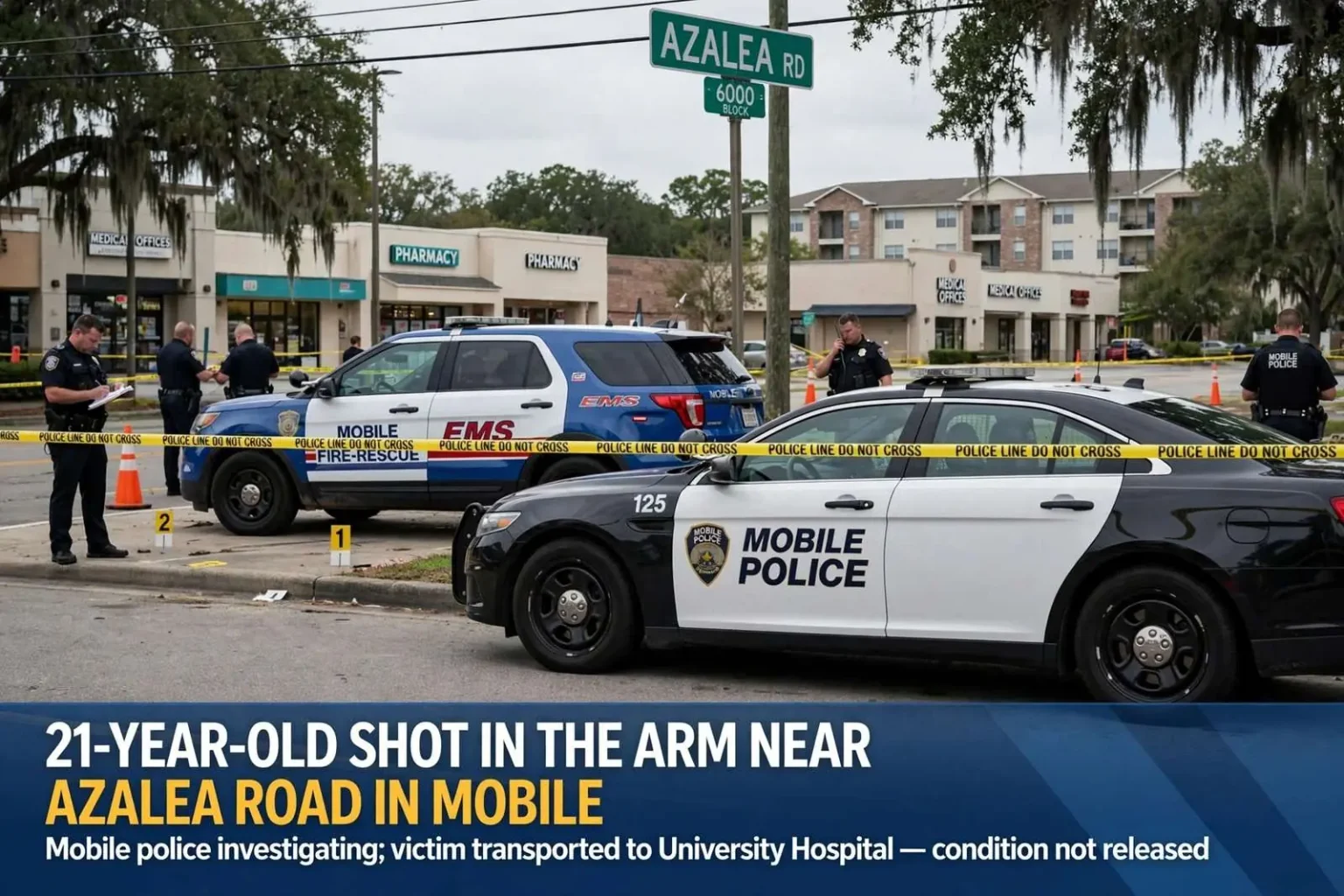
Mobile police are investigating a shooting near Azalea Road that left a 21-year-old man wounded. Mobile Fire-Rescue confirmed the man was shot in the arm and was transported to University Hospital for treatment. His condition was not immediately released. Details about what led to the shooting, including any suspect information, had not been made public as the investigation continued.
The shooting occurred in the area of Azalea Road, a major north-south artery on Mobile’s west side that runs between Government Boulevard and Airport Boulevard, threading through a corridor of apartment complexes, offices, retail centers and established neighborhoods. Police responded to reports of a person shot, and Mobile Fire-Rescue medics stabilized the victim at the scene before transporting him to University Hospital, the region’s only Level 1 trauma center, located just north of downtown. A wound to the arm is among the less serious categories of gunshot injuries, but medics and trauma surgeons treat every shooting as potentially life-threatening until a full evaluation is complete.
In the hours after the shooting, investigators had not released a description of any suspect, and police had not said whether the shooting occurred inside a residence, in a parking area, or along the roadway itself. Detectives with the department’s Major Crimes Unit typically take over shooting investigations once patrol officers secure the scene, and their early work centers on the same foundations in every case: interviews with the victim when his condition allows, statements from anyone who heard the shots or saw the events leading up to them, and a careful search of the area for shell casings, damage and surveillance footage.
Patrol officers arriving first at a shooting scene shoulder responsibilities that shape everything afterward. They check the victim’s condition and relay medical information to responding medics, establish a perimeter so the scene is not trampled, identify potential witnesses before they disperse, and begin noting the layout of shell casings and damage before the scene unit arrives. In busy commercial corridors like Azalea Road, where onlookers gather quickly and traffic keeps moving, controlling the scene in the first ten minutes often determines how much usable evidence survives. The department’s practice of broadcasting suspect descriptions quickly, when witnesses can provide them, also gives patrol units in the surrounding area a chance to spot a fleeing vehicle before the trail goes cold.
The Azalea Road Corridor
Azalea Road carries heavy daily traffic through one of Mobile’s busiest commercial districts, intersecting Government Boulevard to the south and Airport Boulevard to the north and connecting with the residential neighborhoods and apartment communities in between. The corridor is home to medical offices, restaurants, hotels and shopping centers that draw visitors from across west Mobile throughout the day and into the evening hours. Because of the volume of people and vehicles moving through the area, investigators responding to an incident there usually have access to substantial camera coverage from surrounding businesses, which frequently becomes the backbone of the case when witnesses are scarce.
The west side neighborhoods around the corridor have experienced the crime trends typical of mid-sized American cities, with incidents concentrated at certain properties and times. Mobile Police Department leadership tracks shooting activity across its precincts and adjusts patrol deployment accordingly, and community groups in the area have organized around violence interruption and youth outreach programs aimed at the underlying disputes that produce many of the city’s shootings. The department also operates its intelligence-led policing model, which pairs analysts with investigators to identify patterns and repeat participants in gun violence cases.
How Mobile Investigates Nonfatal Shootings
Nonfatal shootings occupy an important place in a department’s caseload, both because the victim survives to provide information and because research has repeatedly shown that these incidents are connected to retaliatory violence if they are not resolved quickly. Mobile investigators move fast on the interviews and evidence collection while memories are fresh, and they coordinate with prosecutors at the Mobile County District Attorney’s Office to build charges that can hold from the outset. Gunshot victims treated at University Hospital are often interviewed by detectives before discharge, and the hospital’s role as the regional trauma center means Mobile police maintain a standing relationship with its staff for these investigations.
The ballistic evidence collected at the scene tells its own story. Shell casings establish how many shots were fired and from what type of firearm, and recovered projectiles can be matched to other shooting scenes through the state’s crime laboratory. Gunshot detection alerts, camera footage and 911 calls help establish a timeline, and investigators compare that timeline against any descriptions of vehicles or people seen leaving the area. In cases where a suspect is quickly identified, arrests can come within days; where the trail is thinner, detectives continue working the case long after the initial scene has cleared.
University Hospital and the Trauma Response
University Hospital, operated by USA Health on Mobile’s near-north side, serves as the region’s primary trauma center, receiving shooting victims, crash patients and other critical injuries from across southwest Alabama. For a victim with an arm wound, treatment typically focuses on controlling bleeding, assessing damage to bone, nerves and blood vessels, and surgical repair where needed. Extremity gunshot wounds can require multiple procedures and lengthy rehabilitation, and the hospital’s trauma team works alongside physical therapists and specialists through a recovery that can extend for months. The hospital also maintains outreach programs addressing community violence, connecting recovering victims with support services as part of the effort to break cycles of retaliation.
The response chain that brings a shooting victim to the trauma center begins with the 911 call and runs through Mobile Fire-Rescue, the department that provides emergency medical services across the city. Medics follow protocols that prioritize rapid transport for penetrating trauma, keeping scene time short when the patient’s condition allows and communicating with the trauma team en route so surgeons are ready on arrival. That choreography, refined across thousands of transports, is a key reason the region’s shooting survival rates have improved over the years even as the injuries treated remain severe. Fire-Rescue units stationed across west Mobile can reach scenes along the Azalea Road corridor within minutes, and the department’s dual role in both firefighting and emergency medicine makes its medics familiar figures at every kind of incident the city produces.
What Neighbors Can Do
Residents and workers in the Azalea Road area who noticed anything unusual in the hours around the shooting, a disturbance in a parking lot, a vehicle leaving at high speed, the sound of multiple shots, are encouraged to share those observations with Mobile Police. The department’s non-emergency line and its Crimestoppers program both accept tips, and Crimestoppers callers can remain anonymous while qualifying for rewards when information leads to an arrest. Detectives stress that fragments of information, combined across multiple callers, often reconstruct the full picture of what happened, particularly in cases where the victim’s own account is limited by his injuries.
Police have not said whether the shooting was random or targeted, and investigators generally withhold that determination until evidence and interviews establish the circumstances. What the department has confirmed is that a 21-year-old man was wounded, that he is being treated at the region’s trauma center, and that the case remains active. Updates are typically released when a suspect is identified, an arrest is made, or new information would assist in generating tips from the public. Until then, detectives continue working the case file, and the victim’s family receives updates through the department’s designated point of contact as his treatment progresses.
Gun Violence in Context
Mobile, like cities across Alabama, has grappled with gun violence that clusters among young adults, and the demographics of this incident, a 21-year-old wounded on the city’s west side, fit the pattern that local violence prevention initiatives are built to address. The city’s efforts include focused deterrence programs that pair law enforcement pressure with social services, hospital-based intervention for victims of violence, and community outreach in the neighborhoods where incidents concentrate. Officials in Mobile have repeatedly emphasized that each solved shooting case reduces the likelihood of the next one, since unresolved disputes between small groups of young men drive a substantial share of the city’s gunfire.
For the neighborhood around Azalea Road, the shooting is a reminder of both the risks that persist in urban Mobile and the systems positioned to respond: patrol officers who secure scenes within minutes, medics who deliver victims to one of the state’s most capable trauma centers, and detectives whose caseload in these incidents is continuous. The days ahead will show whether witnesses come forward and whether camera coverage along the corridor yields an image of the person responsible, the developments detectives are counting on as the case moves forward. Anyone with information about the shooting is urged to contact the Mobile Police Department, and the investigation continues as detectives work to establish what led to the gunfire and who was responsible.