
30 Years Later: Three 1996 Fires That Reshaped Clarke County
Three separate 1996 fires destroyed a Baptist church, a Presbyterian church and an academy in Grove Hill and Jackson, but all three institutions rebuilt and endured.
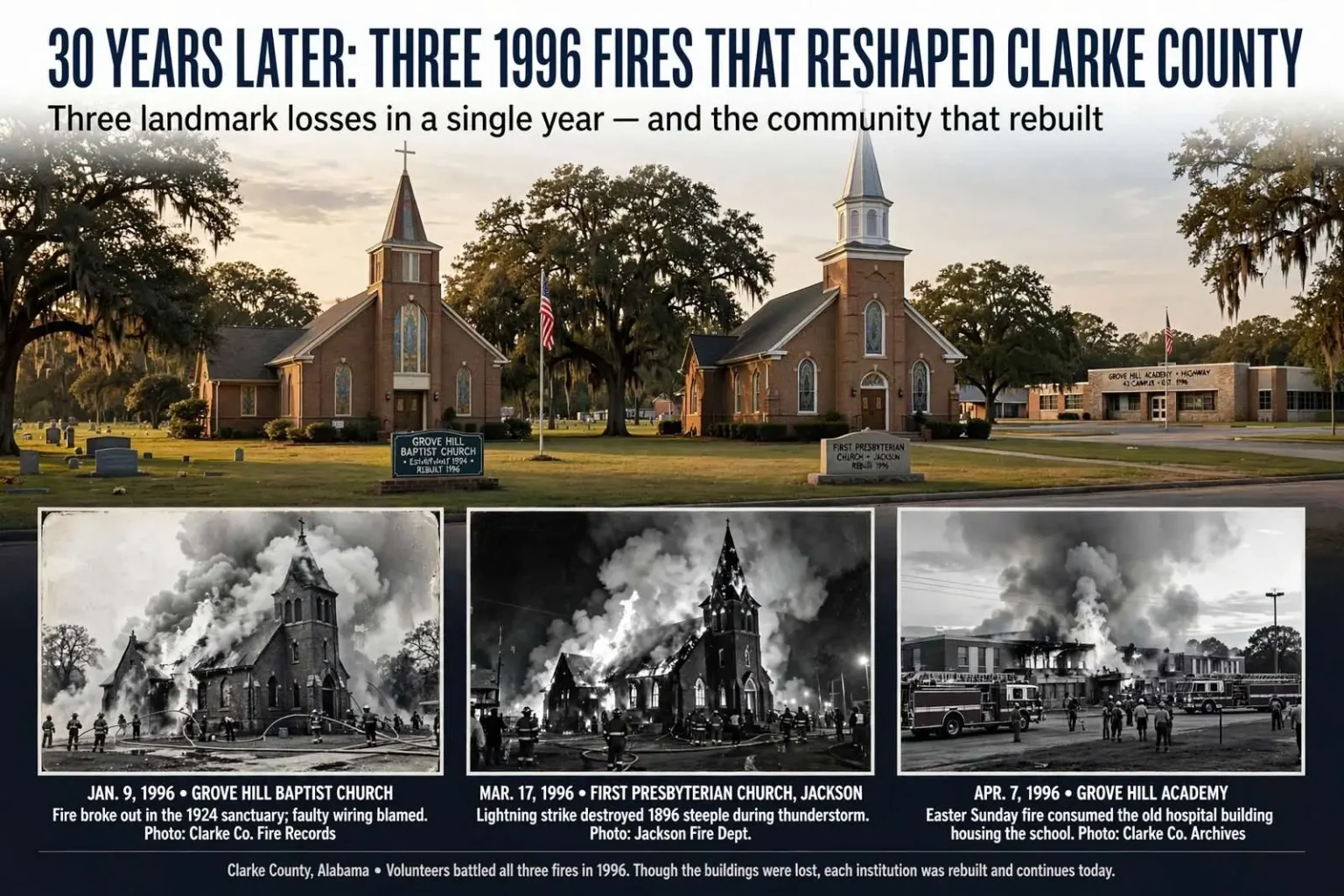
Thirty years ago, three separate fires destroyed landmark buildings in Grove Hill and Jackson within a span of months. Yet the institutions those landmarks represented recovered and carried on. Grove Hill Baptist Church burned on Jan. 9, 1996. On March 17, Jackson’s First Presbyterian Church was destroyed by fire. Then, on Easter Sunday morning, April 7, Grove Hill Academy was consumed.
Although some believed the blazes were connected, investigations determined none of the fires was the result of arson. The coincidence of three landmark losses in a single year tested the county’s fire services, its congregations and its private school community — and, three decades on, stands as a chapter in how Clarke County rebuilt what mattered to it.
Grove Hill Baptist Church
The alarm on the Grove Hill Baptist Church fire sounded at 12:49 p.m. on Jan. 9, and the flames soon broke through the roof of the 1924 structure. The cause was believed to be faulty wiring, according to reports at the time. Fire Chief Billy Fowler said the building’s heart pine rafters and roofing material fanned the fire, and the sanctuary was quickly engulfed.
Grove Hill firefighters, aided by five other area departments, managed to save the recently built fellowship hall, the adjacent Granade Educational Building, the pastorium and the minister of music’s home on either side of the church. The mutual-aid response — the standard practice among rural Alabama’s small volunteer departments, which call on neighbors because no single town has the ladder trucks and manpower for a major structure fire — kept the flames from spreading through the block.
The Rev. David Curtis, the pastor, was out of town when the fire broke out. “We lost the stained-glass windows, the pews and some antiques. They are only material things but what they signify can’t be replaced,” Curtis said at the time.
Heart pine, the dense old-growth lumber common in Alabama buildings of that era, is prized for its durability but behaves badly in a fire, burning hot and fast once it catches. Churches built in the early 20th century with heart pine framing and roofing have repeatedly proven difficult to save once fire reaches the attic, a pattern the Grove Hill fire confirmed.
The congregation regrouped, and on the Sunday after the fire, 350 people attended services in Clarke County High School’s auditorium across the street — more than would have fit in the old sanctuary. A rebuilding project quickly followed, producing a new and larger sanctuary. Stained-glass windows echoing those of the original church became a focal point of the new building.
The rebuilding campaigns also drew on the county’s tradition of congregational self-help. Rural Alabama churches typically finance construction through member pledges and memorial gifts rather than diocesan or denominational funding, which means a sanctuary rebuilt after a fire is, in a literal sense, paid for by the people who worship in it. The stained-glass programs of both rebuilt churches carried dedications to families who gave in memory of loved ones — including, in some windows, those whose names had been tied to the originals lost in the flames.
First Presbyterian Church
The First Presbyterian Church of Jackson was a storybook structure with a steeple, a steep, arching roof and stained-glass windows. Built in 1896 and 1899, it was likely the oldest continuously used public building in Jackson, according to reports at the time.
Pastor Scott Armstrong, who was also a firefighter, had stopped by around 6:45 on Sunday morning, March 17, and saw nothing amiss. The fire was reported about 7:20 a.m. Armstrong said that when he reached the fire station, he could see the smoke and realized the building was lost.
A thunderstorm had moved through the area, and lightning was thought to have sparked the blaze, which quickly consumed the heart pine structure. The church’s rear brick wing of Sunday school rooms, a fellowship hall and offices were used for services until a new building was completed. The new church incorporated interior architectural elements that pay homage to the original.
For Jackson, the loss was as much civic as religious. Small-town Alabama church buildings from the 1890s are scarce survivors, and one in continuous use for a century anchored both the town’s skyline and its memory. The decision to rebuild on the site, with deliberate echoes of the lost interior, reflected the congregation’s sense that the building’s identity — steeple, windows and all — belonged to the town as much as to its members.
Lightning strikes are among the leading known causes of church fires across the South, since steeples and tall rooflines are the tallest points for miles in flat rural landscapes. The spring storm season that brings those strikes to Clarke County runs from late winter through May, and the March 17 fire fell squarely within it.
Grove Hill Academy
Less than a month after the Jackson fire, the alarm was raised at Grove Hill Academy by police officer Royce Kelley, who was on routine patrol in the predawn hours of Easter Sunday, April 7. The school was housed on Fourth Avenue in the old Grove Hill hospital building. A wing had been added when the school opened in 1970, and the fire apparently started in its attic.
County history keepers note that 1996 was not the first time fire had rewritten Grove Hill’s landscape — courthouse and downtown fires in earlier generations reshaped the town before — but the concentration of three losses within a single season made the year a touchstone for the community’s collective memory. Anniversaries of each fire are still recalled by the families who fought them, rebuilt from them and moved on from them.
Kelley reported the fire at 4:30 a.m., and by 8 a.m. the facility was lost despite the efforts of fire departments from around the county. The separate home economics and chemistry lab facilities and the gym were saved. Even though it was Easter Sunday, parents and students rushed to the site to rescue books and desks while the fire was still burning, then salvaged what they could.
Headmaster Mike Smith said the school’s insurance likely would not cover the estimated $500,000 loss. Plans were quickly made to finish the school year. The gymnasium was divided into classrooms for elementary students, while high schoolers held classes in the new National Guard armory.
The improvisation reflected a private school’s reality: no system to fall back on, no central office to assign spare classrooms. Grove Hill Academy was one of the county’s private schools, and its families had to solve the logistics themselves — dividing a gym into elementary rooms, borrowing the armory for high school classes, salvaging what could be carried out of a burning building on a holiday morning.
The old hospital building that housed the school was itself a piece of Grove Hill’s civic history, having served the county before modern medical facilities drew patients elsewhere. Adaptive reuse had kept it in service for another generation, but older frame-and-masonry buildings carry the same attic vulnerabilities as the churches lost earlier that year, and the Easter morning fire followed the same pattern: ignition above, rapid spread through the roof structure, and a building gone within hours.
The school initially said it would rebuild on the site but ultimately chose a new location on U.S. Highway 43. The move out of the old hospital footprint and onto the county’s main north-south corridor gave the school a fresh start with purpose-built facilities — and marked the end of a landmark era on Fourth Avenue.
What the year left behind
Three fires, three institutions, one lesson. Clarke County’s volunteer fire departments — Grove Hill, Jackson, Thomasville and the smaller companies that answered each call — proved in 1996 that mutual aid could save the buildings adjacent to a burning landmark even when the landmark itself was lost. The county’s churches and schools, in turn, demonstrated the resilience that rural Alabama institutions are known for: services in an auditorium within a week, worship in a Sunday school wing, classrooms in a gymnasium and an armory.
The aftermath of each fire also left marks on how the county protects its landmarks today. Electrical systems in mid-century church buildings are now routinely inspected and upgraded, lightning protection has become a standard consideration for steepled rural churches, and attic spaces in repurposed historic buildings get sprinkler and detection attention they once lacked. Fire officials across the region point to losses like these three when they argue for those measures — because the pattern of 1996, one accidental cause after another, is the pattern that can repeat anywhere.
The rebuilt Grove Hill Baptist sanctuary, the recreated interior of First Presbyterian in Jackson and the Highway 43 campus of Grove Hill Academy each stand today as evidence of what the county chose to do with a hard year. Congregations that could have dissolved chose to rebuild; a school that could have closed chose to move and continue. Thirty years later, the burned buildings are gone from the streetscape, but the institutions are not — and in small-town Alabama, that is the measure that counts.