
62-Year-Old Woman Identified as Victim in Roderick Road Homicide
Mobile police identified Martha McGinsey, 62, as the woman found shot to death inside a home on Roderick Road; the investigation is active.
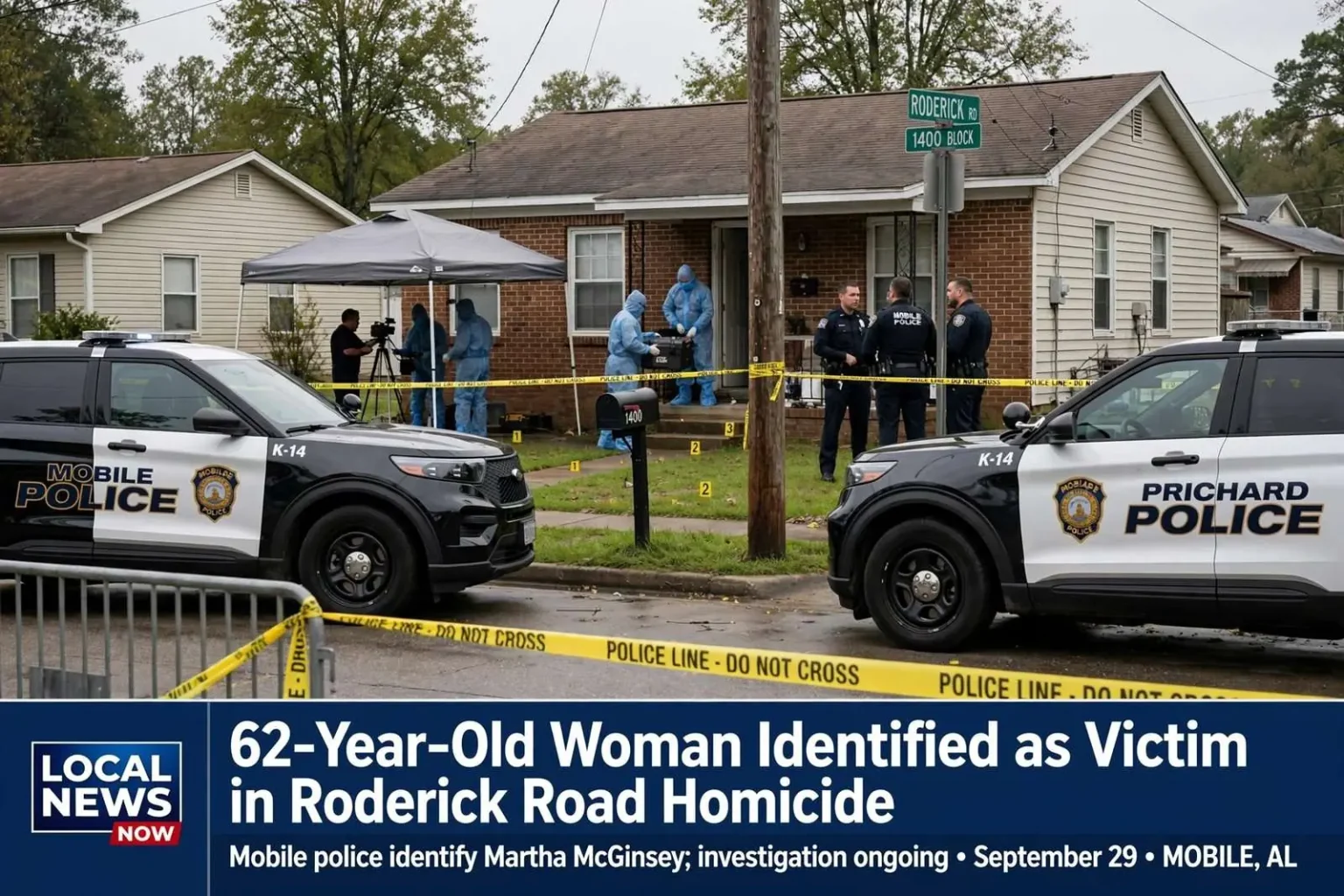
Mobile police have identified 62-year-old Martha McGinsey as the woman found shot to death inside a home on Roderick Road. The identification closed the first chapter of a case that began with a single caller’s report and ended, for the city, with another name added to a homicide ledger that was already running well ahead of prior years. McGinsey’s death inside her own home marked the kind of violence that resonates most deeply in a neighborhood — not a dispute on a street corner, but a killing behind a front door, in a residential block where the sound of a gunshot is rare enough that someone picked up the phone.
Officers responded to the 1400 block of Roderick Road around 2:01 p.m. on September 29 after a report of a single shot fired. The timestamp and the initial report — one shot, daytime, residential street — set the parameters of the first response. The 2:01 p.m. call meant officers arrived to daylight conditions, neighbors awake and watchful, and the scene unobscured by darkness, all of which aid the earliest stages of a homicide investigation: canvassing while memories are fresh, securing witnesses before they disperse, and locking down the residence before the scene is disturbed.
What Officers Found
Inside the residence, they located McGinsey suffering from multiple gunshot wounds. The detail mattered to the investigation from the outset: a report of a single shot followed by the discovery of a victim with multiple wounds told detectives the initial caller had heard only part of what happened, and that the shooting had involved more than the one discharge that carried to the street. The discrepancy between the reported shot and the victim’s injuries is the kind of fact that shapes a case’s early trajectory, telling investigators how much reconstruction the scene requires.
She was pronounced dead at the scene, according to a police release. The on-scene pronouncement set in motion the formal machinery of a Mobile homicide case: the Police Department’s investigation, the Medical Examiner’s examination of the remains, the notification of family, and the documentation of the scene by detectives and forensics technicians. In a residence, that processing is painstaking — every room, every surface, every point of entry and exit examined for evidence that will either place a killer inside the home or point investigators toward the circumstances that brought the violence there.
An Active Investigation With Outside Help
The case remained an active homicide investigation. U.S. Marshals were reported on the scene, with Prichard police also responding to assist — an indication investigators were moving quickly on leads that crossed jurisdictional lines. The presence of two outside agencies on a Mobile crime scene within hours of the discovery is unusual enough to carry meaning: U.S. Marshals bring fugitive-tracking capability and investigative reach that municipal departments call on when a suspect may flee or when leads extend beyond the city, while Prichard officers responding to assist suggests the evidence or the people involved connected to the city just to the north.
No suspect had been announced. In the hours and days after the discovery, police withheld a name, a description and a motive — a posture that in homicide investigations typically signals either an active search for a specific person or a case where the investigators’ working theories were still forming. The public release emphasized the facts that could be confirmed: the victim’s identity, the location, the time and the ongoing status of the investigation. Anything further awaited the progress of the work being done at the scene and beyond it.
For the neighborhood around the 1400 block of Roderick Road, the days after the killing were defined by the visible signs of that work — the scene secured, detectives coming and going, the unfamiliar presence of federal officers on a residential street — and by the questions that follow every unexplained death behind a neighborhood door. Residents with information were faced with the familiar calculus of homicide cases: what they saw, what they heard, and whether to share it with the detectives who asked.
A Year Running Ahead of Prior Years
The killing marked another deadly shooting inside a Mobile residence during a year when the city’s homicide count ran well ahead of prior years. That context is essential to understanding how the case was received. A city tracking well above its usual homicide totals experiences each new case differently: investigators are stretched across multiple active scenes, the community’s tolerance for violence wears thin, and every new name added to the list lands on a public already anxious about the trend. Homicides inside residences carry their own weight within those totals — they represent violence reaching into the places where people are supposed to be safest.
The year’s elevated count placed sustained pressure on every part of the city’s response system: the homicide unit juggling multiple parallel investigations, the medical examiner’s office, the prosecutors who would inherit the cases, and the community organizations that work against the cycle of retaliation and silence that keeps many killings from being solved. Each case competes for the same finite resources, and the speed with which leads are worked in the first hours — as in the response on Roderick Road, where federal and neighboring agencies were engaged almost immediately — often determines whether any given case joins the solved column or the cold one.
Who Answers When a City Calls for Help
The multi-agency response to Roderick Road illustrated how major case investigations actually function in the Mobile area. No municipal department works a homicide entirely alone; the U.S. Marshals Service partners with local departments across the Gulf Coast on violent crime and fugitive matters, and departments like Prichard’s routinely cross lines to assist neighbors on cases whose evidence doesn’t respect city boundaries. The presence of those agencies on the scene within hours signaled that Mobile detectives were pursuing every avenue immediately rather than waiting for the case to develop — a posture that veteran investigators describe as the difference between cases that break and cases that stall.
For Martha McGinsey’s family, the machinery’s speed was cold comfort beside their loss: a 62-year-old woman, killed by multiple gunshots in her own home, her name released to the public as a case number gathered its file. Homicide victims’ families live the investigation differently than the public does — through detectives’ calls, the medical examiner’s processes and the long wait for an arrest that may or may not come. The police release that closed the public account of that September afternoon promised only what it could: an active investigation, worked with help from partners, in a city whose year had already been hard.
How Residence Homicides Are Investigated
A killing inside a home presents investigators with a distinct evidentiary landscape. Whoever entered — or was already inside — left behind the traces that forensics teams are trained to find: entry points examined for force or lack of it, signs of struggle or its absence, the positions and pathways within the residence, and the household objects that tell investigators whether anything was taken or disturbed. Detectives also work the human geography of the case: who knew the victim, who had been to the home, who might have been expected and who would not have been. Residence homicides are frequently solved through that second kind of evidence — relationships, access, history — rather than through street witnesses, because the critical events happened where no one outside could see.
The initial report of a single shot fired adds its own investigative thread. The caller who heard it becomes the first witness, and detectives work outward from the sound: who else on the block heard a shot or shots, how many, from what direction, at what time. In a neighborhood, the acoustic record that residents carry in their memories — one shot or several, before or after a car door, accompanied by voices or silence — becomes a reconstruction tool that supplements the physical evidence inside the home.
The Marshals’ Role in Local Cases
The U.S. Marshals Service presence on a local homicide scene reflects a partnership structure that has become standard on the Gulf Coast. The Marshals’ Gulf Coast Regional Fugitive Task Force and its local operations routinely support municipal departments in locating violent offenders and tracking leads across jurisdictions, work that becomes immediately relevant in a homicide where a suspect’s whereabouts are unknown. Their early involvement — reported on the scene the same afternoon — indicates that Mobile investigators were preparing for the possibility that whoever was responsible would not wait around to be found, and that the resources needed to run leads across city, county and state lines were already engaged.
Prichard police’s role as assisting agency pointed to the practical geography of the case. Roderick Road sits in Mobile, but the metro area’s jurisdictions interlock so tightly — Mobile, Prichard, Chickasaw, the county’s unincorporated areas — that victims, witnesses and suspects routinely move among them, and a lead generated on a Mobile scene can just as easily point north toward Prichard or into the county. Departments that assist one another on major cases maintain the relationships that make such cooperation routine, and in a year when every agency in the area was stretched by violence, that mutual aid was essential to keeping cases moving.
What the Record Shows
What can be said of the case from the public record is this: a 62-year-old woman named Martha McGinsey was found shot to death with multiple gunshot wounds inside a home on the 1400 block of Roderick Road, after officers responded to a report of a single shot fired around 2:01 p.m. on September 29; she was pronounced dead at the scene; the investigation was active; U.S. Marshals and Prichard police assisted; and no suspect had been announced. Everything beyond those confirmed facts — motive, circumstances, whoever was responsible — belonged to the investigation and, in time, to the courts, where any case would be decided on evidence and not on the shock of the afternoon it began.
Until that resolution, the case stood as both a family’s grief and the city’s arithmetic: one more residence, one more victim, one more name in a year Mobile was counting homicides faster than it wanted to. The detectives working Roderick Road carried the case forward from there, and the record picks up only when they found something worth announcing.