
92Zew Taps Underhill Family Orchestra for Second Tuesday at The BlueGill
Mobile band Underhill Family Orchestra joined 92Zew's free Second Tuesday Concert Series at The BlueGill on April 12, 2011.
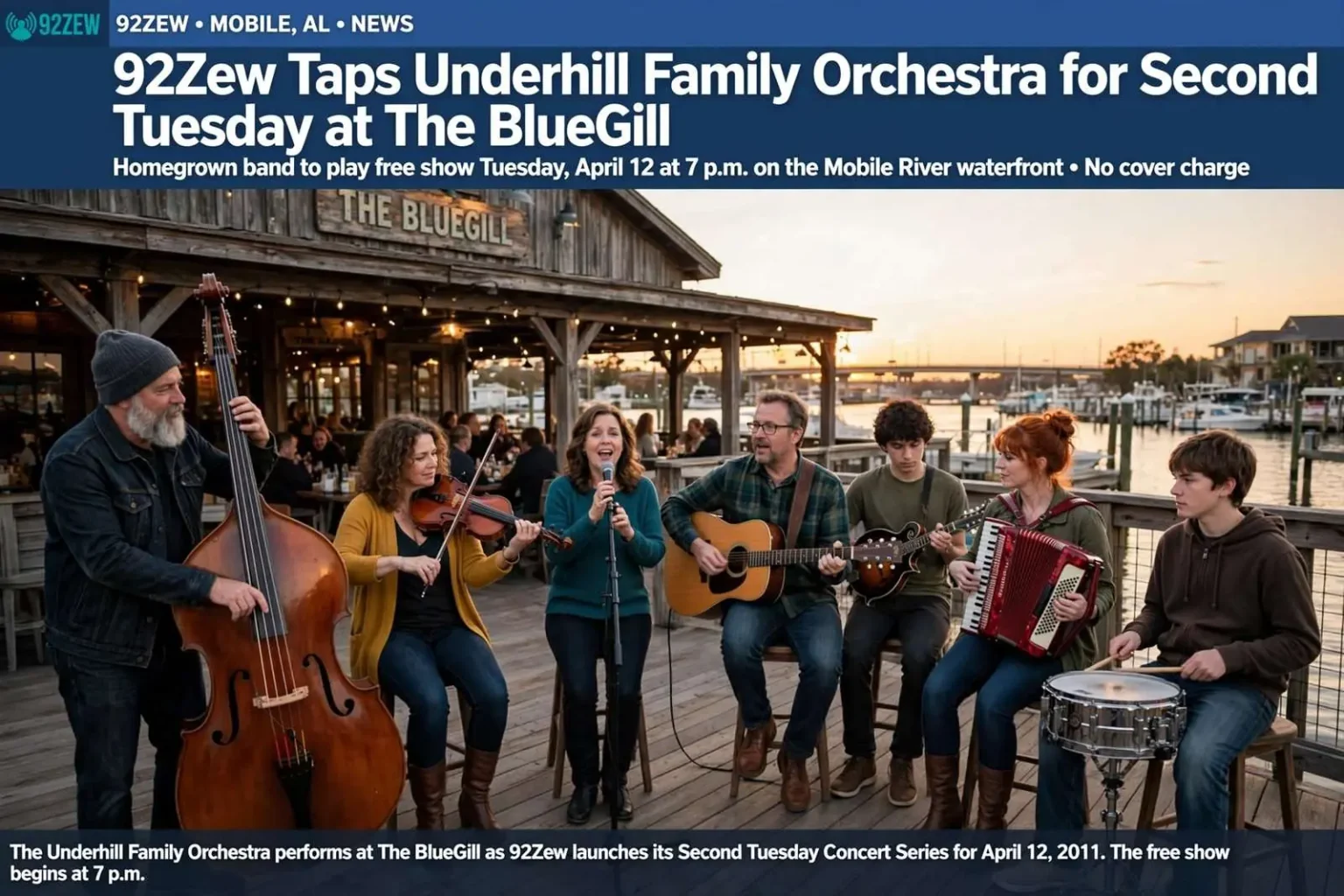
Mobile rock radio station 92Zew has booked one of the city’s most talked-about homegrown acts, the Underhill Family Orchestra, for its Second Tuesday Concert Series at The BlueGill, with the band set to play Tuesday, April 12, 2011, at 7 p.m. There is no cover charge for the show, which puts one of Mobile’s busiest original bands in front of a downtown-area audience at one of the riverfront’s most familiar music venues. For a monthly series built around spotlighting local talent, the pairing is being read by station watchers as one of the most natural fits the program has produced.
The Second Tuesday Concert Series is designed to give area bands something increasingly hard to come by in commercial radio: sustained, on-air attention rather than a single song dropped into rotation. Under the format, a booked act receives roughly an hour of dedicated focus on the station, giving listeners who may have never heard of a band the chance to hear enough of its music and story to decide whether to follow it. For working musicians in a market the size of Mobile, that hour can function as a showcase, an advertisement, and a door to new bookings all at once.
Station watchers noted that series bookings do not always match the station’s playlist, a disconnect that has occasionally made the showcase feel disconnected from what the station actually plays the rest of the month. This time, the pick landed squarely with a band Mobile audiences were genuinely excited to hear. The Underhill Family Orchestra has been building a following across the Gulf Coast with a communal, orchestral approach to rock music, and the booking was read as a sign that the Second Tuesday series could become a true showcase for bands Mobilians actually follow, rather than generic hard-rock touring filler passing through town.
What the Booking Means for Local Listeners
For concertgoers, the practical details are straightforward. The show falls on the second Tuesday of the month, the series’ standing slot, with music starting at 7 p.m. The lack of a cover charge lowers the barrier for casual listeners who might hesitate to buy a ticket for a band they have never seen, and it encourages the kind of walk-in crowd that helps a monthly series build a regular audience. That matters in a market where original local music often competes with cover bands, karaoke nights, and touring acts for the same finite pool of weeknight crowds.
The arrangement also illustrates how a modest radio promotion can ripple outward for a local act. An hour of on-air attention ahead of a free show gives the band a chance to convert radio listeners into show attendees, and show attendees into long-term fans who stream, share, and buy tickets the next time the band plays. In a city that has historically punched above its weight in music, from its civic auditorium days through the modern club scene, that kind of pipeline between radio and stage has been one of the missing links for younger original bands.
A Radio Hour That Matches the City’s Taste
92Zew has long been one of the few commercial stations in the Mobile market giving serious airtime to local musicians. While much of the dial relies on syndicated formats and national playlists, the station has kept a visible commitment to the Gulf Coast scene, spinning area artists alongside the national acts its listeners already know. That positioning has made the station a default first stop for local bands hoping to be heard, and it has given listeners a reason to think of the station as part of the local music community rather than merely a signal playing at it.
The Underhill booking was read in that context. When a series designed to spotlight local talent consistently books acts that listeners already follow and care about, the series builds credibility in both directions: audiences trust the picks, and bands see the slot as a genuine prize rather than a token gesture. A program that books well-known local favorites can also pull lesser-known opening acts into the ecosystem over time, as attendance at the showcase creates demand for more local music programming across the schedule.
The selection also reflects an honest assessment of what Mobile audiences want to hear. The city’s music scene has never been a mirror of national radio. Its audiences grew up on a blend of southern rock, swamp pop, gospel, jazz, and the blues tradition that runs through the Gulf Coast, and the acts that thrive locally tend to be the ones that draw on those roots. A showcase series that ignores that identity risks booking filler; one that embraces it can become part of the cultural calendar. Booking one of the city’s hottest homegrown acts suggests the series understands the difference.
Also in Motion on the Mobile Music Scene
The announcement came as the city’s broader spring arts calendar was filling in. The annual Arts Alive festival was approaching, bringing with it the usual mix of visual art, performance, and unconventional public projects staged across downtown venues. Among the announcements attached to the festival was word that artist Jimmy Lee would spend 72 hours producing work based on a single note inside abandoned buildings, a marathon creative endurance piece that fit the festival’s taste for projects that blur the line between music, performance, and visual art. The concept put an empty, often-overlooked downtown building to work as a temporary studio, drawing attention to both the artwork and the architecture holding it.
Projects of that kind have become a signature of downtown Mobile’s slow cultural revival. Empty storefronts and vacant buildings along the historic core are, in a practical sense, liabilities for property owners and a concern for public safety, but they are also cheap, character-rich space that artists can occupy in ways that conventional retail cannot. Festivals that fund or permit artists to work inside those spaces give the public a reason to walk blocks they might otherwise avoid, and they generate images and word of mouth that carry the neighborhood’s identity well beyond the festival weekend.
Meanwhile, the ongoing noise-ordinance friction around the Alabama Music Box continued, a running dispute over downtown venues turning up the volume in Mobile’s designated entertainment district along Dauphin Street. The conflict has become a recurring test case for the city’s effort to balance a lively nightlife economy against the comfort of the residents and business owners who share the corridor. Clubs argue that amplified live music is the core of the entertainment district’s draw; critics counter that late-night sound bleeding into neighboring blocks drives away the mix of residents and daytime businesses a downtown needs to stay healthy beyond 10 p.m.
The tension is not unique to Mobile. Cities across the country that have redeveloped historic downtowns into nightlife districts have wrestled with the same question of how loud is too loud, and how far a designated entertainment zone’s protections extend. What makes the Mobile version of the dispute consequential is the stakes attached: the Dauphin Street corridor is the center of gravity for the city’s original-music venues, and the bands that play the BlueGill, the Alabama Music Box, and rooms like them depend on the same small ecosystem of owners, sound engineers, and fans. A noise rule written carelessly, or enforced erratically, affects all of them.
Why a Weeknight Booking Matters
Against that backdrop, a free weeknight show by a strong local band carries more weight than it might first appear. Weeknights are the hardest slots for venues to fill and the easiest for bands to decline, yet they are where a scene’s regular habits are actually formed. A listener who hears a band on the radio at work, then walks into The BlueGill that evening without buying a ticket, is far more likely to repeat the behavior than one who has to plan and pay days in advance. Multiply that by a monthly schedule, and a series like Second Tuesday becomes one of the few reliable training grounds for turning radio curiosity into live-music attendance.
The BlueGill itself is a natural stage for that conversion. Sitting on the Mobile River waterfront near the convention center, the venue pairs its music programming with the casual, seafood-forward identity the city is known for, drawing a mixed crowd of after-work regulars, tourists staying downtown, and music fans who follow the booking calendar rather than the menu. A band that can hold that mixed room earns something valuable: proof that its appeal reaches beyond the usual circle of friends and fellow musicians who fill most local original-music nights.
For the Underhill Family Orchestra, the appearance is also a chance to play for listeners who have heard the name but never the band. A group whose arrangements lean on layered vocal harmonies and a family-sized lineup does not always translate in a radio single; on a stage, with the full ensemble working, the scale of the sound becomes the point. Radio exposure can only describe that. A free, centrally located show on a weeknight gives the band its best shot at demonstrating it.
The Broader Economics of a Local Scene
The booking lands at a moment when the practical economics of being a working Mobile musician remain difficult. The market offers a handful of venues that pay original acts fairly, a modest number of festivals that book locally, and a radio landscape with only a few stations willing to play hometown music at all. Bands survive by stacking weeknight residencies, weekend club dates, and regional gigs across the Gulf Coast into something resembling a living. In that environment, attention is often the scarcest resource, more scarce even than paying slots, which is why a station giving an hour of dedicated airtime to a local act is not a small gesture.
It also helps listeners. Music discovery in a mid-sized market is largely accidental: a band exists, tours through twice, and disappears without a casual fan ever knowing it played. A recurring series with a predictable slot, a familiar venue, and a no-cover door turns discovery into a habit. The second-Tuesday date is easy to remember, The BlueGill is easy to reach from both downtown and the eastern shore, and the lack of a cover charge means the only investment a curious listener makes is an evening. Those low-friction conditions are precisely what local scenes need to convert goodwill into actual audiences.
The series’ credibility with local bands matters too. Musicians talk among themselves, and a showcase known for booking acts audiences actually want to hear becomes a slot bands compete for rather than an obligation the station fills. That competition raises the quality of the shows, which raises attendance, which strengthens the case for the station to keep investing in the program. The Underhill booking, coming at a moment of genuine local excitement around the band, feeds that loop at exactly the right point.
What to Watch as the Season Continues
The weeks around the April show give Mobile music followers plenty to track. The Second Tuesday series will continue to announce its monthly bookings, and each pick will be read for the same question raised by this one: whether the program keeps aligning itself with the bands the city already embraces. The Arts Alive festival will unfold downtown, with projects like the 72-hour, single-note performance offering a reminder that the local creative community extends well beyond the club stages. And the noise-ordinance dispute along Dauphin Street will keep testing how much room the city’s entertainment district has to be loud.
For now, the immediate item on the calendar is the simplest one. The Underhill Family Orchestra plays The BlueGill on Tuesday, April 12, 2011, at 7 p.m., with no cover charge, on the strength of a station booking that matched the city’s taste to the city’s radio. If the show fills the room the way the pairing suggests it should, it will make the case for the Second Tuesday series better than any promotional copy could: that Mobile audiences will come out for local music, in numbers, when the announcement, the venue, and the price are all pointing the same direction.