Federal Hearing on MGM Eligibility Lawsuit Against AHSAA Postponed Again, Now Set for Oct. 5
A federal hearing on two mothers' lawsuit challenging the AHSAA's permanent ineligibility ruling against their Mary G. Montgomery sons was postponed Thursday and reset for Tuesday at 1 p.m. in Montgomery.
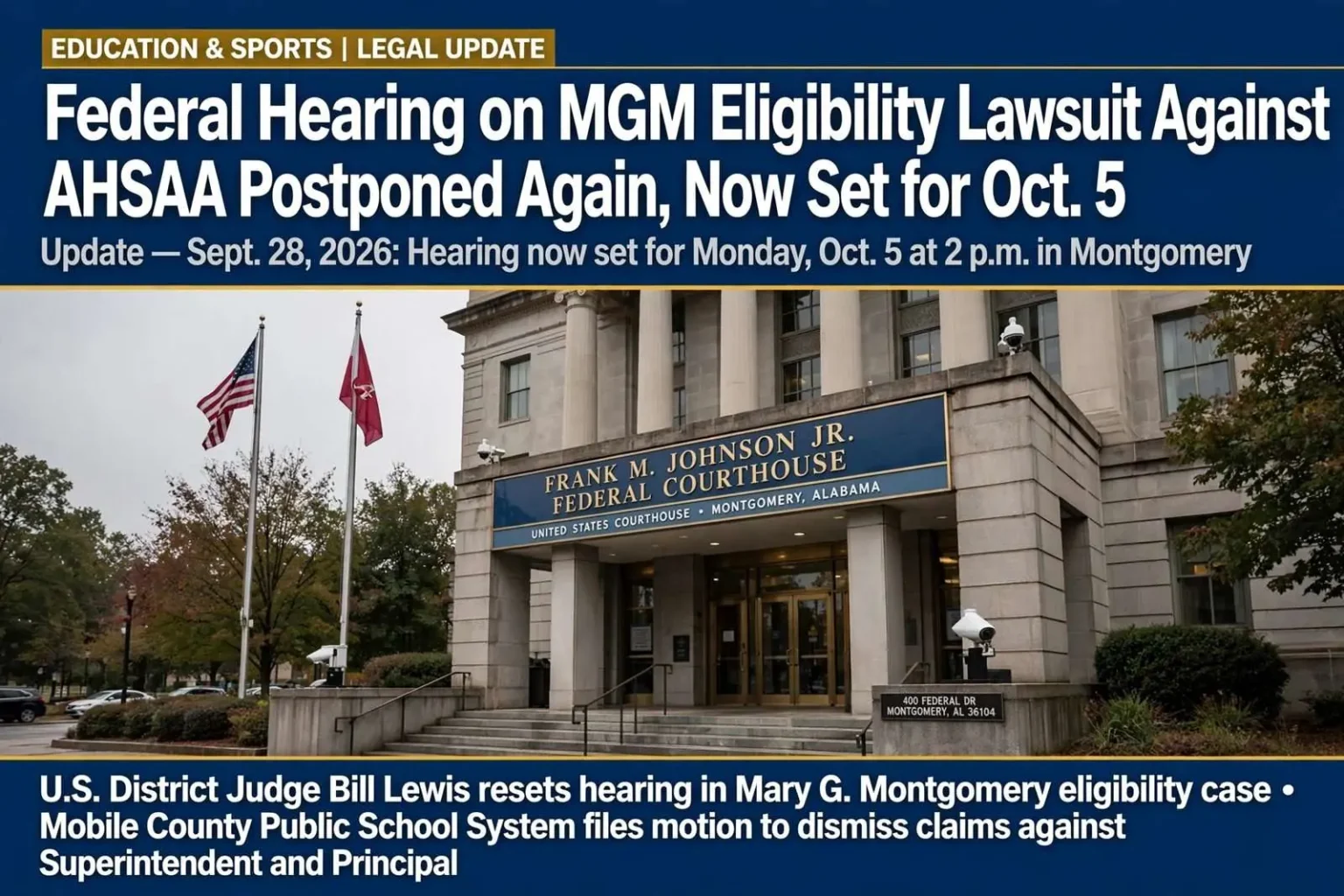
Update (Sept. 28, 2026): Hearing postponed again, now set for Monday, Oct. 5. U.S. District Judge Bill Lewis has reset the hearing in the Mary G. Montgomery eligibility lawsuit for Monday, Oct. 5, at 2 p.m. at the Frank M. Johnson Jr. Federal Courthouse in downtown Montgomery. The hearing had most recently been set for Tuesday, Sept. 29. The Mobile County Public School System has also filed its own motion to dismiss the claims against Superintendent Chresal Threadgill and Principal David Diaz. More details are in the new section at the end of this article.
Update (Sept. 25, 2026): Hearing postponed to Tuesday. The federal hearing scheduled for Thursday in the Mary G. Montgomery eligibility lawsuit was postponed. U.S. District Judge Bill Lewis reset the hearing for Tuesday, Sept. 29, at 1 p.m. at the Frank M. Johnson Jr. Federal Building and U.S. Courthouse in downtown Montgomery. Tameka Dale and Ashley Davis appeared at the courthouse Thursday with their sons before the delay was announced. The judge will consider whether to block the AHSAA from enforcing its ineligibility ruling against the two students while the case proceeds. Details on the latest filings are below.
MOBILE, Ala. — A federal judge is set to hear arguments Thursday in an MGM eligibility lawsuit brought by two mothers who say the Alabama High School Athletic Association violated their sons’ constitutional rights when it declared the Mary G. Montgomery High School students permanently ineligible to play football at the Semmes school.
U.S. District Judge Bill Lewis scheduled the hearing for 10:30 a.m. Thursday, Sept. 24, in Montgomery. Tameka Dale and Ashley Davis are asking the court for a temporary restraining order and a permanent injunction that would restore their sons’ eligibility, along with compensatory damages for what the lawsuit describes as irreparable harm to the boys’ futures.
Who Is Being Sued
Attorney Michael Kidd filed the federal lawsuit Tuesday in the U.S. District Court for the Middle District of Alabama. It names three defendants:
- AHSAA Executive Director Heath Harmon;
- Mobile County Public School System Superintendent Chresal Threadgill;
- Mary G. Montgomery Principal David Diaz.
Dale is the mother of a minor identified in court papers as T.D., and Davis is the mother of a minor identified as B.G. Both boys still attend Mary G. Montgomery, known as MGM, even though the AHSAA declared them permanently ineligible for athletics there. The association said the students were involved in violating its recruiting rule by attending the school’s freshman welcoming ceremonies.
T.D. and B.G. are among 21 students the AHSAA declared permanently ineligible to play at MGM, according to a May 18 letter from Harmon to Diaz that disclosed the sanctions.
Judge Lewis joined the federal bench in the Middle District last year. He was nominated by President Donald Trump in August 2025 and confirmed by the U.S. Senate in October 2025, succeeding Andrew Brasher. Before that, he served briefly as an associate justice of the Alabama Supreme Court, on the Alabama Court of Civil Appeals and as a circuit judge in the 19th Judicial Circuit.
‘That’s the End Game Here’
Kidd said he hopes a favorable ruling for the students could lead to substantive changes in how the AHSAA operates.
“That’s the end game here,” he said Wednesday. “It’s very evident that it is damn the torpedoes with regard to everything that would be contrary to (the AHSAA’s) transfer rule. They are willing to try to preserve their transfer rule at all costs. Damn a court order, damn the U.S. Constitution, damn federal law.”
The lawsuit is the latest legal challenge aimed at Harmon and the AHSAA over the MGM case. In May, the association placed the school on restrictive probation and barred its football team from the playoffs for a year. Then-coach Zach Golson was placed on probation for a year and ultimately lost his job; the Mobile County Public School System removed him as the Vikings’ coach before the sanctions were announced.
Golson has filed his own lawsuit in Montgomery County Circuit Court against the AHSAA, Harmon, Threadgill, Diaz and AHSAA investigator Chuck Anderson, claiming he was denied due process and defamed.
How the Case Began
The dispute traces back to freshman welcoming ceremonies for MGM’s football program that the two students attended in 2024 and 2025. Their mothers say they had already filed paperwork for their sons to attend the school before those events. Diaz has said the students were not invited to the ceremony, and the mothers contend no recruiting for football took place.
According to the lawsuit, both boys were attending Clark-Shaw Magnet School when their mothers took them to MGM’s annual welcoming ceremony, B.G. in 2024 and T.D. in 2025. B.G. was zoned to attend Baker High School and T.D. was zoned for Vigor High School.
The lawsuit says both of those high schools were classified as failing, which would have entitled the students to transfer. However, according to the Alabama Department of Education, Baker had an overall score of 82 in 2023-24 and was not a failing school.
Davis said she wanted her son to attend MGM because of its signature academies. Like Dale, she filed paperwork for B.G. to transfer to MGM before he attended the school’s welcoming ceremony in 2024, according to the lawsuit.
Baker also played a role in the AHSAA investigation. According to Harmon’s May 18 letter, Baker reported Mary G. Montgomery after two other middle school football players who were zoned for Baker attended MGM’s freshman welcoming ceremony on April 23.
The Constitutional Claims
The federal suit argues that the AHSAA violated the students’ rights to free speech and equal protection under the First and 14th Amendments to the U.S. Constitution.
In the lawsuit, Kidd described any contact between MGM, the mothers and their sons as “truthful and non-coercive communications sought by a student and parent who had already chosen the school.” He argues the AHSAA’s insistence on limiting that kind of communication is an unconstitutional restriction on speech, citing a 2007 U.S. Supreme Court decision in a Tennessee athletics eligibility case that he says recognized “truthful communications” as protected.
That 2007 case, Tennessee Secondary School Athletic Association v. Brentwood Academy, involved a private school’s football coach who sent letters to eighth-grade boys. The justices ruled that the association could enforce its anti-recruiting rule against the school in that instance, with the lead opinion comparing the dangers of a coach’s direct solicitation of young students to the “undue influence and overreaching” associated with in-person solicitation by lawyers. Kidd contends that reasoning allows limits only on coercive recruiting, not on all communication.
“A parent has a constitutionally protected right to go to a school and communicate with a coach or a principal or any other administrator about their kid and obtain information that helps them make decisions, what courses they’re going to take, what extracurriculars they’re going to be involved in,” Kidd said.
The lawsuit also argues the AHSAA violates the 14th Amendment’s equal protection guarantee by treating a family’s independent questions about joining a school’s band or other clubs differently from questions about an athletic team.
“In one group, you’ve got the band director and the (Student Government Association) and all that stuff,” Kidd said. “You can go up there and have those conversations all day long. But if you talk to the coaches or anything involving athletics, then all of a sudden not only are you suspended for a certain period of time, you’re suspended permanently for all athletics. It’s the death penalty in high school athletics being given to a student and that’s not only extreme, it’s extremely arbitrary.”
Kidd said the harm caused by the alleged constitutional violations improves his clients’ chances in court.
“The precedent has been set by the U.S. Supreme Court, which has clearly indicated that you cannot restrict all speech,” Kidd said. “The U.S. Supreme Court has said that you can’t impede on that unless it’s directly tied to not just recruiting but recruiting that would be considered coercive, with undue influence, things of that nature.”
The Disputed Rule Changes
The constitutional claims are tied to what Kidd says were improper changes to the AHSAA’s recruiting rule. Those arguments first appeared in a lawsuit he filed on Dale’s behalf on Sept. 4 in Montgomery County Circuit Court, and they are carried over into the federal case.
The original lawsuit claimed portions of the recruiting rule were changed without proper authorization from the AHSAA’s Legislative Council during the tenure of former Executive Director Steve Savarese. Kidd pointed to the 2015-16 AHSAA handbook, which said: “It is permissible for a coach or anyone else connected with a school to talk or speak with a student(s) or parent(s) who, on their own, visit their school for any specific purpose.”
That same rule also said: “No person connected in any way with a school may contact a student or prospective student or his/her parents or guardian who resides outside of the school district to inquire or encourage them to transfer or enroll in their school for the chief purpose of participating in interscholastic athletics.”
According to the lawsuit, the rule was later changed without Legislative Council approval to prohibit contact with a student through phone calls, emails, text messages and social media, while the language allowing coaches and school representatives to talk with students and parents who visit a school on their own “for any specific purpose” remained. Then, in the 2022-23 handbook, that phrase became “any specific purpose other than athletics,” a change Kidd says the Legislative Council also never approved.
Kidd said he wants Harmon to explain under oath how the rule came to be changed.
“Either produce the documentation proving that these rules that are in question went through the proper authentication or obviously they didn’t,” Kidd said. “That’s pretty straightforward. I want to ask what’s the deal with bypassing your bylaws and effectively stripping your membership of being able to have a say in this? This rule has morphed into something that has never been approved. If we’re wrong, they can come in and produce the minutes where it went through the proper procedure, then we’ll withdraw those complaints. But even if they did approve it the way it was supposed to be approved, they cannot restrict all speech.”
In the state case, AHSAA attorney Benjamin Espy filed a motion to dismiss, arguing the circuit court has no jurisdiction over the association. Kidd countered with legal precedent giving circuit courts authority to overrule the AHSAA “if acts of the association are the result of fraud, lack of jurisdiction, collusion or arbitrariness.”
Golson, Dale and Davis have each said nobody from MGM contacted them or their sons about playing football. Golson has said any contact with students at a welcoming ceremony was inadvertent, and his lawsuit states the ceremony was approved by MGM’s administration and that he welcomes an examination of all of his phone and text records.
What a Restraining Order Would Mean
A temporary restraining order is the fastest form of relief a federal court can grant. Under the Federal Rules of Civil Procedure, it is designed to preserve the situation for a short time until the court can consider a longer-lasting preliminary injunction. Courts generally weigh whether the party seeking relief is likely to succeed on the merits, whether it would suffer irreparable harm without an order, how the harms to each side compare and whether the order would serve the public interest. A restraining order is not a final ruling on who is right.
The timing matters for the two students. If Lewis grants a temporary restraining order, they could be eligible to play Oct. 2, when MGM visits Baker. The Vikings, now coached by Alex Page, are 2-3 and are off this week. Because of the restrictive probation, MGM is ineligible for the playoffs this season.
The AHSAA and the Mobile County Public School System have said they do not comment on ongoing legal matters.
Update: What Happened Thursday and What Comes Next
Rather than hearing arguments Thursday, Judge Lewis reset the hearing for Tuesday at 1 p.m. at the Frank Johnson federal courthouse in downtown Montgomery. The mothers, who attended Thursday with their sons, are still seeking a temporary restraining order, a permanent injunction restoring their sons’ eligibility and compensatory damages.
The two boys are among 21 students the AHSAA declared permanently ineligible to play at MGM, according to Executive Director Heath Harmon’s May 18 letter to Principal David Diaz disclosing the sanctions. Under those sanctions, MGM’s football program was placed on restrictive probation for one year, ruled ineligible for postseason play during the 2026-27 season and fined $300. Former head coach Zach Golson was barred from coaching at an AHSAA member school for one year and was later removed from his job by the Mobile County Public School System.
AHSAA: ‘Buzz words’ without evidence
In a motion to dismiss, AHSAA attorney Joe Espy argued that the lawsuit relies on “buzz words” rather than evidence.
“Clear and convincing evidence is the highest burden in civil law, surpassed only by the standard applied in criminal cases, beyond a reasonable doubt. No such evidence has been presented, nor can it be. Plaintiffs simply attempt to invoke the ‘buzz words’ without providing this Court one ounce of evidence, let alone evidence that meets the ‘clear and convincing’ standard,” Espy wrote in the filing.
Attorney Michael Kidd, who represents the mothers, argues that the AHSAA’s recruiting rule was “arbitrarily applied” and limits the plaintiffs’ free speech. In the earlier state court case, Kidd pointed to legal precedent giving circuit courts authority to overrule the AHSAA “if acts of the association are the result of fraud, lack of jurisdiction, collusion or arbitrariness.”
The federal case is one of several legal challenges tied to the MGM investigation. Golson has filed a separate lawsuit in Montgomery County Circuit Court claiming he was denied due process and defamed, naming the AHSAA, Harmon, Superintendent Chresal Threadgill, Diaz and AHSAA investigator Chuck Anderson. In Baldwin County, a lawsuit filed by 10 Robertsdale High School football players against the AHSAA is also moving forward after a judge denied a motion to dismiss.
Latest: Hearing moved to Oct. 5; school system seeks dismissal
The federal hearing on the lawsuit brought by Tameka Dale and Ashley Davis has been pushed back a second time. Judge Bill Lewis, who was appointed to the federal bench in 2025, reset it for Monday, Oct. 5, at 2 p.m. in Montgomery.
Attorney Michael Kidd, who represents the mothers, has described the AHSAA’s permanent ineligibility ruling in stark terms. “It’s the death penalty in high school athletics being given to a student and that’s not only extreme, it’s extremely arbitrary,” Kidd said.
The mothers are seeking a temporary restraining order and a permanent injunction to restore their sons’ eligibility, plus compensatory damages. They argue their own constitutional rights of free speech and equal protection, and those of their sons, were violated when the AHSAA ruled in May that the boys were connected to recruiting violations because they attended freshman football welcoming ceremonies at MGM in 2024 and 2025. Both mothers say they had already filed paperwork for their sons to attend MGM before the ceremonies, and they contend no football recruiting took place.
Motions to dismiss from both the AHSAA and MCPSS
Attorneys for both the AHSAA and the Mobile County Public School System have now asked the court to throw out the case, though Judge Lewis has continued to move toward a hearing.
AHSAA attorney Joe Espy III argued that Dale and Davis lack standing to challenge the association’s rulings because they are not members of the association. He also argued that MGM self-reported the infractions, that the federal court has no jurisdiction over the AHSAA, and that the Alabama Supreme Court has repeatedly emphasized the association’s “near absolute authority” in governing its member schools. Espy added that MGM voluntarily joined the AHSAA and agreed to abide by its anti-recruiting rules.
MCPSS attorney Paul Carbo Jr. filed a separate motion to dismiss the claims against Superintendent Chresal Threadgill and MGM Principal David Diaz, arguing that nothing in the complaint alleges what either official did or did not do.
Related cases still pending
Kidd previously filed a lawsuit on Dale’s behalf on Sept. 4 in Montgomery County Circuit Court claiming the AHSAA and Executive Director Heath Harmon used an improperly modified rule to punish her son and the school; those claims are carried into the federal case. Former MGM coach Zach Golson has filed his own lawsuit in Montgomery County Circuit Court against the AHSAA, Harmon, Threadgill, Diaz and AHSAA investigator Chuck Anderson, claiming he was denied due process and defamed.
The AHSAA’s investigation began after two middle school students zoned for Baker High School attended a third MGM welcoming ceremony in April 2026. Golson and Diaz have said those students were not invited, and Golson has said any contact with them was inadvertent.
Latest: ‘We’re Just Ready to Tell Our Case in Court’
With Monday’s hearing before Judge Lewis approaching, Kidd said his clients are eager to make their arguments. “We’re just ready to tell our case in court,” he said.
Kidd argues the AHSAA changed its recruiting rule without taking it through the association’s legislative process and is now using it to hand out the stiffest penalties available to coaches and players.
“I think that constructively we’ll prove that they tried to even hide it from their membership,” Kidd said. “What I think is important is you can’t have a system where you profess that you’re there for your membership and the membership participates in passing the rules and then you just slide something in that you want in that nobody votes on.”
He called it “the most influential rule that they’ve enforced since I’ve been a parent.” Kidd said the event the boys attended, which the AHSAA described as a “Signing Day Party,” took place as they were finishing middle school, was advertised on MGM’s website and social media, and came after their parents had already completed enrollment paperwork. He described both boys as strong students and said one of them already holds a scholarship offer from Troy as a freshman, arguing that athletics were not the reason the families chose MGM.
The AHSAA’s account of the event
Espy, representing the AHSAA, has asked the court to dismiss the case and offered a very different description of the gathering in a recent filing. He wrote that the plaintiffs attended what was billed as a “Freshman Signing Day” designed by MGM and its head coach to encourage athletes to commit to the Vikings “regardless of where they lived, what high school they were actually designated to attend, or whether they were enrolled at MGM or not.”
“These were not academic fairs—the purpose of these events was clear,” Espy wrote. “Jerseys were handed out, photographs with Coach Golson holding a MGM themed football were taken, and mock ‘letters of intent’ were signed, displayed and photographed as well.”
Espy added that attending such events before enrolling at MGM “violated the AHSAA rule on recruiting.”
The hearing is set for Monday, Oct. 5, in Montgomery.