A Guide to Building Permits, Zoning Reviews and Inspections in Prichard
The City of Prichard Inspections Department has detailed its process for building permits, sign permits, zoning reviews and inspections for residents, contractors and new businesses.
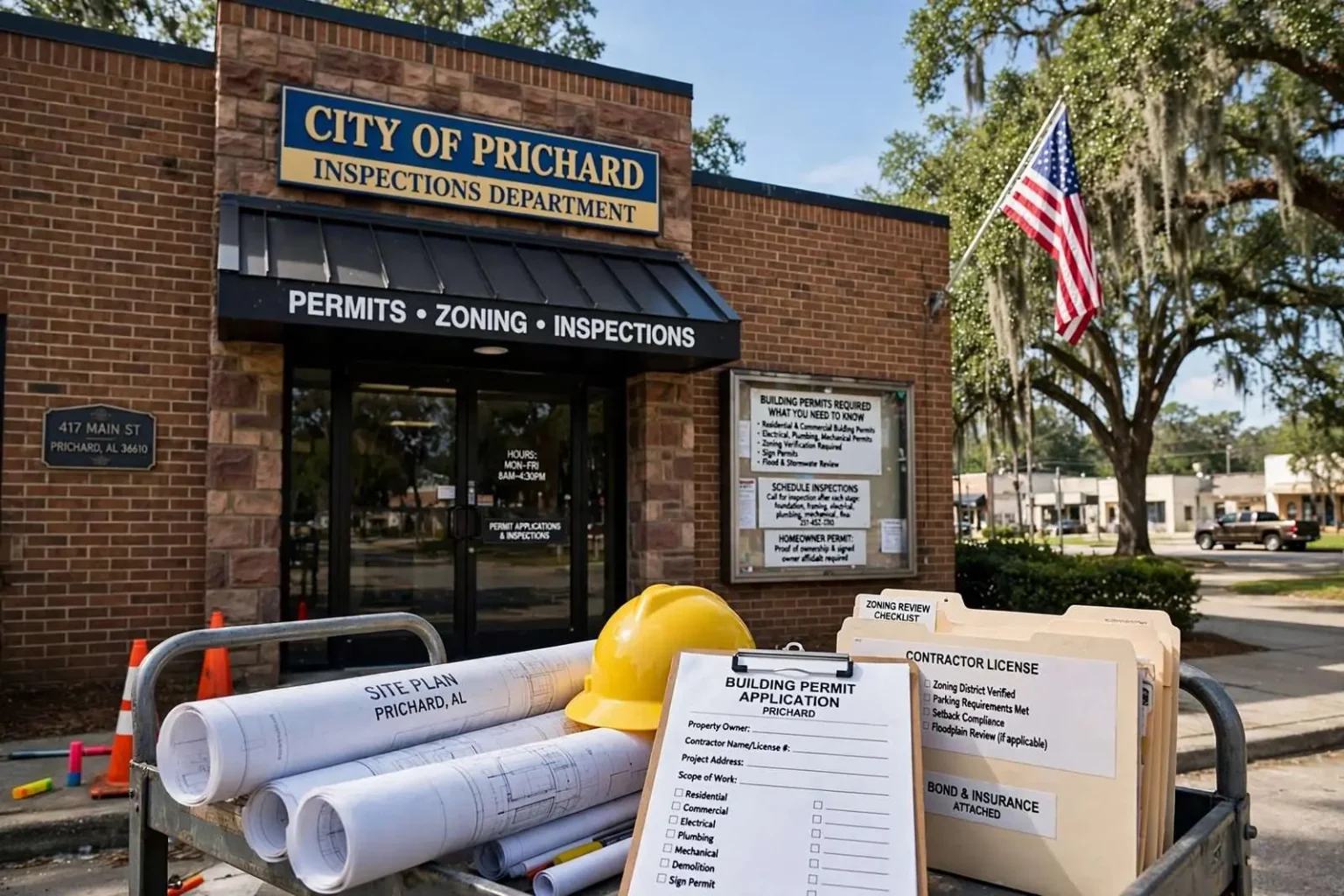
PRICHARD, Ala. — Anyone planning a construction project, new business or property improvement in Prichard will need to work through the City of Prichard Inspections Department, which issues permits covering building, electrical, plumbing, mechanical, demolition, signage, right-of-way work and more. The department has outlined its permitting and inspection requirements to help residents and contractors navigate the process from application to final approval, and city officials stress that the first step for nearly every project is a conversation with the inspections office before work begins.
The city, which sits just north of Mobile in Mobile County, treats permits as the backbone of its effort to keep construction safe and to make sure new development fits the zoning rules that govern each part of the city. Skipping the process can carry real consequences: unpermitted work can be ordered stopped, can complicate a future property sale, and can leave an owner responsible for bringing work up to code after the fact. For contractors, working without a required permit can jeopardize their standing with the city and their ability to pull permits on future jobs.
Building permits: what to bring
The Inspections Department issues building-related permits for both residential and commercial projects, a process designed to ensure work is performed safely and meets current building and trade codes. Before applying, applicants should be prepared with the owner and contractor names, a complete property address, a contact phone number, details of the permit requested, proof of property ownership for homeowner permits, a signed affidavit from the owner if the applicant is not the property owner, and zoning verification confirming the intended use is allowed.
Zoning verification is the step that trips up the most applicants. The parcel may be in a residential district where a proposed business use is not allowed, or in a commercial district where setbacks, parking, or signage limits constrain a planned addition. Checking the zoning classification before paying for drawings or signing a contractor can save weeks of delay, because a use that is not permitted requires either a change of plans or a zoning process with the city’s planning authorities.
Homeowner permits deserve special attention. Property owners in Alabama may perform certain work on their own residences, but the owner must show proof of ownership, and the city holds the homeowner to the same construction standards it applies to licensed contractors. Owners who hire help should remember that a signed owner affidavit is required whenever the applicant is not the person on the deed, and that hiring an unlicensed contractor for work that requires a license shifts all of the risk back to the property owner.
Contractor licensing requirements scale with project size. Work valued under $50,000 requires a current City of Prichard business license, while work over that threshold requires a State of Alabama General Contractor license along with a copy of the signed contract showing total valuation. A bond may also be required, and the City Clerk’s Office handles business license and bond questions. The division between the two tracks matters for both sides of a project: a homeowner planning a modest remodel may only need to confirm the contractor holds a current city business license, while a commercial build out will demand state-level licensure verified before the permit is issued.
State general contractor licensing in Alabama is administered through the Alabama General Contractors Board, which examines and registers contractors for commercial and large residential work. Cities verify the license as part of permit review, and a license that has lapsed or been suspended will hold up an application regardless of how complete the rest of the paperwork is. Contractors who operate in both Prichard and neighboring jurisdictions are wise to keep license, bond, and business license documents current and organized, because the same packet of paperwork tends to be requested city after city across Mobile County.
Fees and plan review
Plan review fees also vary by project type. Commercial plan reviews require a $250 review fee, with some projects requiring $400. New residential houses require a $75 review fee. Larger commercial projects may additionally require architectural drawings, flood review and stormwater runoff drawings before permits move forward.
Once plans are reviewed, permit fees are calculated based on the cost of construction, including labor and materials, with commercial fees typically based on contract price. Applicants should build these fees into project budgets from the start rather than treating them as an afterthought, since an under-budgeted permit cost is one of the most common reasons a project stalls between plan approval and construction. The department can tell an applicant which fee schedule applies once the scope of work is described in detail.
Flood review deserves particular notice in Prichard, where low-lying ground and proximity to streams and drainageways put substantial portions of the city within mapped flood zones. Property in a special flood hazard area triggers additional review and, for substantial improvements or new construction, elevated floor requirements under the community’s floodplain regulations. Homeowners should also understand that floodplain rules affect insurance: work that is not permitted or that violates elevation requirements can complicate flood coverage under the National Flood Insurance Program.
Stormwater review follows a similar logic. Adding roof area, pavement, or grading changes how rainwater moves across a site, and uncontrolled runoff contributes to the drainage problems that have long afflicted older neighborhoods across the Gulf Coast. Drawings showing how a project will handle runoff give the city a chance to require measures such as retention or improved drainage before problems develop, and they protect neighboring properties from the water a new project pushes their way.
Sign permits and zoning reviews
Most permanent signs in Prichard, from storefront lettering to freestanding roadside monuments, require a sign permit before installation, and the sign rules are written into the city’s zoning regulations rather than handled as a separate free-standing code. That means a sign that would be acceptable on one commercial corridor may exceed the limits that apply on another, depending on the zoning district, the road frontage, and the type of business involved.
The sign review process considers dimensions, height, illumination, placement, and whether the sign is attached to a building or standing on its own. Temporary signs, such as banners for grand openings or event promotions, are generally treated differently from permanent installations and may carry their own time limits. Business owners planning a new storefront are encouraged to bring their proposed sign design in early, because reworking a sign after fabrication is far more expensive than adjusting drawings before it is built.
Zoning review also reaches beyond signs. New businesses in particular should confirm that their intended use is permitted in the district where the property sits, that parking requirements can be met on the site, and that any outdoor storage, display, or activity complies with the district’s rules. A use that does not fit may require a special exception or a rezoning, processes that involve public hearings and add time that owners should account for in their opening schedules.
Electrical, plumbing and mechanical work each require their own permits, even when they are part of a larger building project. The separations matter because each trade is inspected at its own stage: wiring must be inspected before walls are closed, plumbing lines before they are concealed, and mechanical systems before and after connection. Pulling trade permits under a general building permit without listing the individual trades is a frequent source of failed inspections and rework orders.
Demolition permits cover more than tearing down a structure. In Prichard, as in other Mobile County municipalities, demolition requires attention to utilities, debris disposal, and the condition of the lot after the work is done. Owners should confirm that gas, electric and water services are properly disconnected, that contractors hold any required licenses for the scope of the work, and that the site will be left in a condition that meets city standards rather than simply cleared.
Right-of-way permits apply to any work that touches public streets, sidewalks, alleys or utility corridors — driveway cuts, curb work, utility connections, and anything that closes or obstructs a street temporarily. Because the right of way is public property, the city reviews such work for safety and for how the surface will be restored. Contractors should expect conditions on traffic control and restoration standards, and they should schedule inspections of the work once the excavation or construction is complete.
The inspection sequence
After a permit is issued, the inspection sequence is what turns a paper approval into a legal, finished project. Inspections are requested as work reaches defined stages, and covering or concealing work before it has been inspected is the classic violation that forces contractors to open walls again at their own expense. Applicants should keep the permit posted or available on site, understand which inspections their project requires, and call for each one at the right moment rather than bundling them in ways the code does not allow.
Inspectors look for compliance with the adopted building, electrical, plumbing and mechanical codes, along with the conditions written on the permit itself. A failed inspection produces a correction list, and the project moves forward only after the corrections are made and a re-inspection passes. Experienced contractors treat the inspector as part of the quality process rather than as an obstacle, asking questions at the plan stage that prevent failures later.
Final approval closes the process. A project is complete not when the work looks done but when every required inspection has passed and any outstanding conditions have been satisfied. That final sign-off matters for property owners in practical ways: lenders, insurers, appraisers and buyers routinely ask whether improvements were permitted and inspected, and a clean permit history supports a property’s value and avoids surprises during a sale.
For residents and business owners in Prichard, the practical guidance is straightforward: involve the Inspections Department early, gather the ownership, licensing and zoning documents listed above before submitting an application, budget for review and permit fees, and schedule inspections as the work progresses. The city’s process exists to catch problems while they are still cheap to fix, and applicants who follow it from start to finish generally find that permits move faster than they expected once the paperwork is complete.