
A Moment With Devon Walsh: Mobile Anchor on Winning AP’s Best News Anchor Award
Mobile anchor Devon Walsh talks about being voted Alabama's Best News Anchor by the Associated Press for the third time.
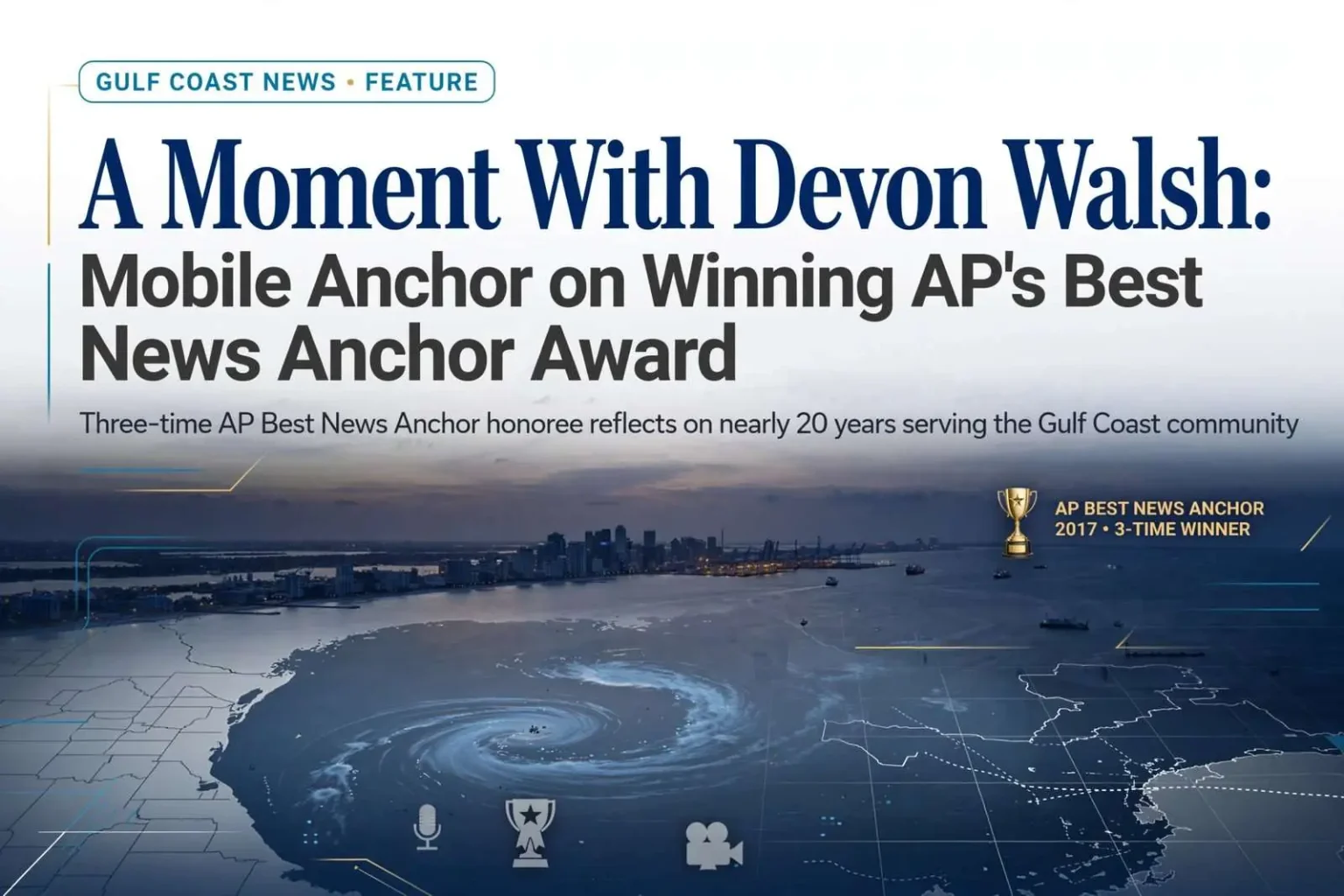
Devon Walsh has spent nearly two decades in Gulf Coast television, and in 2017 the Associated Press named her Best News Anchor in Alabama — an honor she has now captured three times. The longtime Mobile personality recently sat down to talk about the award and what keeps her passionate about local news.
Three AP Best News Anchor awards place Walsh in rare company in the Alabama broadcast community. The Associated Press broadcast contests have long served as the industry’s yardstick for local news excellence across the state, judged by fellow journalists on anchoring, delivery and news judgment, and winning the top anchor prize once marks a career. Winning it three times — with the latest coming in 2017, deep into a career spent entirely on the Gulf Coast — signals a level of consistency that few in the Mobile-Pensacola market have matched.
Longevity itself has become part of her story. In an era when television careers routinely bounce anchors between markets every few years, Walsh’s nearly twenty years in the same coastal market have made her a fixture in living rooms from downtown Mobile to the Eastern Shore — a broadcaster viewers have literally grown up with, through hurricanes, elections, economic booms and the slow transformation of how the Gulf Coast gets its news.
For Walsh, the appeal of the work comes down to service. “Hands down, the best part of my job is being able to help people,” she said. “I always felt like from the very beginning that this job really provided a public service. Whether we’re providing information or telling someone’s story, the fact that people entrust us every single day to get out whatever message they want to get out is amazing.”
That framing of local news as a public trust is more than a sound bite. In a mid-sized market like Mobile, the anchors and reporters on screen are not distant celebrities; they are neighbors who shop at the same stores, sit in the same traffic on Airport Boulevard and weather the same storms. Viewers call them at home. They stop them in restaurants. And on the days when it matters most — a hurricane in the Gulf, a school closing, a missing child — the person delivering the information is someone the community feels it knows.
The Trust That Keeps the Work Satisfying
She said that trust — sitting down with someone while they share a difficult or meaningful chapter of their life — has remained the most satisfying part of the job from her first day on air to today. “Here almost twenty years later, that is still so satisfying to me, to be trusted with someone’s personal story and be able to share that with everyone,” Walsh said.
It is a sentiment that experienced journalists return to often: the moment before an interview begins, when a grieving parent or a surviving business owner decides that this reporter, on this day, will carry their story. In local news, those conversations are the raw material of the broadcast — the house fire, the courtroom verdict, the scholarship awarded, the family reunited — and the responsibility of handling them honestly is what separates anchoring from mere presentation.
The award itself, she noted, reflects work that happens well before the broadcast begins. Anchor recognition in the AP contest typically weighs a body of work — newscasts built with producers, reporters, photographers and the rest of a newsroom team — which makes the individual trophy a shared accomplishment in practice. Anchors in markets like Mobile often double as reporters and community hosts, and the judging rewards the combination of calm delivery and genuine news judgment that daily local broadcasting demands.
Community involvement has been a parallel thread of the job. Gulf Coast anchors spend much of their off-air time emceeing charity events, hosting school programs and lending their visibility to causes across Mobile and Baldwin counties — part of the same service instinct Walsh describes, and part of why local anchors accumulate a loyalty that national broadcasts never develop. When a familiar face shows up at a school assembly or a fundraiser, the relationship between station and viewer deepens in ways ratings never quite capture.
Drawn to Broadcasting
In a wide-ranging conversation, she also reflected on what first drew her to broadcasting and how much the business has changed since she started — from the technology in the studio to the ways viewers now consume the news.
The industry she entered two decades ago was a different machine. Newscasts were planned for fixed appointment times: the morning show, the evening block, the late report. Viewers who missed a broadcast missed it. Film and tape gave way to digital cameras and server-based editing, graphics systems grew by generations, and the studio floor that once required a small crew of camera operators and technical directors now runs on far leaner automation. Anchors who have lasted through that transition describe it as learning a new craft while performing the old one live every night.
The bigger change has come from the audience side. Local stations once competed against three or four rivals on the dial; they now compete against an infinite scroll. Social media platforms, streaming apps and push alerts have fractured the audience into thousands of small screens, and stations that once delivered news in two tidy daily blocks now publish continuously across websites, Facebook, Twitter and live video feeds. Anchors of Walsh’s generation have had to become multimedia journalists in practice — writing for the web, appearing in vertical video on a phone, and engaging directly with viewers online in ways that did not exist when she started.
Yet the fundamentals she cites — accuracy, fairness, and the trust of the person across the interview chair — have not changed at all. The platforms have multiplied, but the core transaction is the same one she describes from her first day: someone has something the community needs to know, and they trust her to get it right and get it out.
Local News on the Gulf Coast
The Gulf Coast market Walsh has served is one of the more distinctive in the country. Mobile’s stations reach viewers across two states and a coastline where severe weather is not an occasional story but a defining beat. Hurricane coverage — the long hours tracking a storm’s approach, the evacuations, the recovery that follows — has historically been where Gulf Coast anchors earn their community’s deepest trust, and where the public-service role Walsh describes becomes most literal.
The region’s news rhythm also runs through its own traditions: Mardi Gras, which Mobile claims as the oldest in the country; the shipbuilding and port economy; high school football on Friday nights; the ongoing growth along I-10 between Mobile and the beaches. A longtime anchor becomes the thread that connects all of it, year after year, for viewers who count on the same face to explain what changed while they were away.
Against that backdrop, a third AP Best News Anchor award in 2017 reads as both an industry honor and a community endorsement. Awards judged by journalists measure craft; sustained careers in one market measure something harder to quantify — the accumulation of credibility, one story at a time, with an audience that can tell the difference between a passing professional and a genuine presence.
Walsh’s reflections on the changes in the business also carry a wider lesson for local journalism. The economics of local television have tightened as advertising dollars scattered across digital platforms, and newsrooms everywhere have been asked to produce more content for more channels with fewer resources. The anchors who endure are the ones who can stretch across those demands without letting the on-air product slip — a balance that awards like the AP’s suggest she has managed.
For viewers, though, the conversation likely confirms what they already sense from watching her: the person delivering their news sees the work the same way they do — as a service to the community rather than a performance before it. Nearly twenty years in, with three state anchor awards on the shelf, Walsh says the most satisfying part remains the same as it was on day one: being trusted with someone’s story, and getting it right.
In an industry where careers are measured in contract cycles and market jumps, that kind of constancy has become its own headline. Mobile viewers have watched anchors come and go across the dial; the ones who stay, and who keep treating every viewer’s story as if it were their own family’s, are the ones the community keeps choosing to come back to — night after night, and in Walsh’s case, year after year.
And if the last two decades are any guide, that trust will keep paying dividends for the Gulf Coast audience — in the nightly newscast, in the next hurricane season, and in the stories of ordinary people that still form the heart of local news.