Accused Cop Killer Marco Perez Set for Preliminary Hearing Tuesday as Gag Order Issued
Marco Perez, accused in the killing of Mobile Police Officer Sean Tuder, was scheduled for a preliminary hearing after a gag order was issued.
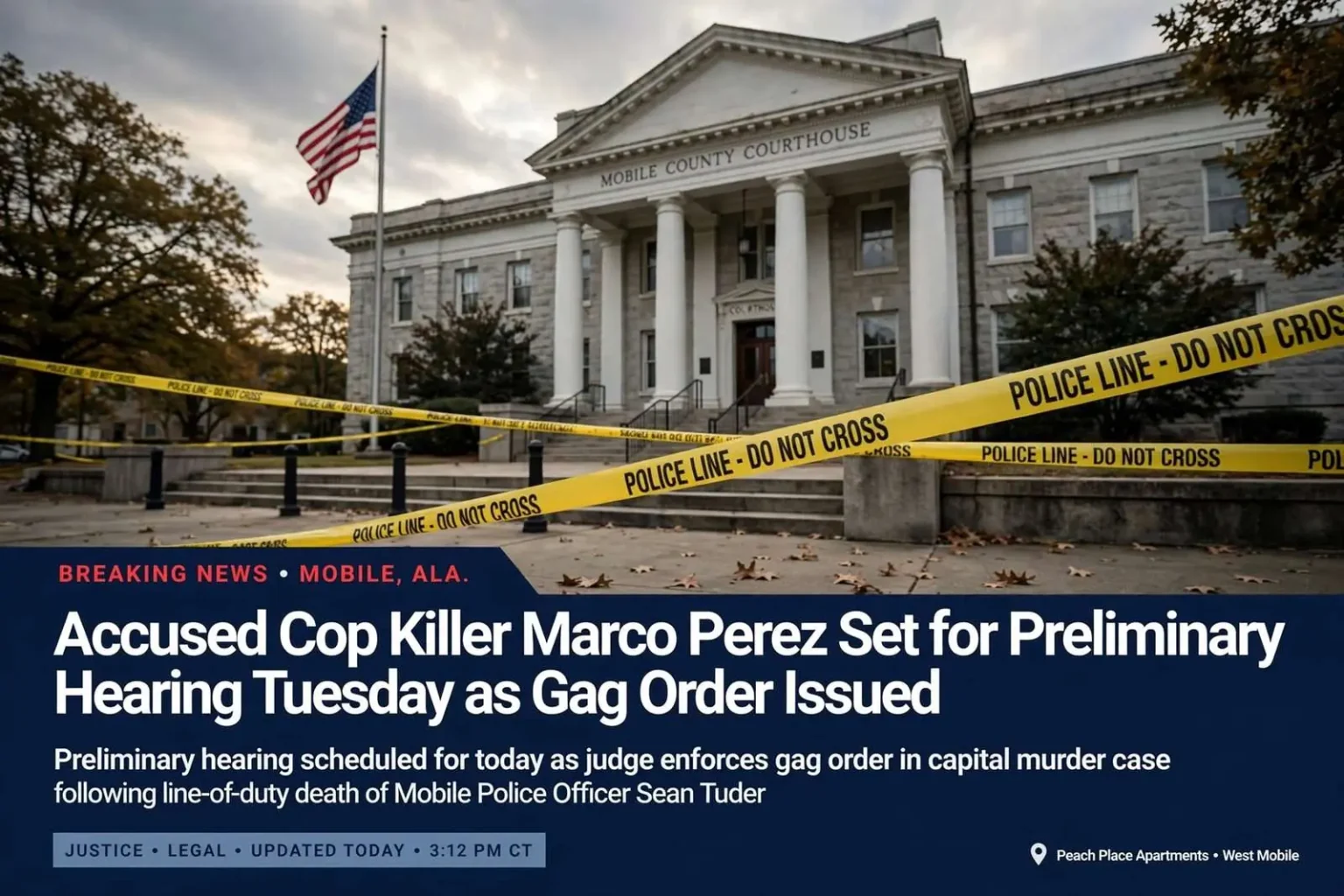
MOBILE, Ala. — The man accused of killing a Mobile Police officer earlier that year was scheduled to face a judge Tuesday for a preliminary hearing, a procedural milestone that begins to move the capital murder case from the streets where the manhunt unfolded to the courtroom where it will be decided.
Marco Perez was to have a preliminary hearing that afternoon. The session could lay out more of the details against Perez in the shooting death of Officer Sean Tuder, the Mobile police officer killed in the line of duty at an apartment complex in the city earlier that month.
Perez is accused of trying to evade police for several days before being confronted by Tuder at the Peach Place Apartments the previous month. The state says Perez shot and killed the officer.
Tuesday’s hearing came one day after a gag order was issued in the case. The order forbids anyone involved in the capital murder trial from talking to the media or making public statements about the case.
What a preliminary hearing does
In Alabama’s court system, a preliminary hearing is not a trial and does not decide guilt. Its purpose is narrow: a judge hears enough evidence from the prosecution to determine whether probable cause exists to believe the defendant committed the offense. If the judge finds probable cause, the case is bound over to a grand jury, whose indictment is the step that formally sends a felony case to circuit court for trial.
For that reason, preliminary hearings are often the first public look at the state’s evidence. Prosecutors are not required to present everything they have — only enough to clear the probable-cause bar — but in a case of this profile, testimony from investigators at the hearing typically establishes the basic narrative of what happened, when, and where. Details that emerge in open court at this stage are frequently the fullest public account available until trial.
Defense attorneys use the hearing differently. Cross-examination at a preliminary hearing gives the defense its first chance to probe the state’s witnesses under oath, lock in testimony, and identify weaknesses in the investigation months before a jury is selected. The transcript that results can shape motion practice and trial strategy on both sides.
The hearing’s timing also reflects the practical rhythm of a capital case. Capital prosecutions involve additional procedural requirements, extensive discovery, and penalty-phase preparation that ordinary murder cases do not, and the early hearings set the schedule that everything downstream follows.
The charges and what capital murder means
The killing of a police officer is among the most serious offenses in Alabama’s criminal code. Under state law, murder becomes a capital offense when the victim is a peace officer acting in the line of duty, a designation that exposes a defendant to the harshest penalties available under Alabama law and triggers the special procedures that accompany capital prosecutions.
That classification is why the case has drawn the attention it has, and why the court moved quickly to impose controls. Capital cases in Mobile County, as elsewhere in the state, proceed with appointed defense counsel experienced in death-penalty litigation, and the prosecution of an officer’s killing carries an emotional weight that court officials must manage from the first hearing onward.
The accusation that Perez evaded law enforcement for several days before the confrontation adds a fugitive dimension to the state’s narrative, and the search that preceded the encounter with Tuder involved multiple agencies working to locate him before he was found at the Peach Place Apartments complex in west Mobile.
The manhunt and the encounter at Peach Place
According to the account laid out by authorities, Perez was sought by police for several days in connection with other matters before officers located him at the Peach Place Apartments. When Officer Sean Tuder confronted him there, the state alleges, Perez shot and killed him.
Peach Place Apartments sits in a residential section of west Mobile, a part of the city where apartment complexes, schools, and commercial corridors sit side by side. The killing of a police officer at the complex brought a massive law enforcement response to the area and placed the neighborhood at the center of a story that followed for months — the funeral procession for a fallen officer, the arrest of a suspect, and the legal machinery that began turning in the weeks after.
Officer Tuder’s death was the first line-of-duty death for the Mobile Police Department in years, and the department and the city’s broader law enforcement community treated the loss accordingly. Officers killed in the line of duty are mourned publicly in Mobile, with processions that close highways and memorial services that draw officers from across the Gulf Coast, and Tuder’s funeral was no exception.
The search for Perez in the days before the encounter illustrated the pressures of a manhunt in an urban area. Officers from multiple units, assisted by other agencies, worked around the clock to locate a suspect they considered dangerous, and the confrontation that ended the search underscored the risks that police face in precisely those circumstances — a wanted man, a residential setting, and a moment when the search and the suspect meet.
The gag order and why courts issue them
The gag order issued the day before the hearing is a standard tool in high-profile prosecutions. Courts issue such orders when pretrial publicity threatens a defendant’s right to a fair trial, restricting the lawyers, investigators, witnesses, and officials connected to the case from making public statements about the evidence, the parties, or the merits of the charges.
The reasoning is practical. Capital murder cases attract intense coverage, and statements from either side can pollute the jury pool in the county where the trial will be held. By restricting what participants can say publicly, the court preserves its options — including the ability to seat an impartial jury locally without resorting to a change of venue — and keeps the evidence argument where it belongs, in the courtroom.
Gag orders also protect the integrity of the record. Statements made outside court, before the evidence has been tested, can complicate later proceedings if witnesses’ accounts shift or if publicity reaches jurors. For the family of Officer Tuder and for the community, the order means the fullest picture of the case will come from court proceedings rather than press statements — a slower but more reliable account.
Such orders are not absolute, and courts tailor them narrowly. They typically leave room for the routine public work of justice — hearings that are open to the press and public, filings that become part of the public record, and statements limited to procedural matters — while drawing the line at commentary on evidence, confessions, witness credibility, or a defendant’s character. Attorneys who violate a gag order face contempt proceedings, which is why, in cases like this one, the day-to-day public statements from both sides simply stop once the order is signed.
The Mobile Police Department’s loss
For the Mobile Police Department, the preliminary hearing marked another step in a case that the department has followed from the first moments of the manhunt. Departments that lose an officer in the line of duty carry the case personally — officers attend the hearings, the department supports the family through the process, and the outcome of the prosecution matters to the force in a way few other cases do.
Officer Tuder’s killing also prompted the kind of departmental and community reflection that follows line-of-duty deaths: renewed attention to the risks of serving warrants and confronting wanted suspects, tributes from officers across the region, and public recognition of the work that officers do in the apartment complexes and neighborhoods where much of urban policing happens.
The response to Tuder’s death — the search for his killer, the swift arrest, and the capital charge — reflected both the law and the sentiment of the community. Alabama treats the killing of a police officer as a capital crime precisely because of what such an attack represents, and Mobile’s response to the case has matched that gravity.
What comes after Tuesday
If the judge finds probable cause at the preliminary hearing, the case moves to the grand jury, where the presentation is one-sided by design — the prosecution presents, the defense does not, and the grand jury decides whether to indict. An indictment in a capital case sets the trial calendar in motion, with arraignments, motion practice, and the long pretrial process that capital prosecutions require.
The gag order will shape that entire period. With participants barred from public comment, coverage of the case will rely on what happens in open court — hearings, filed motions, and eventually the trial itself. For a community that followed the manhunt and mourned the officer, that means the answers to the questions the case raises will come slowly, through the courtroom record.
Tuesday’s hearing is the beginning of that process, not the end. Months of proceedings remain between a preliminary hearing and a trial in a capital case, and the details laid out in court this week will be tested, challenged, and weighed long before a jury ever hears them. For Mobile, the case stands as the city’s reckoning with the loss of one of its officers — pursued now not on the streets, but under the rules and protections that the justice system requires.