
Acting Navy secretary tours Austal and Ingalls shipyards in Mobile
Acting Navy Secretary Thomas Harker toured the Austal and Ingalls shipyards in Mobile with U.S. Rep. Jerry Carl amid a turbulent year at Austal.
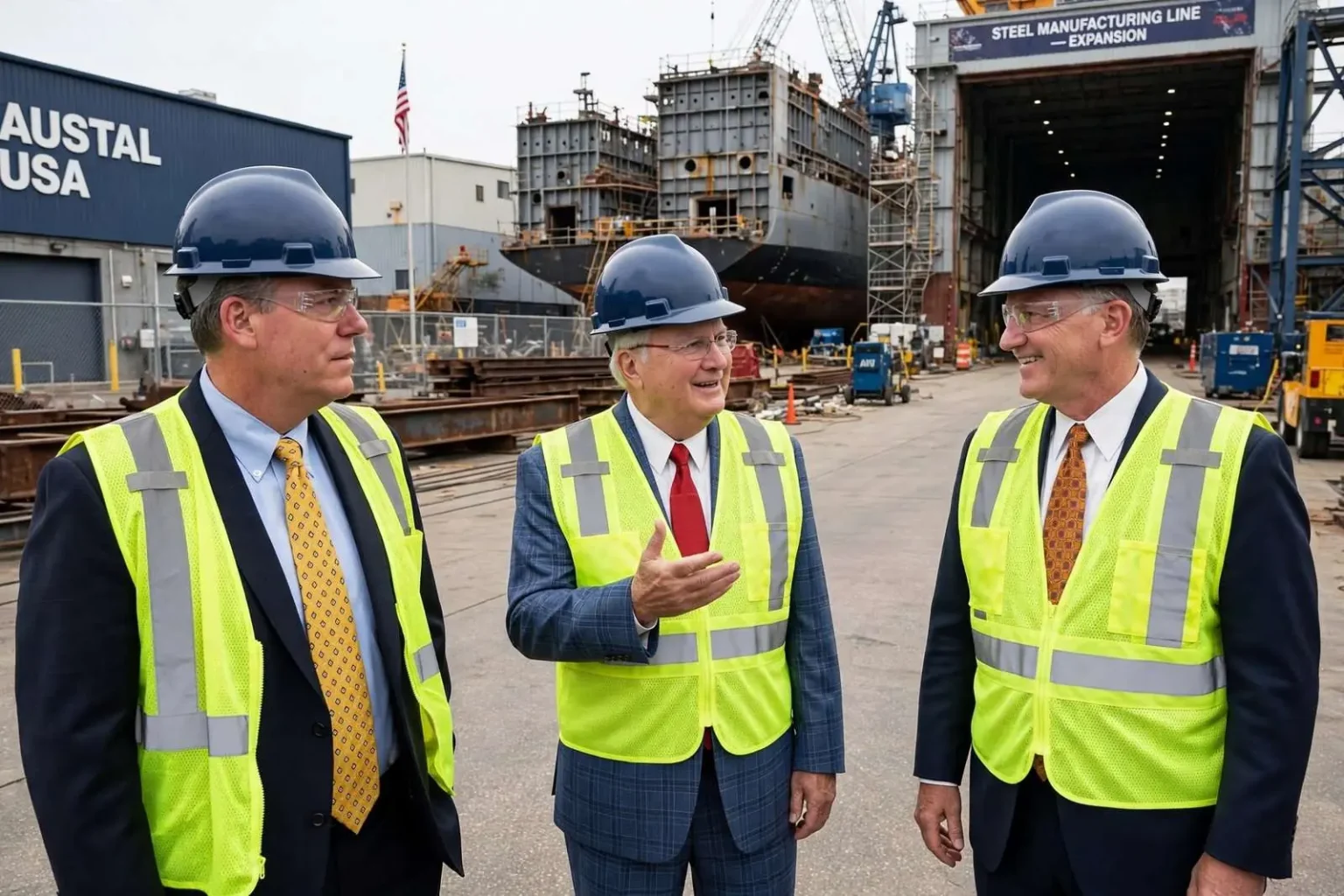
MOBILE, Ala. — Acting Secretary of the Navy Thomas Harker joined U.S. Rep. Jerry Carl of Alabama’s 1st District and U.S. Rep. Steve Palazzo of Mississippi’s 4th District on tours of the Austal and Ingalls shipyards Wednesday, a two-yard itinerary that put the Navy’s top civilian official inside the two Gulf Coast facilities that build a large share of the service’s surface fleet.
At Austal, Mike Bell, the company’s senior vice president of operations, and Congressman Carl gave Harker an in-depth look at the company’s investment and modernization work around its new steel manufacturing line at the shipyard in Mobile on March 31. The steel line marks a significant expansion for a yard that made its name in aluminum shipbuilding, opening a second production path that broadens the types of vessels Austal USA can compete to build for the Navy and other customers.
The visit came amid a particularly bumpy year at the Mobile shipyard. Austal had only recently seen the resignation of President Craig Perciavalle amid a federal investigation into financial and contracting irregularities, an episode that put the company’s leadership and its flagship Navy programs under scrutiny even as work on the waterfront continued. Against that backdrop, the tour functioned as both an operational briefing and a reassurance exercise — senior Navy leadership on the ground, seeing the work firsthand.
Why the two shipyards matter to the Navy
Austal USA and Ingalls Shipbuilding anchor the central Gulf Coast’s role in American shipbuilding. Austal’s Mobile riverfront yard has produced littoral combat ships and expeditionary fast transport vessels for the Navy, building its reputation on high-speed aluminum hulls and modular production techniques that keep multiple ships moving through the facility at once. Ingalls, across the state line in Pascagoula, builds much of the Navy’s large-deck surface combatant and amphibious force, from destroyers to amphibious assault ships, and ranks among the largest private employers on the Gulf Coast.
The two yards sit roughly an hour apart on the Gulf, which is what made a single-day visit by the acting secretary practical. Congressional support for both facilities runs through the delegations of Alabama and Mississippi, and Carl and Palazzo — whose districts respectively include Mobile and the Mississippi Gulf Coast — have been consistent advocates for the shipbuilding dollars and program decisions that keep both yards’ bays full.
For the Navy, the visits are part of how civilian leadership stays connected to the industrial base that actually produces the fleet. Budget requests, contract structures and class management decisions made in Washington land on these waterfronts as hulls under construction, and tours of the kind Harker took Wednesday let officials see production realities — schedules, workforces, supply chains — that paperwork alone cannot convey.
The steel line and Austal’s bet on the future
The modernization work Bell and Carl walked Harker through centers on Austal’s new steel manufacturing line, an investment that changes what the Mobile yard can build. Aluminum construction gave Austal its niche in the Navy’s high-speed vessel programs, but the majority of the Navy’s large combatant and auxiliary force is built in steel, and a yard that can work in both metals can compete across far more of the service’s shipbuilding portfolio.
The expansion also speaks to production capacity at a moment when the Navy and Congress have pressed for higher shipbuilding rates across the fleet. Gulf Coast yards have absorbed much of that push, and modernized facilities — new manufacturing lines, expanded module halls, updated equipment — are how a yard positions itself for the larger programs the service is expected to award in coming years.
Shipyard investment of this scale ripples through the local economy as well. Mobile’s shipbuilding workforce draws from across the region, and new production lines mean hiring across trades — welders, pipefitters, electricians, shipfitters — along with the supplier businesses that feed the yard. The workforce dimension is a standing theme in every such visit by Navy leadership, which is why local members of Congress so often join them.
The bumpy year behind the tour
The visit came at a sensitive moment for Austal. The company had only recently seen the resignation of President Craig Perciavalle amid a federal investigation into financial and contracting irregularities, a development that touched the very programs the Mobile yard exists to build. Federal inquiries into a major defense contractor tend to shadow everything else the company does — investor calls, contract awards, congressional hearings — and Austal spent the period managing both the investigation and the shipbuilding.
For the Navy, the practical concern in such episodes is continuity: the ships under construction are public assets, and the service has a stake in whether management turmoil translates into schedule slips or cost growth on the waterfront. Tours like Wednesday’s give Navy officials a direct look at whether production is proceeding and give the company a chance to demonstrate stability in its operations.
The two members of Congress on the tour have their own stake in that continuity. Shipbuilding contracts support thousands of jobs across the First District of Alabama and the Fourth District of Mississippi, and both Carl and Palazzo have framed yard health as a constituent issue as much as a national security one. Their presence alongside the acting secretary underscored the delegation-level attention the Gulf Coast shipbuilding industry commands in Washington.
Ingalls and the Mississippi side of the visit
The tour’s second stop, Ingalls Shipbuilding in Pascagoula, represents the other half of the Gulf Coast’s shipbuilding story. The yard, part of Huntington Ingalls Industries, builds the Navy’s large surface ships — destroyers, amphibious assault ships, cutters for the Coast Guard — and its workforce and payroll make it a pillar of the Mississippi Gulf Coast economy. Palazzo’s district includes it, and Mississippi’s delegation has long treated the yard’s program wins as a statewide priority.
Pairing the two yards in a single visit reflects their complementary roles. Austal’s aluminum expertise and its new steel capability position it for the Navy’s smaller combatants and auxiliary programs, while Ingalls concentrates on the large-deck fleet. Navy officials visiting both in one day see the breadth of what the central Gulf contributes to the fleet — from fast, modular production to the heavy construction of the service’s biggest surface ships.
The region’s shipbuilding cluster also feeds itself: workers move between yards, suppliers serve both, and the two companies’ fortunes rise together with national shipbuilding budgets. That interdependence is why visits by Navy leadership typically cover both sides of the state line, and why the congressional representatives involved often appear together at industry events regardless of party or state.
What the acting secretary’s visit signals
Harker was serving as acting secretary at a time of transition in the Navy Department’s civilian leadership, and acting officials’ travel schedules tend to emphasize continuity — reassuring commands, contractors and delegations that programs are proceeding. A Gulf Coast swing through the two biggest shipyards in the region fits that pattern precisely: high-visibility stops where production progress is on display and where local support for the Navy runs deep.
For Mobile, the visit put the city’s shipbuilding role in front of the department’s top civilian. The Mobile yard’s expansion into steel manufacturing, the modernization work around it, and the jobs tied to all of it are exactly the investments the delegation wants Navy leadership to see when shipbuilding budgets are being shaped.
The tour of Austal and Ingalls closed with no announced program decisions — visits of this kind are about observation and relationship rather than announcements. But the symbolism was legible to anyone following the industry: the Navy’s acting secretary, two Gulf Coast congressman, a shipyard investing in its future and another building the fleet’s largest surface ships, all within a single Wednesday in March. It was a snapshot of an industry that, despite a federal investigation and a leadership change at one of its companies, remains central to both the Navy’s plans and the Gulf Coast’s economy.
Shipbuilding as a Gulf Coast institution
The industry Harker toured is generations deep on the central Gulf Coast. Mobile and Pascagoula have built ships for more than a century, and the yards’ workforces carry skills passed down through families — trades learned on the waterfront and taught in the region’s technical programs and community colleges. When Navy leadership visits, they are walking through an economic and cultural institution as much as an industrial one.
That depth is part of why the region competes successfully for Navy work against yards in other parts of the country. The concentration of experienced hull, mechanical and electrical tradespeople, the supplier network that has grown around the yards, and the geographic advantage of a deepwater coast all add up to an ecosystem that is difficult to replicate. New manufacturing lines, like the steel facility at Austal, are layered onto that foundation rather than built from nothing.
The congressional dimension sustains it. Shipbuilding contracts are authorized and appropriated in Washington, and the Gulf Coast delegations — Alabama and Mississippi alike — have historically protected the programs that keep their yards busy. Carl and Palazzo’s presence on the tour was a working expression of that arrangement: the region’s representatives showing the service’s leadership what the region produces, in the company of the executives who produce it.
Looking past a difficult stretch
The federal investigation and the leadership change at Austal form the backdrop to every account of the company in this period, but they do not change the underlying position of the yard: ships in the water, ships under construction, and new capacity coming online. Companies in the defense industrial base routinely work through such episodes while production continues, because the work itself — and the contracts behind it — is too substantial to pause.
For Mobile, the stakes of that continuity are measured in jobs and in the city’s identity as a shipbuilding port. The Austal yard on the Mobile River, alongside the other maritime operations on the waterfront, is among the largest industrial employers in the area, and its modernization investments signal an intent to grow rather than merely hold. The Navy’s interest in visiting, and in seeing the steel line, suggests the service sees the same possibility.
Wednesday’s tours — Austal in the morning’s context of investment and modernization, Ingalls as the region’s heavy-industry anchor — ended the way such visits do, with handshakes and a flight back to Washington. What remained on the waterfront was the work itself: steel being cut and modules taking shape in Mobile, large hulls rising in Pascagoula, and a Gulf Coast shipbuilding industry that continues to build the Navy’s fleet through the scrutiny and the transitions alike.