
Adam Eaton Named to All-Time Mobile BayBears Team as Franchise Counts Down Final Games
Former first-round pick Adam Eaton joins the All-Time Mobile BayBears Team as the franchise nears its final game after 23 seasons.
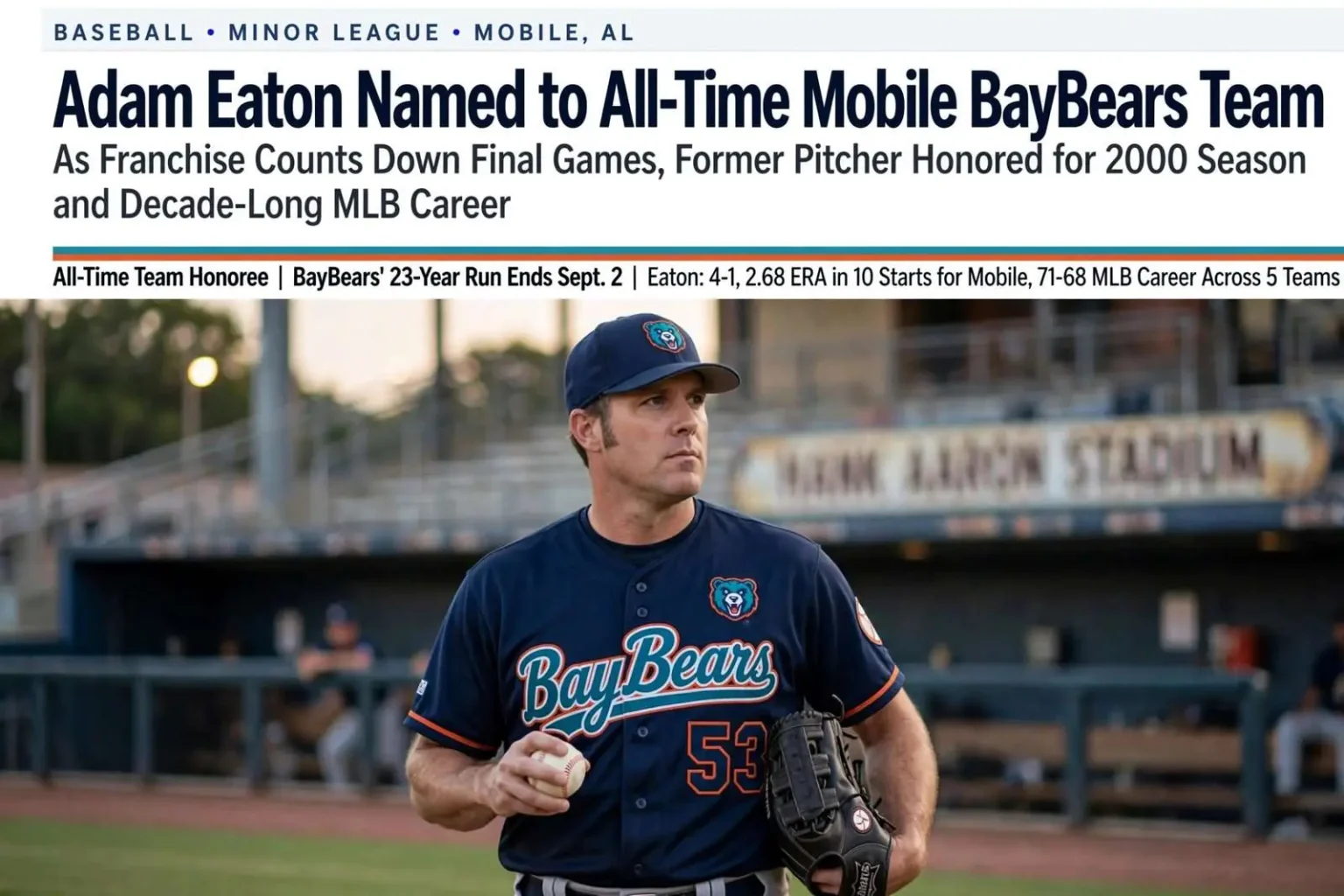
Former big-league pitcher Adam Eaton is the latest honoree on the All-Time Mobile BayBears Team, a retrospective series unveiled as the franchise approached the end of its 23-year run in Mobile. The club began naming its all-time team as it counted down to its final game on Sept. 2, with selections based on each player’s or coach’s overall career rather than only their time in a BayBears uniform.
The retrospective gave the franchise a way to close its Mobile chapter with gratitude rather than grief. Over more than two decades at Hank Aaron Stadium, the BayBears sent dozens of players to the major leagues and served as the summer home for generations of baseball fans on the Gulf Coast — families who came for the fireworks and stayed for the prospects, scouts who came to chart the future and found it on the Gulf’s best minor league rosters.
The all-time team series built toward that final game by honoring one member at a time, mixing stars whose careers were defined elsewhere with those who did their best work in Mobile. The selection criteria — career-wide achievement rather than BayBears tenure alone — meant the honorees included players whose brief stops in Mobile gave little hint of what followed, and Eaton’s case was exactly that kind.
Eaton debuted in Mobile in 2000, his fifth season in the minors, after being selected in the first round of the draft. The right-hander arrived as one of the pitching prospects on whom the franchise’s parent club had staked its future, and his season on the Gulf Coast was the last stop between the minors and the career he had been drafted to have.
A quick rise through Mobile
In 10 starts for the BayBears he went 4-1 with a 2.68 ERA, a performance that earned him a quick promotion: he was called up to the major leagues on May 30, 2000. The trajectory — from Double-A Mobile to a big-league mound within weeks — was the dream sequence every prospect chases, and for Eaton it began with a spring in a ballpark named for Mobile’s most famous baseball son.
Hank Aaron Stadium, the BayBears’ home since the franchise’s inception, sits in Mobile’s western suburbs and carries the name of the city’s greatest athlete. For players like Eaton, pitching there meant performing in the hometown of Aaron, Ozzie Smith, Billy Williams, Satchel Paige and Willie McCovey — a lineage of Hall of Famers that has made Mobile, by some counts, one of the most productive baseball cities of its size in America.
The 2000 BayBears roster that Eaton pitched for was in the middle of a memorable run for the franchise, and his brief tenure — just 10 starts — was enough to stamp his name into the club’s record books. A 2.68 earned run average in the hitter-friendly Southern League, where summer heat and small ballparks inflate offense, signaled a pitcher ready for the next level.
He spent most of the next six seasons pitching for the San Diego Padres, with his best year coming in 2005, when he went 11-5 in 22 starts. The Padres of that era were building around young pitching, and Eaton grew into a front-of-the-rotation arm in San Diego — workhorse starts, deep counts, the steady accumulation of a career that had begun with a May call-up from Mobile.
Trades, titles and the long road
Eaton was traded to Texas before the 2006 season and then dealt to Philadelphia ahead of 2007, when he made 30 starts and went 10-10 for the Phillies. The moves placed him at the center of two of the era’s notable deals — the kind of trades that reshape franchises — and in Philadelphia he became part of the foundation of a team that was about to grow into a champion.
He was part of the Philadelphia organization in 2008 as the Phillies won the World Series, though he did not appear in the postseason that year. The title ring that followed was an odd comfort for a pitcher who had missed the playoff roster through injury, but it attached Eaton to the first Phillies championship in nearly three decades and to one of the signature moments of the era in Philadelphia sports.
Eaton closed out his career in 2009 with brief stops in Baltimore — eight games — and Colorado, where he made four appearances. The final season took him through two more organizations, ending a major league journey that had begun with a phone call in May 2000 and lasted a decade across five teams and both leagues.
He finished with a career record of 71-68 across five major-league teams, a journey that began on the mound in Mobile. The win total places him among the more durable pitchers of his generation of prospects — a first-round pick who reached the majors quickly, ate innings for a decade, and left the game with more wins than losses, a balance that only a minority of big-league pitchers ever achieve.
The all-time team honor joined Eaton to a franchise history that began in 1997, when the Southern League arrived in Mobile with a new ballpark named for Aaron and a market that had gone decades without affiliated professional baseball. Over 23 seasons, the club served as the Double-A home for the San Diego Padres and later the Arizona Diamondbacks, and its rosters read like a who’s-who of the era’s prospects — players who passed through Mobile on the way to All-Star games, pennant races and, in some cases, Hall of Fame careers.
For the franchise’s final season in Mobile, the all-time team series served a purpose beyond nostalgia. Minor league baseball’s reorganization had sent the franchise north — the club’s departure for the Huntsville area as the rebranded Rocket City franchise ended Mobile’s run as a Southern League city — and the countdown series let fans say goodbye to their history one honoree at a time, reconnecting the final home stand with the players who had defined the previous two decades.
What the honor means
Selections for the All-Time team were based on each player’s or coach’s overall career rather than only their time in Mobile, a choice that elevated the honor above a local popularity contest. The franchise was, in effect, recognizing the people whose careers it had touched — the future big-leaguers who spent a summer or two on the Gulf Coast, the managers and coaches who built winning teams, the players whose Mobile performances foreshadowed careers their fans could only imagine.
Eaton’s case illustrated the criteria perfectly. His BayBears tenure was short — 10 starts in the spring of 2000 — but what followed was a decade in the majors, a World Series ring, and a career record compiled for five teams. Mobile was where the big leagues first saw him, and the franchise was right to claim a share of the credit: Double-A is where prospects stop being prospects and start being players, and Eaton’s dominant spring on the Gulf Coast was the proof.
The honor also connected Eaton to the broader story of baseball in Mobile. The city that produced Hank Aaron and Ozzie Smith, that sent Satchel Paige’s legend across the country, and that has filled major league rosters for more than a century, lost its affiliated team with the BayBears’ final game on Sept. 2. The all-time team — Eaton among its honorees — stands as the franchise’s final statement about what those 23 years meant: a bridge between Mobile’s incomparable baseball past and the hundreds of careers that passed through Hank Aaron Stadium.
For the fans who followed the club from its first season, the retrospectives were a reminder of how minor league baseball works: the players are borrowed, the rosters change every year, and what remains is the institution — the ballpark, the summer nights, the memories of watching a 22-year-old with a 2.68 ERA pitch his way to a May call-up. Adam Eaton’s career, from Mobile to San Diego to Philadelphia to a World Series ring, is the kind of story the All-Time BayBears Team was built to tell.
The 2005 season in San Diego deserved particular mention in the story of Eaton’s career. An 11-5 record in 22 starts came for a division-winning Padres team, and the left side of his run differential that year told the story of a pitcher at his peak: when Eaton took the ball, San Diego won more often than it lost, and the Padres’ rotation leaned on him in a season that ended with a National League West title.
His move to Texas in the trade before 2006 sent him into the American League for the first time, a transition that challenges pitchers with deeper lineups and the designated hitter, and the subsequent deal to Philadelphia restored him to the National League, where his career had been built. The two trades in two years are the unglamorous side of professional baseball — the player learns his fate from a phone call, packs for a new city and reports to a clubhouse of strangers who will become, briefly, his team.
In Philadelphia, the 2007 season of 30 starts and a 10-10 record made him a mainstay of a young staff, and the Phillies’ rise over the following seasons — the 2008 championship among them — grew from the rotation he helped stabilize. His 2009 finale, split between Baltimore and Colorado, closed the circle on a career that had spanned both leagues and five organizations.
Scouts who watched him in Mobile in the spring of 2000 saw the ingredients that made the decade possible: a durable arm, command of the strike zone and the composure of a pitcher unbothered by the moment. Those are the qualities franchises draft in the first round, and Eaton’s career validated the investment made in him on draft day years before he ever threw a pitch at Hank Aaron Stadium.