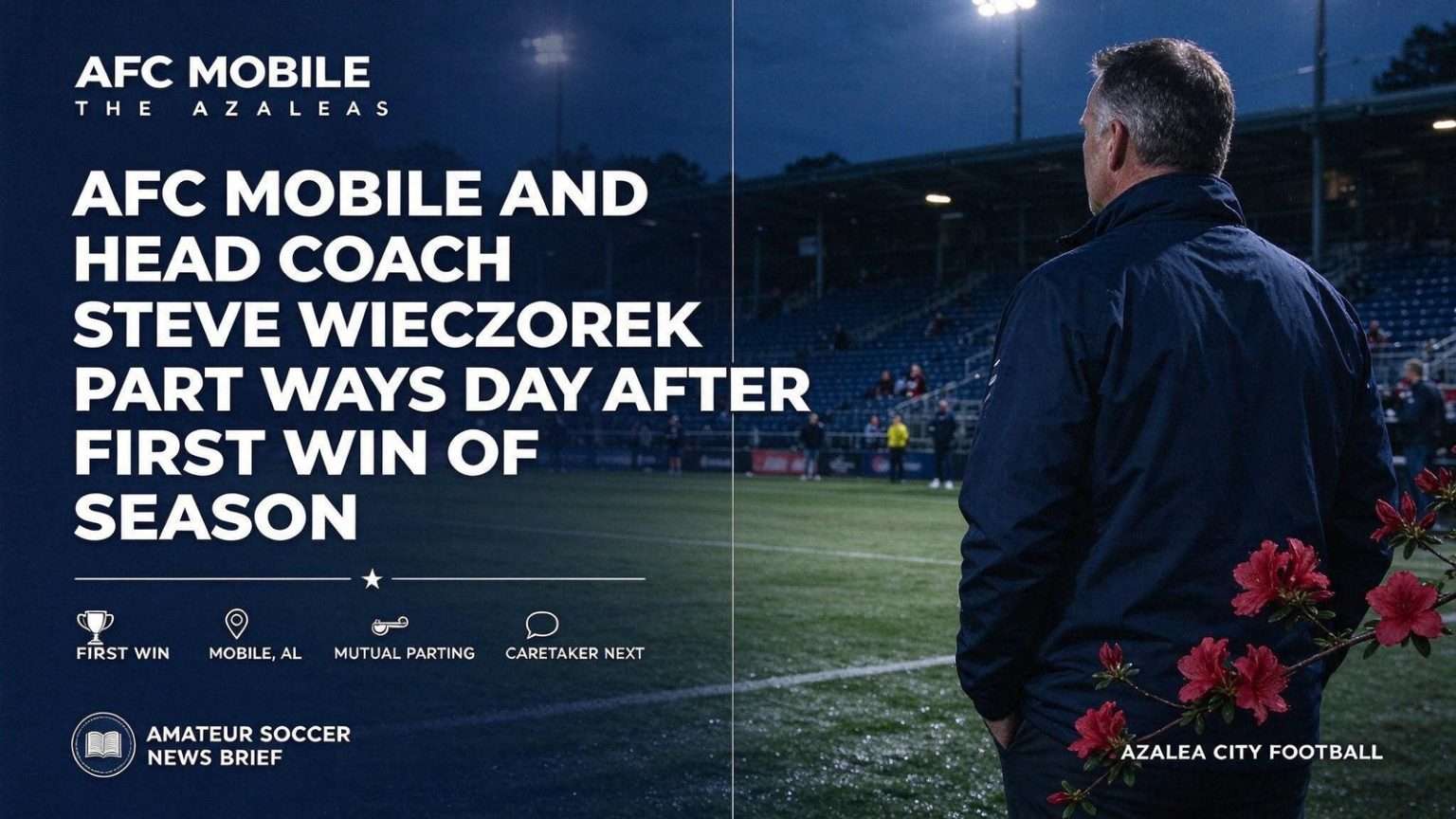
AFC Mobile is looking for a new leader on the sideline. The Port City soccer club and head coach Steve Wieczorek have mutually agreed to part ways, one day after the Azaleas picked up their first win of the season. The split, though sudden on the surface, came down to a career move: Wieczorek is leaving Mobile for a new job in the Northeast, where he has been named head coach of the men’s soccer program at The College of Saint Rose in Albany, New York.
The timing made for an awkward contrast. Wieczorek’s final match in charge was a fitting send-off, with the Azaleas beating Pensacola FC 2-0 on Wednesday night in a match played in Foley, giving the club its first victory of the year. The coaching change was announced the following day, converting a night of celebration into the start of a transition the club did not plan for when the season began.
A short but eventful run in Mobile
Wieczorek had led AFC Mobile since the 2019 season, guiding the club through its early years in the National Premier Soccer League and its return to play after the pandemic wiped out the 2020 campaign. The 2020 shutdown was a body blow to every club in the league: the NPSL, a national league in which AFC Mobile competes, canceled its season entirely as the virus spread, leaving players, coaches and supporters without a summer of soccer and forcing clubs to rebuild momentum from scratch the following year.
In that context, Wieczorek’s tenure covered the club’s formative stretch in the league — the seasons that established its identity, its roster-building habits and its place in the Gulf Coast soccer landscape. Clubs at the amateur level see constant roster turnover as players graduate, transfer or move for work, and the coach’s job is as much about rebuilding each spring as it is about match-day tactics.
“It’s been a great run”
“It’s been a great run over the last couple of years at AFC Mobile, but it is important for me to step down and focus on the coaching opportunity that’s ahead of me,” Wieczorek said. “And I also think it’s important for the club and for the players to have a new voice that will help us achieve the goal of reaching the conference playoffs, which I think is well within our grasp.”
The move to college coaching marks a step up in institutional structure for Wieczorek. The College of Saint Rose, in New York’s capital region, competes in NCAA Division II, where men’s soccer programs carry full recruiting calendars, scholarships and year-round training schedules. Coaching at the college level offers stability and resources that amateur summer-league clubs, however well run, cannot match, which is why the NPSL regularly loses coaches to college benches when openings come along.
Grube steps in as caretaker
Former AFC Mobile goalkeeper and current assistant coach Brent Grube will take over as caretaker manager while the club weighs its next move. The arrangement gives the Azaleas continuity in the short term: a coach who knows the roster, the training regimen and the club’s systems, without forcing a permanent hire mid-season.
Caretaker appointments are a familiar device in soccer at every level. They buy the club time to search properly for a permanent head coach, let the players adjust to a change without a second disruption, and give a candidate from within the staff a chance to make his case with results. For Grube, a former player turned assistant now handed the top job on an interim basis, the remaining fixtures amount to an extended audition.
What the win over Pensacola FC means
The 2-0 victory over Pensacola FC, played in Foley, did more than give Wieczorek a winning send-off. It was the club’s first victory of the year, the kind of result that can reset a season’s trajectory in an amateur league where confidence and chemistry swing quickly. Beating a Gulf Coast rival by two goals also offered evidence that the roster Wieczorek assembled is competitive within the conference — the basis for his parting assessment that a playoff push is “well within our grasp.”
For Grube, inheriting a squad on the back of its first win is a better hand than most caretakers are dealt. The task now is to preserve the momentum of that result across the remaining schedule, keeping the club in range of the conference playoffs that both coaches have identified as the season’s goal.
AFC Mobile and the Port City soccer scene
AFC Mobile represents Mobile in the National Premier Soccer League, a national amateur league that occupies a distinctive niche in the American soccer pyramid. NPSL rosters are built largely from college players who return home for the summer to stay sharp between collegiate seasons, along with other promising local talent. The club plays its home matches in front of a supporters’ base that has grown with the sport’s rising popularity across the Gulf Coast, and the Azaleas nickname ties the club to the city’s identity — Mobile is, after all, the Azalea City.
Clubs like AFC Mobile matter to the region’s soccer pipeline. They give Mobile-area players who have gone away to college a summer home, give local high school graduates a visible level to aim for, and give the city’s soccer community a shared institution around which supporters’ groups and youth players alike can gather. A head coaching change, even an amicable one, touches all of that — which is why the club moved quickly to name a caretaker rather than leave the sideline vacant.
The road through the rest of the season
With the change announced the day after the Pensacola win, the club’s immediate focus shifts to stability. Training schedules, match-day routines and the tactical framework the players have absorbed since the preseason all remain in place under Grube, minimizing the disruption a mid-season coaching change can cause. The caretaker’s early matches will show whether the club can ride the Pensacola result into a consistent run of form.
The club’s supporters, meanwhile, get an unusual stretch of soccer: a team finding its footing under new leadership, a playoff race that the departing coach called well within reach, and a roster with a proven two-goal win already on the ledger. How the season finishes will say a good deal about the foundation Wieczorek built in his two-plus years on the Azaleas’ bench — and about whether the club’s next permanent coach inherits a contender or a rebuild.
A mutual parting
Both sides emphasized the mutual nature of the separation. Wieczorek departs with the club’s blessing for a college head coaching job he described as the opportunity he needed to focus on, and the club gains a clean transition rather than a contested exit. In the small world of Gulf Coast soccer, where coaches, players and club staff cross paths season after season, the good will matters — the paths between AFC Mobile and the coaches who pass through its bench tend to cross again.
Coaching paths through the amateur ranks
Wieczorek’s move illustrates a well-worn route in American soccer coaching. The amateur summer leagues have become proving grounds where coaches accumulate head-coaching experience, build win records and develop reputations that college programs watch closely. When an NCAA opening appears, the league’s benches are among the first places athletic directors look, since a coach who has managed roster churn, short preseasons and travel-heavy schedules arrives tested in exactly the improvisation college soccer demands.
The pattern runs in both directions, too. College coaches take sabbatical-season roles in summer leagues, and returning college players bring collegiate tactics back to their NPSL clubs each June. The result is a coaching and playing ecosystem along the Gulf Coast that is more interconnected than most fans realize, with Mobile clubs plugged into regional and national networks through every summer roster and every coaching hire.
What Saint Rose gets, and what Mobile loses
For The College of Saint Rose, hiring from the NPSL brings in a coach with recent head-coaching reps and familiarity with the summer-league pipeline that supplies much of college soccer’s recruiting landscape. Coaches who have run amateur clubs know how to evaluate players quickly, manage egos on short timelines and get the most from squads that train together for a few months — skills that translate directly to a college preseason.
For Mobile, the loss is of a coach who steered the club through its most unsettled era. Taking over ahead of the 2019 season, surviving the cancellation of the entire 2020 campaign, and rebuilding through the return to play in 2021 required a steadiness that supporters of the club saw up close. The win over Pensacola FC in Foley was the last measurable result of that work, and the roster he leaves behind carries his fingerprints.
The supporters’ stake in the transition
Supporters’ culture is central to lower-division soccer, and AFC Mobile’s fan base has been part of the club’s identity since its founding years. A coaching change tests that relationship: fans commit to players and to the badge more than to any single coach, but they also invest in a club’s direction. The caretaker arrangement gives the supporters’ groups continuity to rally around while the club’s leadership conducts its search away from the spotlight.
The remaining home fixtures now double as community events with a story attached — a club in transition, an interim coach with history as a player, and a playoff chase that keeps every match meaningful. Whatever the search produces, the standard for the next coach has been set by the season’s only win so far: a two-goal, clean-sheet victory over a regional rival, delivered in the kind of match the Azaleas will need to win if the conference playoffs are to remain, as promised, within reach.