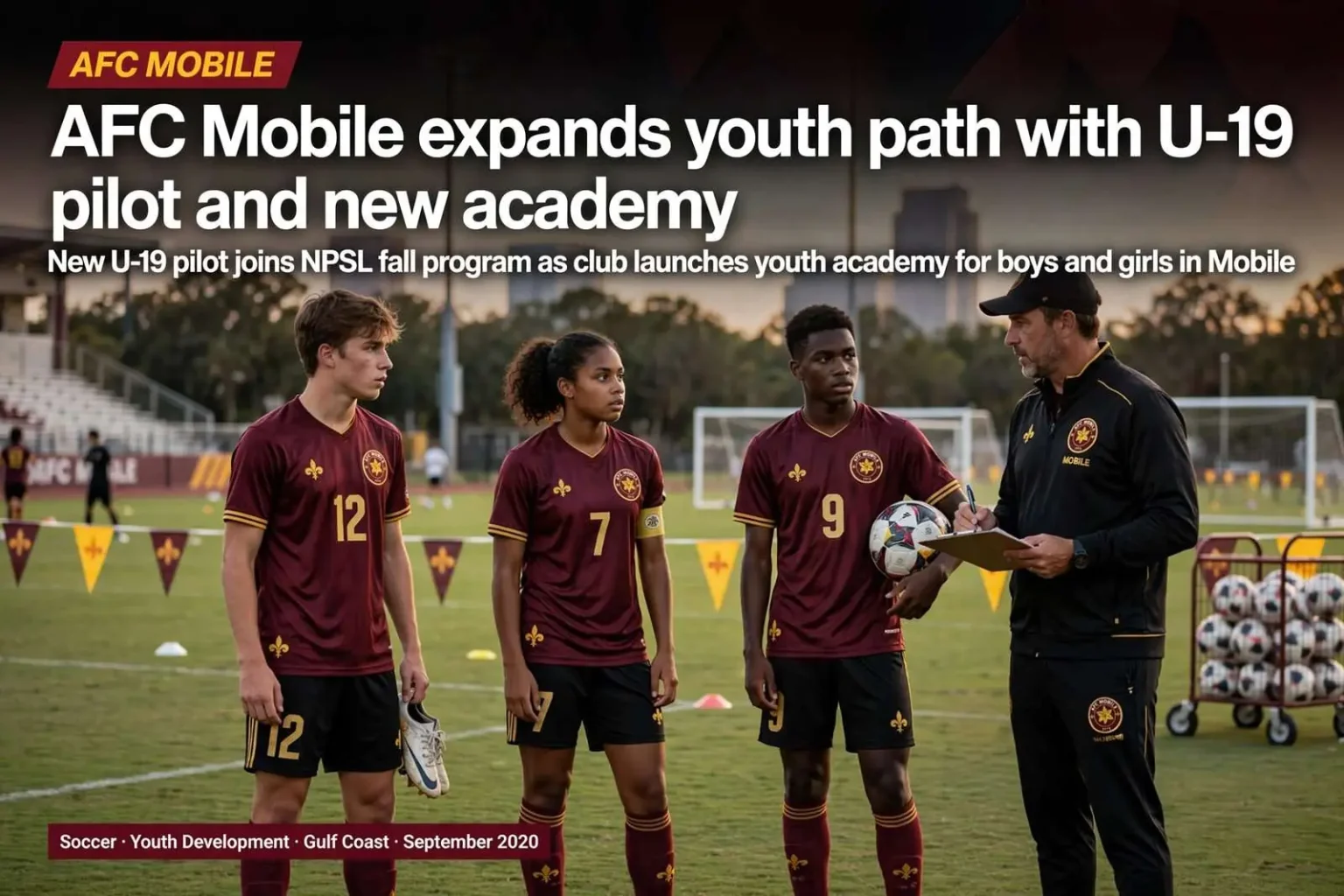
AFC Mobile is broadening its footprint beyond the senior team with a new youth development pathway. The club announced in July that it would join the National Premier Soccer League’s Under-19 pilot program, a fall effort that comes after the 2020 season was scrubbed in March. For a club that has grown rapidly since its founding, the move represents a deliberate answer to a question every ambitious Gulf Coast soccer organization eventually faces: where do the next senior players come from?
The pilot, run under the NPSL and affiliated with the U.S. Adult Soccer Association, includes AFC Mobile, the New Orleans Jesters, Pensacola FC and Port City FC. Each team plays six games from September through November, three home and three away. Game-day rosters are made up of U-17, U-18 and U-19 players, with up to three overage players allowed per team. “As of right now, the U-19 pilot program is still on for the fall, although we don’t have official match dates set,” said Mitchell Kahalley, AFC Mobile’s director of communications. The regional format gathers four Gulf Coast clubs into a compact competitive loop — short travel, familiar opponents, and meaningful minutes for teenage players at a level above ordinary youth leagues.
“The introduction of a U-19 pilot under the NPSL umbrella represents our commitment to grassroots soccer and supporting our teams’ growth potential,” NPSL Chairman Kenny Farrell said in a release. “This new venture positions our clubs to further refine the local pathway to the top level of soccer in their area. Players from all backgrounds will have access to a highly visible platform to showcase their talent — particularly in geographic areas where opportunities are limited.” The league’s framing is significant: the NPSL, a national league with hundreds of clubs, chose to test the U-19 concept in exactly the kind of markets — Mobile, Pensacola, the Gulf Coast — where elite youth pathways have historically been thin.
AFC Mobile co-owner Sean Landry said the pilot mirrors what the conference wants from its academies: “a direct relationship with a pathway to our senior team.” “It’s exciting that the NPSL is providing new and challenging developmental opportunities for the young players in Mobile, on the Gulf Coast and, hopefully soon, throughout the country,” he added. That first sentence is the club’s whole strategy in miniature — not a stand-alone youth program, but an on-ramp, with the U-19 squad feeding the first team that plays at the Stadium at Memorial Park in front of Mobile’s growing soccer crowd.
Wieczorek Takes the U-19 Reins
First-team coach Steve Wieczorek, who guided AFC Mobile to the GCPL Cup playoffs in 2019, will lead the U-19 squad. Wieczorek has also coached the Spring Hill College men’s team since 2015; he led the Badgers to a 12-3 finish and a second-place Gulf South Conference showing in 2017, the program’s best mark to that point, then topped it in 2018, when Spring Hill became the only team in Gulf South Conference history to go undefeated in conference play while sweeping the regular-season and tournament titles. He is the winningest head coach in program history. Wieczorek’s dual role is deliberate: the same coach who sets standards for the senior team now supervises the players who might one day meet them, ensuring the tactical language, fitness expectations and professional habits are identical at both levels. Continuity of coaching is what separates a true development pathway from a marketing label.
The U-19 pilot’s fall schedule — six matches against the Jesters, Pensacola FC and Port City FC — gives Wieczorek a competitive laboratory. Gulf Coast derbies against regional rivals carry intensity that exhibition matches cannot replicate, and for players weighing whether they have a future beyond youth soccer, a playoff-caliber league is the honest test. The format also mirrors the senior club’s own conference play, so the transition from U-19 matches to first-team fixtures involves no change in rhythm or travel demands.
The Academy Launch
The club also plans to launch a youth academy this fall. Organizers say the goal is to develop players of all ages in Mobile and surrounding communities through a shared system of coaches and training philosophy. The academy will field teams for both boys and girls, and its first teams will be built from the players and coaches of the former Mobile Texans youth club, previously a satellite program of the Pensacola-based Gulf Coast Texans, whose roster and staff now form the nucleus of the AFC Mobile academy.
Absorbing the Texans’ players and coaches rather than starting from scratch gives the academy an immediate foundation: existing team structures, families already committed to the club, and coaches who know the local talent pool from years on the sidelines. The shared philosophy that organizers describe — one coaching system running from the youngest academy groups to the senior team — is the model that established clubs in larger markets have used for decades, and AFC Mobile is attempting to compress that development timeline into a single fall.
“As of right now, we’re still planning on going ahead with Academy training,” Kahalley said of the pandemic’s possible effect on the timeline. “This is a step we’ve been talking about for a few years, but we wanted to make sure we could execute our vision and do things the right way,” Landry said. “The AFC Mobile Academy will enable us to dedicate ourselves to producing the next generation of AFC Mobile players and supporters. We’re committed to producing players who are passionate and knowledgeable about the game and their community.”
Wieczorek, who is completing a doctorate in sports management, will serve as technical director, with former Texans director of coaching and Indiana University forward Craig Ginsberg joining him as academy director. “With the AFC Mobile Academy, the senior club is creating a clear pathway for young players to reach their highest potential and develop a lifelong love for the game,” Wieczorek said. Landry called him “unbelievably passionate about our club and its growth,” adding, “I’ve rarely encountered anyone with the technical and coaching knowledge he has.” The combination pairs an academic’s understanding of player development with a practitioner’s knowledge of the local youth landscape — a pairing the club clearly views as the intellectual spine of its new pathway.
What the 2020 Scrub Meant
The announcement in July came with the senior team’s own season in limbo — the NPSL’s 2020 campaign was scrubbed in March as the coronavirus pandemic shut down sports nationwide. For AFC Mobile, a club that had built momentum through its first-team seasons and its 2019 playoff run, the lost season threatened to be a year of standing still. The U-19 pilot and the academy launch turned that idle year into a pivot point: rather than waiting for senior competition to resume, the club built the youth infrastructure it had been planning anyway.
The pandemic context also shaped the pilot’s appeal. With high school seasons disrupted and showcase events cancelled, 2020 offered young players few legitimate stages on which to be seen. A six-game competitive league against regional opponents — organized, officiated and recorded — restored some of that visibility at precisely the moment it had disappeared. Farrell’s point about “a visible platform in areas where opportunities are limited” was never more literal than it was that fall.
The Regional Context
The pilot’s four clubs map the central Gulf Coast’s soccer geography. The New Orleans Jesters bring an established NPSL pedigree from a market with a deep soccer culture; Pensacola FC and Port City FC extend the network across the Florida line and into Mississippi’s coast; AFC Mobile anchors the Alabama side. A U-19 league among these clubs creates natural regional rivalries at the youth level — the same opponents the senior teams meet, producing the same derby atmosphere in miniature — and keeps talented teenagers in Gulf Coast pathways rather than watching them leave for Atlanta, Dallas or Florida’s saturated youth markets.
For Mobile families, the practical significance is access. A player in West Mobile or Satsuma can now progress through a locally based academy into a U-19 league and, in theory, into the first team, without the relocating and paying that elite pathways elsewhere demand. Whether every player makes that full climb is beside the point; the pathway itself changes what soccer in Mobile means for the players living in it.
Interested players can reach the club at [email protected] or visit afcmobile.net. With the U-19 pilot kicking off in September, the academy launching this fall, and Wieczorek’s dual-role structure in place, AFC Mobile enters the post-scrubbed-season era with more of a future mapped out than it had when 2020 began.
Why the NPSL Chose the Gulf Coast
The NPSL’s decision to pilot its Under-19 program with these four clubs says something about where American soccer development is heading. The league’s senior ranks have long served as a summer proving ground for college players, but the U-19 pilot extends that model downward, to the age group where professional academies traditionally begin identifying talent. In markets without Major League Soccer academies or developmental academies of their own, the NPSL structure offers the closest equivalent: organized competition, senior-level coaching and a documented league table that college and professional scouts can read.
The Gulf Coast pilot clubs also share a practical advantage: proximity. A league in which every away trip is a bus ride — Mobile to New Orleans, Pensacola to Gulfport — keeps costs low for clubs operating on volunteer energy and local sponsorship, and it keeps players in school, at home and on the pitch. Larger national youth leagues demand travel budgets that many Mobile families cannot justify; a regional loop asks for an afternoon on I-10.
The timing, September through November, fits the Gulf Coast calendar as well. Fall soccer here avoids the worst of the region’s summer heat, conflicts less with the senior NPSL season, and positions U-19 players to head into the spring club and high school cycles with competitive form already established.
Building From the Texans’ Foundation
The decision to build the academy’s first teams from the former Mobile Texans youth club deserves attention as a strategic choice. Starting a youth academy from nothing means recruiting players one family at a time against entrenched local clubs — years of work before the first meaningful squad takes the field. Adopting the Texans’ teams, coaches and families imports an operating organization wholesale, complete with the team cultures and volunteer networks that make youth clubs actually function.
Ginsberg’s role as academy director alongside Wieczorek bridges the transition. As the Texans’ former director, he knows every player in the pipeline — their tendencies, their families, their ambitions — and can translate that knowledge into a technical structure designed for players whose endpoint might be the AFC Mobile first team rather than another year of recreational soccer. The club’s description of a “shared system of coaches and training philosophy” depends on exactly this kind of continuity between the old club and the new structure.
Wieczorek’s doctorate in sports management adds an academic dimension to the project that few clubs this size can claim. His research-era understanding of how development pathways succeed — how many touches, what coaching ratios, which competitive structures retain players — informs the design rather than arriving after the fact. For a club whose senior team plays its home matches in front of a growing local crowd, the combination of rigorous planning and local talent retention is the bet: that Mobile’s kids, given a real pathway, will fill it.