AL-01 Candidate Bradley Byrne Points to Two-Year College Cleanup in Bid for Congress
First District candidate Bradley Byrne cites his two-year college cleanup, $70 million in cuts and the Airbus moment in his 2013 campaign for Congress.
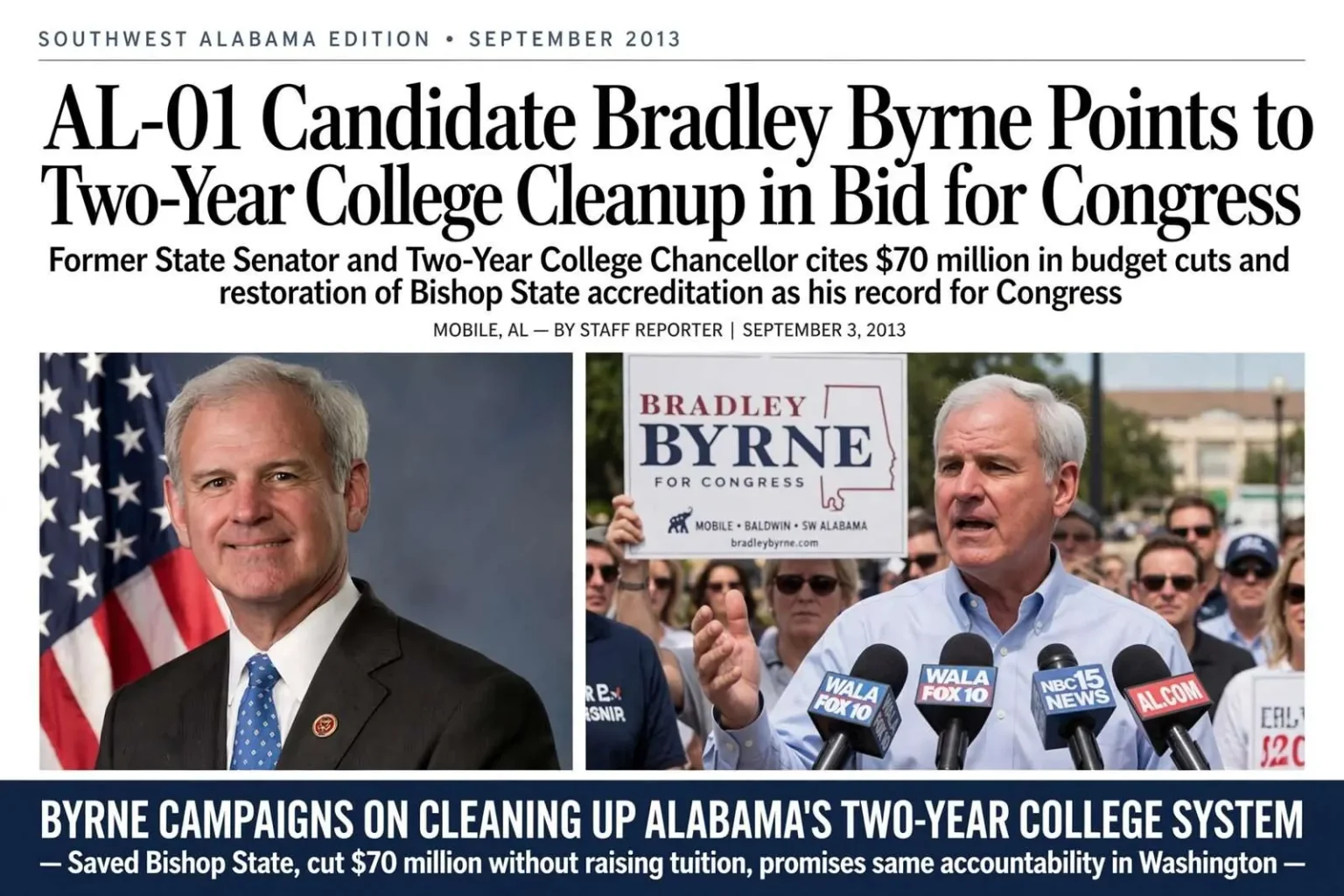
Bradley Byrne, a Mobile native running for the First Congressional District seat, made his case to Southwest Alabama voters in September 2013 by leaning on his record cleaning up Alabama’s scandal-plagued two-year college system — a chapter of state government that had, years earlier, consumed headlines across Alabama and landed the state’s community college network in federal courtrooms.
Byrne’s argument to voters was straightforward: he had taken on one of the most entrenched political machines in Alabama government and fixed it, and that experience — more than any speech — was the qualification he offered for Congress. For voters in the district, which stretches from Mobile and Baldwin County across southwest Alabama, the record was familiar history, and that familiarity was the point of his campaign.
From statehouse to chancellor’s office
Byrne cited eight years on the State Board of Education and five years in the State Senate before Gov. Bob Riley tapped him as chancellor of the two-year college system. That path gave him an unusual vantage point: he had watched the system as an elected board member and legislator, then been handed responsibility for it at the moment of its deepest crisis.
He took over amid successive scandals and federal investigations rooted in decades of political cronyism — no-show jobs handed to legislators, back-room deals and widespread waste. The two-year college scandal was among the worst public-corruption episodes in modern Alabama history: investigations by federal prosecutors uncovered that legislators and their allies had been placed on community college payrolls for work they never performed, that college resources had been steered into political campaigns, and that the system’s leadership had tolerated the arrangements for years. The revelations led to convictions, guilty pleas and a sweeping loss of public confidence in institutions that were supposed to be training Alabama’s workforce.
The damage reached into Mobile directly. Bishop State Community College in Mobile, he noted, had been on the verge of losing its accreditation and closing its doors — a prospect that would have stripped the city’s students of an institution that had served the community for generations and removed a linchpin of local workforce training.
What the cleanup accomplished
Byrne said that during his tenure the system cut more than $70 million from its budget without raising tuition or eliminating a single essential program. The number is the measure of the waste the system had accumulated: administrative bloat, redundant positions and the patronage payroll itself, all of which had been sustained by the political arrangements the investigations exposed. Trimming it without touching instruction or tuition was the balancing act the chancellor’s job demanded — prove the system could live within its means while keeping classrooms open and costs on students unchanged.
He also cited two broader results. The system restored Bishop State’s reputation, pulling the Mobile institution back from the accreditation crisis that had threatened its existence. And it overhauled the workforce training delivery system while working with economic developers in the state, nationally and internationally — an effort aimed at making the two-year colleges an actual engine of job creation rather than a payroll patronage machine. In Alabama’s economic development model, where recruited industries routinely ask about workforce pipelines before they commit, the credibility of the community college system is a genuine competitive asset, and Byrne argued his tenure rebuilt exactly that credibility.
A ‘magic moment’ for Mobile
Looking at the district’s economy, Byrne pointed to Airbus and Austal as proof the Mobile area was drawing national and international attention in industry-recruiting circles.
The two names anchored Mobile’s economic story of the era. Austal’s shipyard on the Mobile River had grown into a major defense contractor, building the U.S. Navy’s littoral combat ships and employing a workforce that expanded year after year — the largest new manufacturing story on the Gulf Coast. Airbus’s decision to build its first U.S. assembly line at the Brookley Aeroplex, announced in 2012, put Mobile into a category no American city outside the traditional aerospace centers had occupied: home to a final assembly line for the world’s largest commercial aircraft maker. Together they signaled to site selectors worldwide that Mobile could win global industry, and Byrne called it a magic moment for the Mobile area.
His conclusion from that moment was about representation. He argued the district needed a representative in Washington with the courage to stand up for the region’s interests — and, in his words, someone who wouldn’t back down no matter how hard it got. The framing connected his two-year college record to the congressional job: both, in his telling, required confronting entrenched interests and holding a position under pressure, whether the opponent was a patronage network in Montgomery or the competitive pressures of global economic development.
The race he entered
Byrne was among the candidates who accepted an invitation to address readers in their own words during the campaign for the seat vacated by Jo Bonner, a race that drew national attention to southwest Alabama in the fall of 2013.
The special election was one of the most closely watched congressional contests in the country that season, and its intensity reflected the unusual circumstances: a safe Republican seat suddenly vacant, a large field of well-known candidates, and a compressed campaign calendar that forced the contenders to introduce themselves to voters in a matter of weeks. Mobile County, Baldwin County and the district’s rural counties each represented distinct electorates, and the campaign sprawled across them from the summer onward.
Byrne’s positioning within that field rested on the record he described to voters: a former state senator and state school board member, a former chancellor who had taken on the two-year college establishment, and a candidate whose central claim was that he had already done the hardest kind of public work — cleaning up a corrupted institution — and could be trusted to do the same kind of work in Washington.
Why the two-year college record mattered politically
The cleanup story gave Byrne something most candidates lack: a specific, verifiable, high-stakes accomplishment that voters could evaluate. Alabama’s two-year college scandal had touched communities across the state — including districts within the 1st Congressional District — and the memory of no-show jobs and federal investigations was still fresh in 2013. A candidate who could say he cut the patronage, saved Bishop State, cut $70 million without raising tuition and rebuilt workforce training was telling a story with names and dates behind it, not abstractions.
It also fit the district’s economic moment. With Austal scaling up and Airbus building toward its Mobile opening, workforce training was the central question for the region’s next decade: whether local institutions could supply the skilled workers the new industries required. Byrne’s argument was that he had spent his tenure making the two-year college system answer that question — and that Congress, for a district riding an industrial boom, needed a representative who understood both the economic development game and the training infrastructure beneath it.
That was the case Bradley Byrne presented to Southwest Alabama voters in September 2013: a Mobile native, a veteran of the state senate and state school board, the chancellor who cleaned up the two-year college system, and a candidate who believed the district’s magic moment demanded a fighter in Washington who would not back down.
The district and its economy
Alabama’s First Congressional District encompasses Mobile County, Baldwin County and a swath of southwest Alabama that includes Washington, Clarke, Monroe, Escambia and surrounding counties. Its economy is layered: the Port of Mobile and the maritime industries around it, the shipyards and aerospace plants of the Mobile area, the tourism and construction economy of Baldwin County’s Eastern Shore and beaches, and the timber, agriculture and small manufacturing that anchor the rural counties inland. A representative from the district splits time between those constituencies, and candidates for the seat traditionally build their campaigns around economic development — the belief that the region’s growth depends on attracting and keeping major industry.
Byrne’s emphasis on Airbus and Austal followed directly from that tradition. Both companies represented the kind of high-wage, export-driven manufacturing the district had spent decades pursuing, and both had landed in Mobile in part because of the state’s incentive programs and workforce commitments — the very systems Byrne had helped steward from his seats on the state school board and, later, the chancellor’s office. His pitch asked voters to connect those dots: economic development, workforce training and political representation as a single chain.
Lessons of the cleanup era
The two-year college scandal reshaped how Alabama thought about its workforce institutions. In its aftermath, the legislature tightened ethics laws, the state board imposed new governance rules on the college system, and chancellors who followed were charged with maintaining the reforms against any backsliding. The episode became a standing case study in what patronage costs a state: beyond the direct waste, it eroded trust in institutions that rural and urban communities alike depend on for job training and education.
For candidates who lived through it, the era also became a credentialing test. Alabama voters of that generation had watched corruption investigations sweep through Montgomery and beyond, and a politician who could document a fight against that corruption — rather than mere association with reform rhetoric — carried a distinctive claim. That was the political meaning of Byrne’s September 2013 message: not simply that he held office during the cleanup, but that he had been placed at its head by a reform-minded governor and could point to measurable results.
Workforce training as the district’s future
The overhaul of workforce training delivery that Byrne described anticipated the question that would define the Mobile area’s economy through the following decade: whether local workers would fill the jobs that Airbus and Austal created. Assembly lines for commercial aircraft and advanced warships require precision skills — welding, avionics, systems integration, quality control — and industries of that scale choose locations partly on the strength of the training pipelines beneath them. Community colleges are those pipelines.
Byrne’s account of working with economic developers in the state, nationally and internationally, reflected that reality. Modern industrial recruitment is a team effort among state incentives, local governments, utilities and colleges, and the chancellor who overhauled training delivery was, in effect, building the piece of the pitch that convinced companies their workforce would exist. His argument to voters in 2013 was that this experience translated directly to Washington, where federal support for workforce programs, ports and defense contracts shapes the same economic machinery he had worked from Alabama.
Whatever weight voters gave each element, the September case he presented was complete on its own terms: a Mobile native with eight years on the state school board and five in the senate, the chancellor who cut $70 million and saved Bishop State, and a candidate who saw a magic moment in Mobile’s economy that demanded a representative who would not back down.