Alabama artist Trés Taylor brings a peace project to Fairhope’s Eastern Shore Art Center
Alabama artist Trés Taylor brings a peace project to Fairhope's Eastern Shore Art Center Reported by South Alabama News from local coverage of the Mobile.
For Alabama artist Trés Taylor, the turn from science to painting became a path to something deeper than a career. This winter, that path leads to Fairhope, where Taylor’s “enCHANTment” exhibition fills the Eastern Shore Art Center at 401 Oak St., built around a towering monument to peace that visitors can walk inside.
The Eastern Shore Art Center has anchored the arts in Fairhope for decades, occupying a spot in the heart of the downtown business district where galleries, studios and classrooms sit within walking distance of Mobile Bay. The center hosts rotating exhibitions in its galleries along with art classes and community programs, and its schedule of openings and artist events has made it a focal point for the town’s long-standing creative community. Taylor’s exhibition brings a distinctly Alabama voice into those galleries, in keeping with the center’s habit of pairing regional artists with work drawn from farther afield.
Fairhope itself is a fitting stage. The town was founded in 1894 by settlers from the Midwest who came seeking a fair hope of prosperity on a single-tax utopian model, and it has cultivated artists, writers and free spirits ever since. Generations of painters and craftspeople have shown along its oak-lined streets, and the annual arts and crafts festival that draws thousands to the shore each spring grew out of that same tradition. An exhibition centered on prayer and peace finds a natural home in a town built on idealism.
From biochemistry to house paint
Taylor’s route to the easel was anything but conventional. He once worked as a biochemist, a career of laboratories and data, before a visit with outsider artist R.A. Miller inspired him to change directions. Miller, a Georgia folk artist whose metal cutouts and whirligigs made him one of the South’s most beloved self-taught artists, left a mark on Taylor that reshaped his life, and Taylor has often credited that encounter with opening the door to art as a calling rather than a hobby.
Miller’s influence places Taylor in the lineage of Southern outsider art, a tradition that includes Alabama masters such as Bill Traylor and Mose Tolliver and Georgia’s Howard Finster, artists who worked outside the gallery system and made art from whatever materials were at hand. Like those predecessors, Taylor is self-taught, and his materials are plain and unpretentious: he works in house paint on tarpaper, the tar-saturated paper used in roofing, letting the gritty surface carry figures and symbols rendered in bold, immediate strokes.
The choice of material is part of the point. Tarpaper, bought by the roll and painted straight from the can, ties Taylor’s work to the everyday world of roofs, sheds and work clothes, and it gives his figures a rough-hewn presence that polished canvas rarely matches. Collectors across the United States and in Japan have taken notice, and his results have earned him shows across the two countries, a reach that began with work made in a spirit closer to devotion than to commerce.
The Jolly Lama at the center
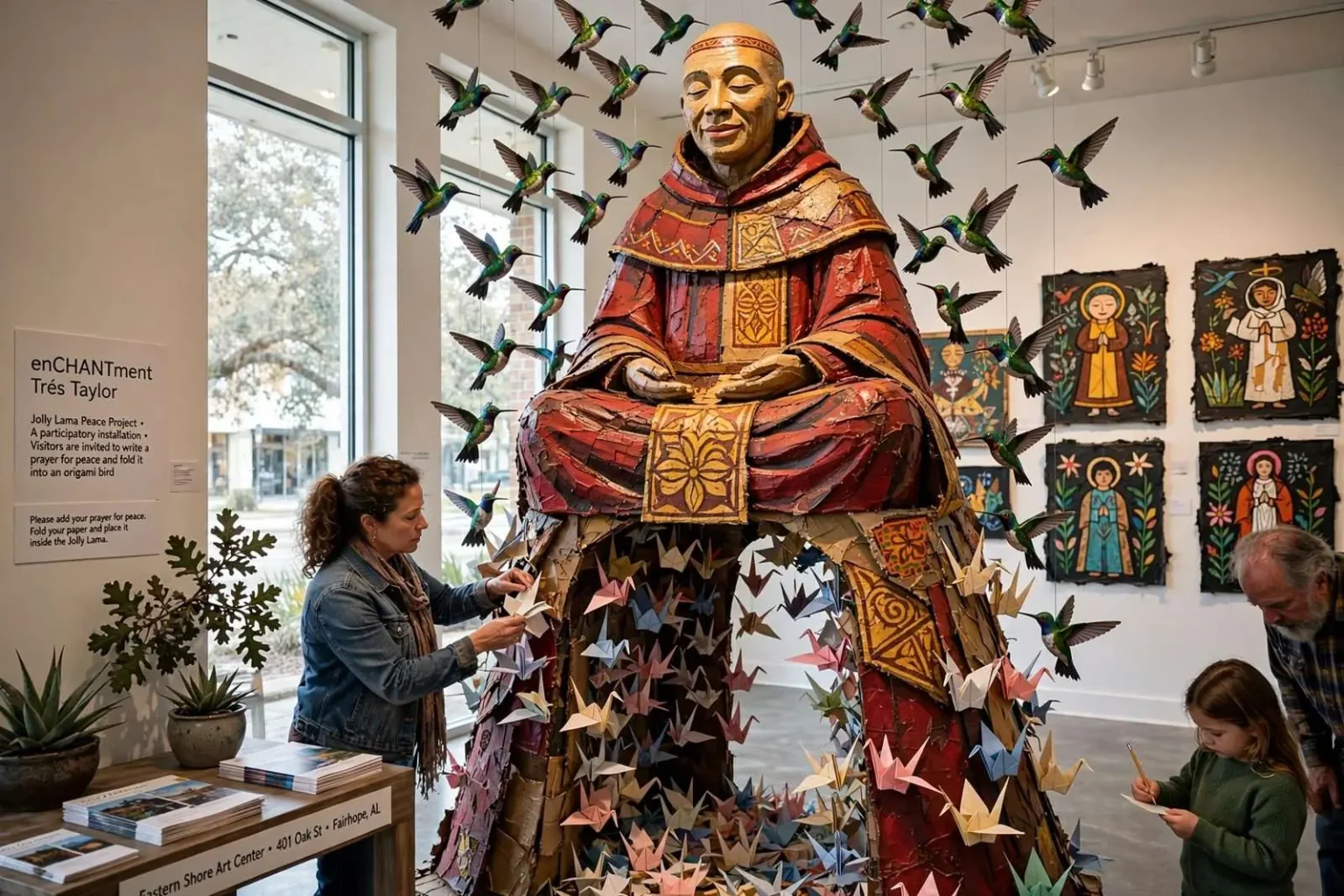
At the heart of “enCHANTment” stands the Jolly Lama Peace Project, a 15-foot sculptural monk draped in red and gold beneath a cascade of hummingbirds. The figure borrows its look from Tibetan Buddhist imagery, the crimson and saffron robes of monastic tradition rendered in Taylor’s signature painted style, and it rises through the gallery space as both sculpture and shelter. The hummingbirds that swirl around it add motion to the composition, a swarm of small, bright messengers circling a figure of stillness.
Visitors are invited inside the structure, and that invitation carries the exhibition’s central act. Inside, guests jot down prayers for peace, which volunteers then fold into origami birds that join the display, so that the artwork grows one folded wish at a time for as long as the show is up. The piece treats peace not as a finished image on a wall but as an accumulation of individual intentions, gathered from everyone willing to pause and add one. By the time the exhibition closes, the monk will hold within it the handwritten hopes of hundreds of Eastern Shore visitors.
Participatory work of this kind has become one of the most engaging forms in contemporary art, dissolving the line between viewer and maker. In Taylor’s practice it also fits naturally: an artist who paints with the materials of everyday life has built a monument that anyone can complete. Children fold their first paper cranes beside grandparents writing careful prayers, and the gallery becomes something closer to a chapel than an exhibition hall.
The project previously appeared in Birmingham during the Dalai Lama’s October visit, giving it a provenance that few Alabama artworks can claim. The exiled Tibetan spiritual leader’s appearance drew one of the largest crowds in the city’s recent history, and the Jolly Lama stood within that moment as a local echo of the message that brought the world’s attention to Birmingham. Bringing the piece to Fairhope extends that ripple across Mobile Bay.
The exhibition’s title, “enCHANTment,” gestures at the mixture of play and reverence that runs through Taylor’s work. His figures, saints and simple souls rendered in house paint, have always carried a devotional air without ever becoming solemn, and the Jolly Lama continues that balance: a monumental spiritual figure that smiles, surrounded by hummingbirds and staffed from within by the prayers of whoever walks in.
For the Eastern Shore Art Center, the show is also a demonstration of the range that regional galleries increasingly offer. The same halls that host watercolor societies and photography clubs are welcoming large-scale installation and participatory art, giving Baldwin County audiences access to work that once required a trip to Birmingham, Atlanta or New Orleans. Exhibitions like this one blur the old line between folk art and contemporary practice, presenting Taylor’s tarpaper paintings and his sculptural monument side by side as a single, unified vision.
Teachers and families have particular reason to take note. A 15-foot monk that visitors enter, write within and help complete is the rare exhibition that welcomes children as collaborators rather than bystanders, and the act of folding a prayer into an origami bird gives young visitors a tangible lesson in both art-making and intention. School groups and art classes in the area have long used the center’s galleries as extended classrooms, and this installation practically teaches itself.
Times and details
The show closes Jan. 10, giving visitors a limited window to add their prayers to the project before the monk and the paintings move on. Taylor will be on hand Jan. 9 at 3:30 p.m. to talk with visitors about his work, a rare chance to hear the artist describe his journey from biochemistry to art, his years of friendship with R.A. Miller and the thinking behind a peace monument that visitors are invited to complete themselves.
The Eastern Shore Art Center is open Tuesday through Friday, 10 a.m. to 4 p.m., and admission to the galleries is free, keeping the exhibition accessible to everyone from downtown strollers to school groups and winter visitors along the Eastern Shore. The center sits at 401 Oak St. in downtown Fairhope, within easy walking distance of the town’s shops and restaurants, and a visit pairs naturally with an afternoon on the bluff above Mobile Bay.
For Taylor, the exhibition is the latest chapter in a career that began with a visit to a Georgia artist’s yard and grew into shows across the United States and in Japan. For Fairhope, it is a season of enchantment in the most literal sense, a gallery turned gathering place where the town’s founding idealism gets painted in red and gold, feathered with hummingbirds, and folded one prayer at a time.
The interest from Japan is worth a pause of its own. Japanese collectors and curators have long shown an affinity for American self-taught art, valuing the directness and spiritual current that run through work made outside academic training, and Taylor’s figures have found an audience there alongside other Southern outsider painters. For an Alabama artist working in roofing paper and hardware-store paint, international attention of that kind is a reminder that the region’s visual tradition travels farther than its reputation sometimes suggests.
Taylor’s story also speaks to a question many working adults carry quietly: what to do with a gift that arrived late. He did not come to painting through art school or youthful ambition, but through an encounter in middle life that reorganized his priorities, and he has built from that encounter a body of work recognized on two continents. Visitors who hear him speak on Jan. 9 will hear that story firsthand, including the practical and spiritual turns it took to leave a laboratory career for a life measured in tarpaper sheets and cans of house paint.
For now, the invitation stands. The Jolly Lama waits beneath its hummingbirds at the corner of Oak Street, ready to receive a few more folded prayers before the show closes on Jan. 10, and the Eastern Shore Art Center’s galleries hold one of the more memorable exhibitions the bay has seen this winter.