
Alabama Contemporary Art Center Opens ‘Sister Shores’ Exhibit Exploring Mobile’s Cultural Ties to Cuba
The Alabama Contemporary Art Center's Sister Shores exhibit pairs portraits of Cuban residents with their stories, previewing its Back to Havana show.
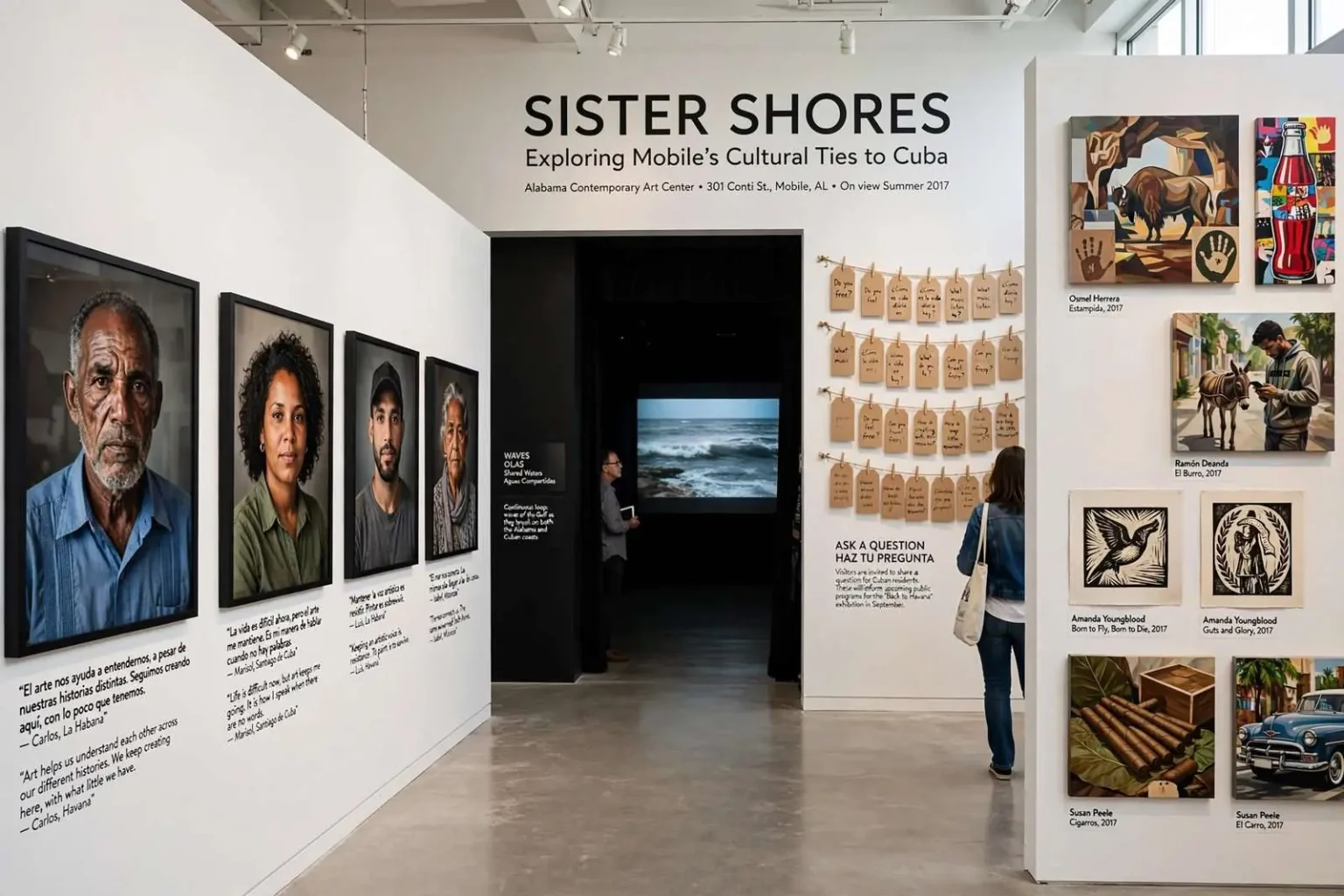
MOBILE, Ala. — The Alabama Contemporary Art Center at 301 Conti St. in downtown Mobile is examining the Gulf’s connection to Cuba with “Sister Shores,” an exhibition built around portraits of Cuban residents and their own words about life on the island. The show places Mobile’s long cultural and geographic kinship with Cuba at the center of the gallery, and it marks the opening move in a longer slate of Cuban programming the center has planned.
Visitors are greeted by a dozen large-format portraits of Cuban citizens, each paired with conversational excerpts gathered by Eastern Shore writer Lynn Oldshue and printed in both English and Spanish. The bilingual presentation is central to the exhibition’s approach: the subjects speak for themselves, in their own translated words, rather than being filtered through wall text written about them.
Photographer Michele Stancil, who collaborates with Oldshue on the magazine The Southern Rambler, shot the portraits, drawing on her earlier reporting trips to Cuba. The two Gulf Coast creatives built the portrait-and-interview format through their magazine work, pairing images with extended conversation, and the exhibition carries that editorial sensibility into a gallery setting.
Many of the quoted subjects speak to economic fragility on the island and the struggle to keep an artistic voice alive. One artist told Oldshue that art helps people understand one another across personal histories, a theme that runs through the exhibition’s pairing of image and text. The remarks collected in the show are conversational rather than formal — reflections on daily life, work and creative practice recorded the way they were spoken.
Waves, Questions And Shared Water
Near the portraits, a small black-box theater runs a continuous loop of waves breaking along an urban shoreline — a nod to the ocean currents and storms the Gulf Coast shares with the island. The installation ties the two shores together through the water between them: the same currents that carry weather toward the Alabama coast shape the Cuban shoreline, and the same hurricane seasons touch both.
On the opposite side of the entrance, visitors are invited to scrawl questions on paper tags hung from draped strings. The queries collected, ranging from “Do you feel free?” to lighter fare, will feed public programming for the center’s larger “Back to Havana” exhibition planned for September 2017. The question wall turns the audience into a contributor, and the center plans to draw on what visitors actually ask as it builds panels, discussions and events around the larger show.
The device also mirrors the exhibition’s core method. Just as the portraits pair a face with an unguarded quote, the question wall pairs a visitor with an unpolished question, hung in public for the next visitor to read. The accumulated tags become a running record of what Mobile wants to know about Cuba — a curatorial input as much as an audience exercise.
Paintings Along The East Wall
Paintings line the east wall, including Osmel Herrera’s playful “Estampida,” which mixes imagery from the Altamira cave paintings with a modern soft-drink logo. The collision of prehistoric art and commercial branding is characteristic of a generation of Cuban artists working with borrowed symbols, layering the island’s deep history against the global consumer imagery that reaches it.
Nearby hangs Ramon Deanda’s “El Burro,” in which a man tows a donkey cart while absorbed in his phone. The painting compresses old and new Cuba into a single image — an animal-drawn cart that would have looked unchanged for a century, pulled past a figure whose attention is fixed on a device that did not exist a generation ago.
Local artists appear as well: Mobilian Amanda Youngblood contributes the woodcuts “Born to Fly, Born to Die” and “Guts and Glory,” while Susan Peele shows four large paintings of archetypal Cuban scenes — cigars, an old car and a guitarist. Including local artists alongside Cuban and Cuba-focused work is the point of the show: the Gulf Coast and the island are presented as artistic neighbors whose imagery has long flowed in both directions.
Youngblood’s woodcuts bring the region’s own printmaking tradition into the conversation, while Peele’s large canvases collect the images most visitors already associate with Cuba — vintage automobiles, cigars, music — and give them formal weight on the gallery wall. The contrast between the visiting photographers’ documentary portraits and the local painters’ symbolic scenes frames two ways of looking at the island from across the Gulf.
An Early Step In A Longer Arc
Center officials describe the show as an early step in a longer arc of programming. Additional Cuban artwork will arrive in September alongside a film series surveying Cuban cinema, building toward the larger “Back to Havana” exhibition planned for the same month. The sequencing is deliberate: “Sister Shores” introduces the themes and the audience, and the fall programming expands them.
The Alabama Contemporary Art Center has built its reputation on new work by living artists rather than a permanent collection, which makes a show like “Sister Shores” a natural fit — the portraits, paintings and installations on view are all recent, and the conversation they stage is contemporary rather than historical. The center’s downtown location on Conti Street places it within walking distance of the historic districts where Mobile’s Cuban trading ties were formed generations ago.
Mobile and Cuba share more than proximity. The port cities traded with each other for more than a century, weather systems move between their shores each hurricane season, and generations of Gulf Coast families have family stories that cross the Florida Straits. “Sister Shores” gives that relationship a contemporary artistic form, built from the faces and words of people living on the other shore.
What Visitors Will Find
Visitors moving through the exhibition encounter three distinct registers: the documentary intimacy of the portrait wall, the sensory loop of the black-box theater, and the participatory question strings near the entrance. The east-wall paintings tie the room together, giving visitors scenes to study at length after the quicker encounters with photography and sound.
The bilingual wall text is more than a courtesy. Spanish-first presentation keeps the Cuban subjects as the primary voices in the room, with English translations alongside, and it reflects the bilingual reality of the Gulf Coast itself — a region where Spanish is spoken in ports, restaurants, churches and neighborhoods from Tampa to New Orleans, including Mobile’s own growing Hispanic community.
Admission details and programming dates for the film series and the September “Back to Havana” exhibition are available through the center, which has framed the summer show as the first chapter of a sustained engagement with Cuba rather than a single exhibition. As the question wall fills with tags, the center will be able to shape its fall programming around the questions Mobile residents are actually asking.
Why The Gulf Coast Is Looking South
For local audiences, the exhibition lands in a region where interest in Cuba has grown alongside easing travel and cultural-exchange rules, with Gulf Coast ports, universities and arts organizations all building connections to the island. Mobile’s cultural institutions have increasingly looked to the broader Gulf as their frame of reference — an approach that treats the Gulf of Mexico not as a barrier but as the connective tissue of the region.
“Sister Shores” makes that argument visually. The waves in the black-box theater do not distinguish between shores; the currents and storms they evoke arrive on both. The portraits put faces on the other side of that shared water, and their words — about economic fragility, about keeping an artistic voice alive, about art helping people understand one another across personal histories — insist that the distance between Mobile and Havana is smaller than a map suggests.
The exhibition remains on view at the Alabama Contemporary Art Center, 301 Conti St., with hours and event details available from the center. Visitors who see it this summer will be watching the first installment of a programming arc that culminates in September with “Back to Havana,” a larger exhibition, new artwork from the island, and a film series — all shaped in part by the questions Mobile has already begun hanging on the wall.
The exhibition’s title points to the geography that frames all of it. Mobile sits on Mobile Bay, which opens into the Gulf of Mexico; Havana sits on the Gulf’s southern shore. Oceanographers and forecasters describe the Gulf as a single connected system, with the Loop Current, shared fish stocks and hurricane tracks that treat the 600 miles between the two cities as a short crossing. That shared water is the exhibition’s organizing metaphor, made literal in the wave loop playing in the black-box theater.
For the artists involved, the show also represents a Gulf Coast model of cultural reporting. Oldshue and Stancil built the portrait-and-conversation project the way journalists build any story: repeated trips, long conversations and photographs made in the subjects’ own surroundings. The exhibition preserves that texture, letting visitors read a fisherman, a dancer or a painter in the subject’s own words before moving on to the next portrait.