
Alabama Gulf Coast Recovery Council Opens Call for RESTORE Act Project Proposals Ahead of Oct. 1 Deadline
The Alabama Gulf Coast Recovery Council is accepting RESTORE Act project proposals for coastal recovery through Oct. 1, having already funded 46 projects worth $435 million.
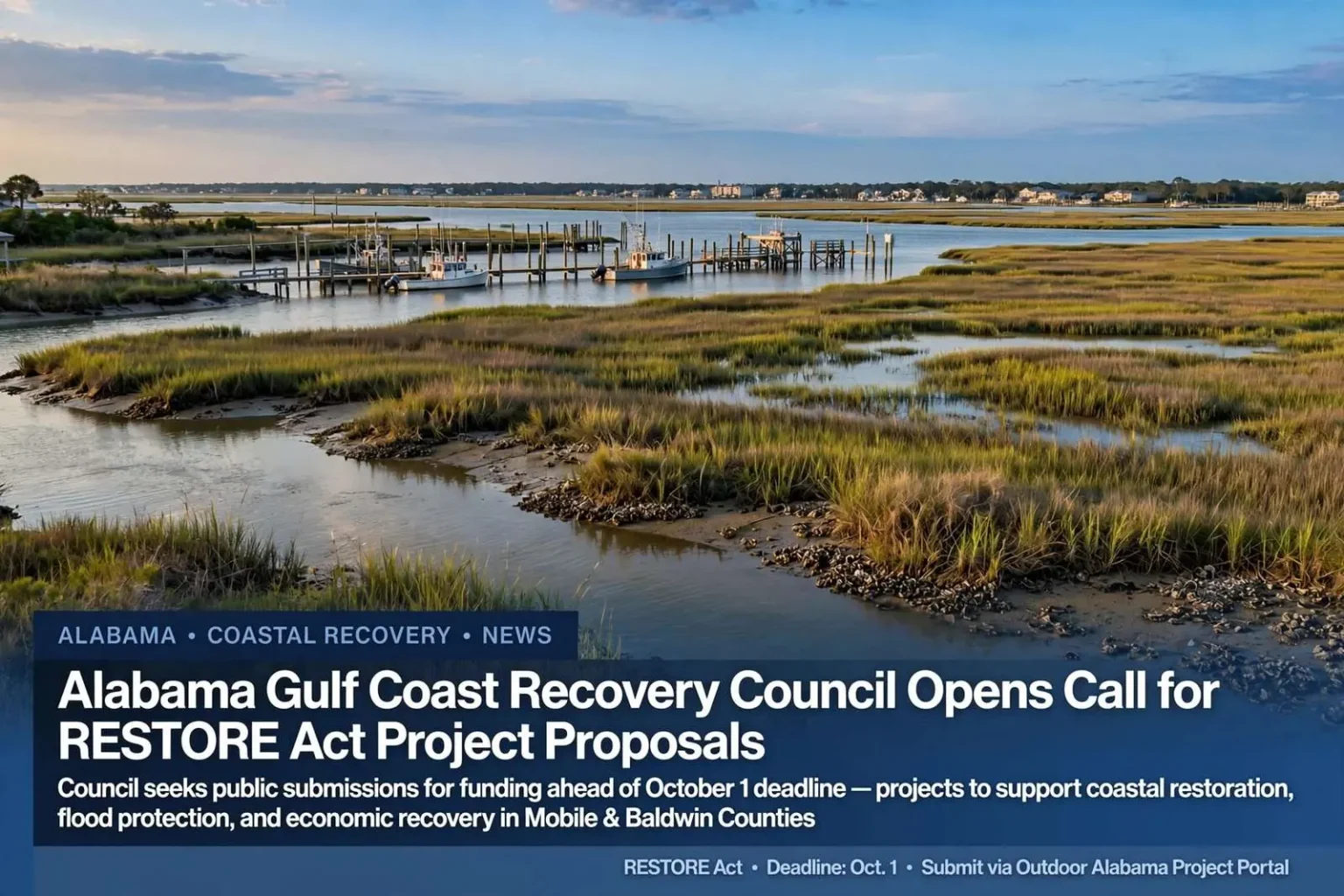
The Alabama Gulf Coast Recovery Council is calling on residents, businesses and local governments to submit project ideas for RESTORE Act funding as it continues prioritizing coastal recovery efforts stemming from the 2010 Deepwater Horizon oil spill. Submissions are due by Oct. 1, and the window represents one of the clearest opportunities yet for communities across Mobile and Baldwin counties to shape how the region’s share of oil spill money is spent. From waterfront towns like Bayou La Batre and Dauphin Island to the growing beach communities of Gulf Shores and Orange Beach, the projects funded under this process will touch nearly every corner of Alabama’s coastline.
The call for ideas is more than a routine paperwork exercise. The RESTORE Act directs billions of dollars in Clean Water Act civil penalties from the spill back to the five Gulf Coast states, and Alabama’s council is responsible for deciding which local projects rise to the top. With tens of millions of dollars in play and a list of funded projects already stretching across the coast, the submission period gives municipal leaders, nonprofit groups and ordinary residents a direct channel into a process that will influence the region’s environment and economy for decades.
The RESTORE Act — formally the Resources and Ecosystems Sustainability, Tourist Opportunities, and Revived Economies of the Gulf Coast States Act — was signed into law on July 6, 2012, in response to the spill. The legislation grew out of a recognition that the April 2010 disaster, which began with the explosion of the Deepwater Horizon drilling rig and became the largest marine oil spill in U.S. history, inflicted damage that went far beyond oiled beaches. Coastal economies built on tourism, seafood and commercial fishing absorbed enormous losses, and the ecosystem itself — from oyster reefs and seagrass beds to the wetlands that buffer the shoreline — needed sustained, science-based restoration rather than a one-time cleanup.
The Deepwater Horizon disaster began with an explosion aboard the drilling rig on April 20, 2010, and the resulting uncontrolled well release continued for 87 days, fouling waters and shorelines across the Gulf of Mexico and closing vast areas to fishing during the height of the season. Along Alabama’s coast, the economic ripple effects reached charter captains, seafood processors, beachfront businesses and the workers they employ, and images of oil-blackened water traveled far beyond the region, chilling the tourism trade even where sand stayed clean. Those years of disruption are precisely why the RESTORE Act paired environmental restoration money with economic recovery tools.
To guide that work in Alabama, the law created the Alabama Gulf Coast Recovery Council, known as the AGCRC, to guide how the state’s share of settlement funding is prioritized and spent. The council structure was deliberately designed to put coastal decision-making in local hands rather than leaving it entirely to federal agencies, pairing state leaders with the elected officials who represent the communities closest to the water.
Who sits on the council and how the money flows
The 10-member council includes the governor of Alabama, the director of the Alabama Port Authority, the president of the Mobile County Commission, the chair of the Baldwin County Commission, and the mayors of Bayou La Batre, Dauphin Island, Mobile, Fairhope, Gulf Shores and Orange Beach. The composition ensures that both of Alabama’s coastal counties are represented alongside the state’s largest city and its smaller, seafood- and tourism-dependent communities. It is a roster that spans very different constituencies: a working waterfront town known for its shrimp fleet, barrier island communities on the front line of storm impacts, and resort cities whose economies rise and fall with the health of the beaches.
The council oversees two funding streams: the Direct Component, known as “Bucket 1,” and the Spill Impact Component, known as “Bucket 3.” The Direct Component flows to the council based on a formula tied to spill impacts, giving local officials direct authority over a steady stream of funding for eligible projects. The Spill Impact Component, by contrast, is tied to a comprehensive plan developed under state leadership to restore the ecosystem and economy of the entire Gulf region. Together, the two buckets give the council both project-level discretion and a broader regional planning mandate. In practice, the council supports the development and approval of Multiyear Implementation Plans for Bucket 1 funding and State Expenditure Plans for Bucket 3 funding.
The distinction between the two buckets has real consequences for how projects get funded. Direct Component dollars tend to favor tangible, site-specific work — a living shoreline, a new public pier, an upgraded stormwater system — that can be defined, bid and built within the life of a grant agreement. Spill Impact Component dollars are directed by a state-expenditure plan that balances similar priorities across the coast, and they often support larger, multi-year restoration programs that individual municipalities could not fund alone. Applicants who understand which stream their idea fits are better positioned to frame a proposal the council can act on quickly.
To date, the AGCRC has funded 46 projects worth more than $435 million — a portfolio that already spans ecosystem restoration, infrastructure and community improvements across the two coastal counties. That track record matters for prospective applicants: the council has moved beyond early planning stages and into an established rhythm of evaluating, approving and overseeing projects, and new submissions will be weighed against a body of work that shows what kinds of proposals have succeeded in the past.
To be considered, a project must address at least one of the priorities established under the RESTORE Act program guidelines. Those priorities include restoring natural resources, ecosystems, fisheries and coastal wetlands; mitigating damage from the spill; supporting workforce development and job creation; improving coastal state parks; strengthening port and flood-protection infrastructure; and boosting Gulf Coast tourism, including recreational fishing and seafood promotion. The breadth of that list is deliberate. Congress wrote the RESTORE Act to allow both environmental restoration and economic recovery, reflecting the reality that along the Gulf Coast the two are inseparable — a healthy fishery supports a working seafood industry, and a clean, resilient beach supports a tourism economy that sustains thousands of jobs.
What residents should know before the deadline
Project ideas must be submitted through the council’s online Project Submission Portal by the October deadline. The portal standardizes the intake process, ensuring that proposals arrive with the information the council and its staff need to evaluate them fairly — a description of the work, the need it addresses, the expected benefits and realistic cost expectations. For smaller communities without professional grant writers, the structured format lowers the barrier to entry and means a well-argued idea from a town hall meeting can compete alongside proposals from large institutions.
There is an important wrinkle for people who have participated before: anyone who submitted a suggestion before Aug. 1 is asked to resubmit with updated information, including current cost estimates. The request reflects the practical realities of a multi-year funding program. Construction costs shift, project scopes evolve, and a proposal framed with outdated figures can misstate both the need and the benefit. Resubmission also ensures the council’s current project pipeline reflects live, comparable data rather than a mixture of documents gathered over different periods.
Local officials have encouraged a wide range of submissions in previous rounds, and the eligible priorities suggest where ideas are likely to find traction. Wetland and oyster restoration proposals speak to the ecosystem goals written into the law. Flood-protection and drainage projects address the chronic vulnerability of low-lying coastal neighborhoods. Workforce development concepts — from maritime trades training to hospitality skills programs — aim at the job-creation mandate. Even projects that seem modest, such as improvements to boat launches, piers or coastal access points, can fit the tourism and recreational fishing priorities that the act explicitly names.
More information available online
Timing also matters beyond the deadline itself. Once submissions close, council staff typically screen the ideas for eligibility against the RESTORE Act’s statutory goals, then compile them for the council’s consideration in future funding rounds. Projects that arrive with clear cost estimates, identifiable local benefits and a named sponsor or partner stand the best chance of advancing. Communities that have been through previous rounds have learned to pair their proposals with supporting material — engineering studies, harbor condition reports, tourism data — that helps the council see the full picture without additional back-and-forth.
More details, including a project-submission webinar, are available through Outdoor Alabama, the online home of the Alabama Department of Conservation and Natural Resources. The webinar format gives prospective applicants a chance to hear directly from council staff about what makes a strong proposal and to ask questions before the deadline — a valuable step for first-time submitters navigating the process.
For residents of Alabama’s coastal counties, the deadline is a reminder that recovery from the 2010 spill remains an ongoing, locally directed effort more than a decade after the well was capped. The money at stake came from a disaster, but the decisions about it belong to the communities that lived through it. Between now and Oct. 1, anyone with an idea for restoring habitat, protecting a neighborhood from flooding, training coastal workers or improving a public waterfront has a formal, funded pathway to put that idea in front of the officials who control the state’s RESTORE dollars — and, if past rounds are any guide, a real chance of seeing it built.

