
Alabama Historical Commission Confirms Mobile River Wreck as the Clotilda
The Alabama Historical Commission confirmed a Mobile River shipwreck is the Clotilda, the last known slave ship to reach the U.S., after a year of study.
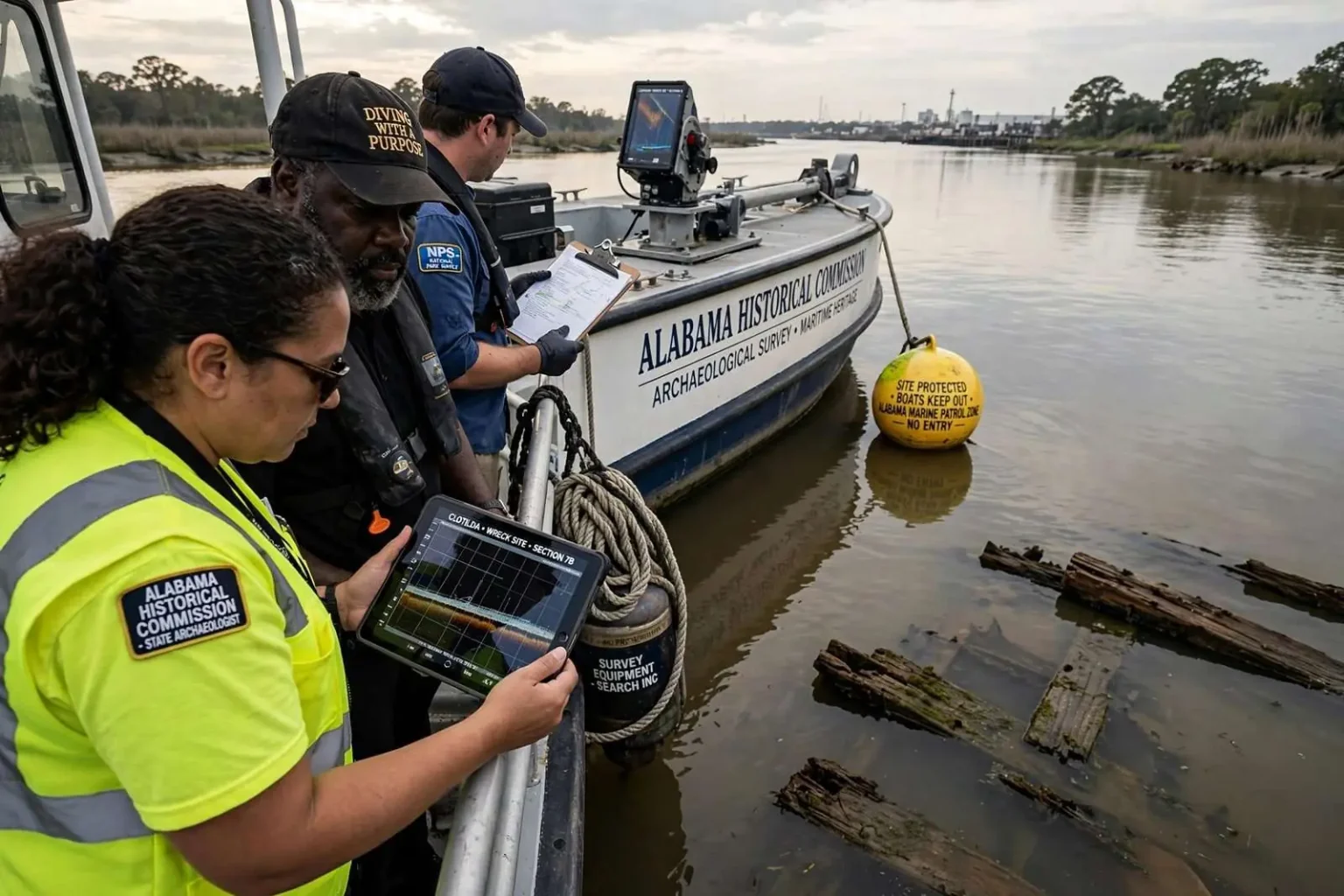
State archaeologists have confirmed that a shipwreck lying in the Mobile River is the Clotilda, the last known vessel to bring enslaved Africans to the United States. The Alabama Historical Commission announced the identification Wednesday, closing a mystery that had stood for more than 150 years and setting in motion a new chapter in how Alabama preserves one of the darkest and most consequential sites in its history.
The schooner’s story began in 1860, when it illegally carried 110 people from what is now Benin to Mobile, decades after the federal ban on the transatlantic slave trade made such a voyage a crime punishable under law. According to historical accounts, those who organized the voyage later burned and sank the ship in an attempt to destroy the evidence of what they had done. The survivors and their descendants built a community on Mobile’s north side that became known as Africatown, a place founded by Africans who arrived in bondage and, after emancipation, pooled what they had to buy land, build homes and keep their languages and traditions alive in exile.
For generations, the Clotilda’s final resting place was the subject of rumor, legend and periodic searches. Stories passed down in Africatown held that the ship had been scuttled in the waters north of the city, but no wreck had been conclusively identified, and the absence of physical proof left one of America’s most important stories without its central artifact.
A Years-Long Search
Interest in the wreck surged in early 2018 after a local reporter claimed to have located it. The ship he found turned out to be a different vessel, but the episode pushed the Historical Commission to launch a systematic investigation rather than let the question rest with false alarms. Working with the Black Heritage Council, the National Geographic Society, the Smithsonian’s National Museum of African American History and Culture, the Slave Wrecks Project, Diving with a Purpose and the National Park Service, the commission assembled a team of maritime archaeologists led by Dr. James Delgado and the firm SEARCH Inc.
The scale of that partnership reflected how much was riding on the answer. Descendants of the Clotilda survivors had waited more than a century and a half for the wreck to be found, and the risk of a premature or mistaken identification hung over every announcement. The commission’s approach was deliberately cautious: survey first, study everything, and announce nothing until the evidence could withstand outside scrutiny.
The team surveyed a stretch of the Mobile River that had not been examined before and documented roughly two dozen vessels from the 19th and 20th centuries. The river’s bottom has accumulated wrecks for generations, and separating the candidate from the clutter required methodical work by divers and remote-sensing equipment. One wreck matched characteristics associated with the Clotilda, and from that point the investigation narrowed to a single hull.
The Physical Evidence
After a year of study, including forensic analysis in laboratories, consultation with outside experts and extensive review of original shipping records, the team concluded the wreck was likely the lost slave ship. Researchers pointed to the vessel’s unusual size and dimensions, its locally sourced lumber and the presence of pig iron, all of which lined up with descriptions in historic registries. They also found signs of burning consistent with accounts that the ship was set afire after it was scuttled, a detail that connected the physical remains directly to the historical accounts of the cover-up.
To rule out the possibility that the wreck was any of the other ships known to have met their end in the river, the researchers cast a wide net. A detailed survey of schooners across the Gulf of Mexico region turned up roughly 1,500 vessels, but only the Clotilda matched the wreck’s profile. The elimination of every alternative was as important as the match itself, because a wrong identification would have been a second injury to a community that had already endured more than a century of uncertainty.
The findings were sent to an international panel of maritime archaeologists for peer review, and those experts independently reached the same conclusion. Peer review of this kind is rare in wreck identification, and its use here signaled the commission’s awareness that the announcement would face worldwide attention and deserved the highest standard of proof available. When the results came back, the commission put its name on the finding and made the announcement public on Wednesday.
Why the Clotilda Matters
The Clotilda occupies a singular place in American history. The transatlantic slave trade had been outlawed in 1808, more than half a century before the ship’s voyage, making the 110 Africans carried aboard the last known group brought to the United States directly from Africa in bondage. Their arrival was itself a crime, committed by financiers who wagered that a fast ship and a bribed port could beat the federal ban. When the gamble succeeded, the perpetrators burned the evidence, and the people they trafficked were left to build lives in a country that had made their very arrival illegal.
What the survivors accomplished afterward became the story of Africatown. The community they founded on Mobile’s north side has been recognized on the National Register of Historic Places, and its churches, graveyard and family lines remain today, anchored by descendants who have kept the story of the voyage alive through generations when official history ignored it. The identification of the wreck gives that oral history a physical anchor and gives the community a site it can visit, study and protect.
What Comes Next
With the identity established, the commission said its focus now shifts to protecting the site. The area is already covered by a state “Boats Keep Out” zone, and Alabama Marine Patrol troopers regularly patrol it, guarding against the treasure hunters, curiosity seekers and recreational divers who would otherwise be drawn to a wreck of this significance. Submerged wrecks are fragile, and the mud and water that preserved the Clotilda for more than 150 years could be undone quickly by careless human contact, which is why officials have moved to lock down access while the long-term preservation plan is developed.
Decisions about the wreck’s future, whether it remains in place, how it is interpreted for the public, and what role Africatown’s descendants will play in telling its story, are expected to involve the same coalition of agencies and organizations that found it. The National Park Service’s involvement and the Smithsonian’s expertise give the site access to conservation resources that few state-level discoveries can claim, and state leaders have described the identification as the beginning of a stewardship obligation rather than the end of a search.
Commission leaders, archaeologists and Africatown descendants described the discovery as a step toward healing and remembrance. State Archeologist Stacye Hathorne said additional study will help tell the fuller story of the people who survived the voyage and built a community in Mobile, work that is expected to continue as researchers examine the wreck and its contents in the years ahead. For the families of the 110, the ship that was meant to disappear forever has instead been found, and its story now belongs to the community that never stopped looking for it.
How the Search Stayed Honest
The commission’s methodology is likely to become a case study in underwater archaeology. Rather than chase leads as they surfaced, the team built its case from the river bottom up: first documenting every vessel in the target stretch of the Mobile River, then comparing each candidate against the historical record, then testing the leading candidate with laboratory forensics and independent experts. The year between the initial match and the public announcement was devoted almost entirely to proving the conclusion wrong, and the fact that no expert could is what made Wednesday’s announcement credible.
Original shipping records proved essential to that work. The Clotilda was built in Mobile specifically for the illegal voyage, and the documents describing its construction, dimensions and materials gave researchers a detailed profile to match against the wreck. The locally sourced lumber and pig iron found in the hull corresponded to those records, tying the physical remains to the paperwork in a way that testimony or legend alone never could. The burning found on the vessel matched the historical accounts of what happened after the captives were unloaded, completing a chain of evidence that ran from the archives to the riverbed.
A Site With Deep Roots in the Community
The search itself was shaped by the people it most concerns. Africatown’s descendants had kept the story alive for generations, and community members participated in the investigation alongside the professional partners, from the Black Heritage Council’s advisory role to the divers of Diving with a Purpose, an organization that trains divers to document submerged heritage sites connected to the African diaspora. Their involvement ensured that the wreck would be treated not simply as an archaeological prize but as a family inheritance, the last physical trace of an event that defines their community’s founding.
The identification also lands in the middle of a broader effort to recognize and restore Africatown itself. The community north of downtown Mobile has worked for years to preserve its church, its cemetery and its historic structures while the surrounding industrial landscape encroaches, and the confirmed wreck gives those efforts a center of gravity. Heritage tourism, museum planning and educational programs around the Clotilda are expected to grow from here, bringing visitors and resources to a neighborhood whose story has long deserved them.
Protection Comes First
In the near term, state officials have made clear that the priority is protection rather than excavation. The “Boats Keep Out” zone around the site and the regular presence of Alabama Marine Patrol troopers are intended to keep boats and divers away while experts determine what, if anything, should be recovered and how the site can best be preserved where it lies. Submerged wooden vessels survive in the river’s low-oxygen mud, and disturbing that environment can do irreversible harm, so the state’s caution reflects both respect for the site and the practical science of underwater preservation.
The announcement ends one of the longest-running searches in American maritime history and begins an obligation that will outlast everyone involved in finding it. For the descendants of the 110 people carried across the Atlantic in the hull of the Clotilda, the ship’s recovery from anonymity is a recognition that their community’s founding story was true all along, exactly as their families had always said. For Alabama, the identification is a chance to protect and interpret a place where the full weight of the state’s history, its crime and its resilience, is preserved in the dark water of the Mobile River.