
Alabama lawmakers open 2017 session with early bills out of committee
Alabama lawmakers opened the 2017 legislative session with early bills on monuments, judicial override, adoption and the state budget advancing through.
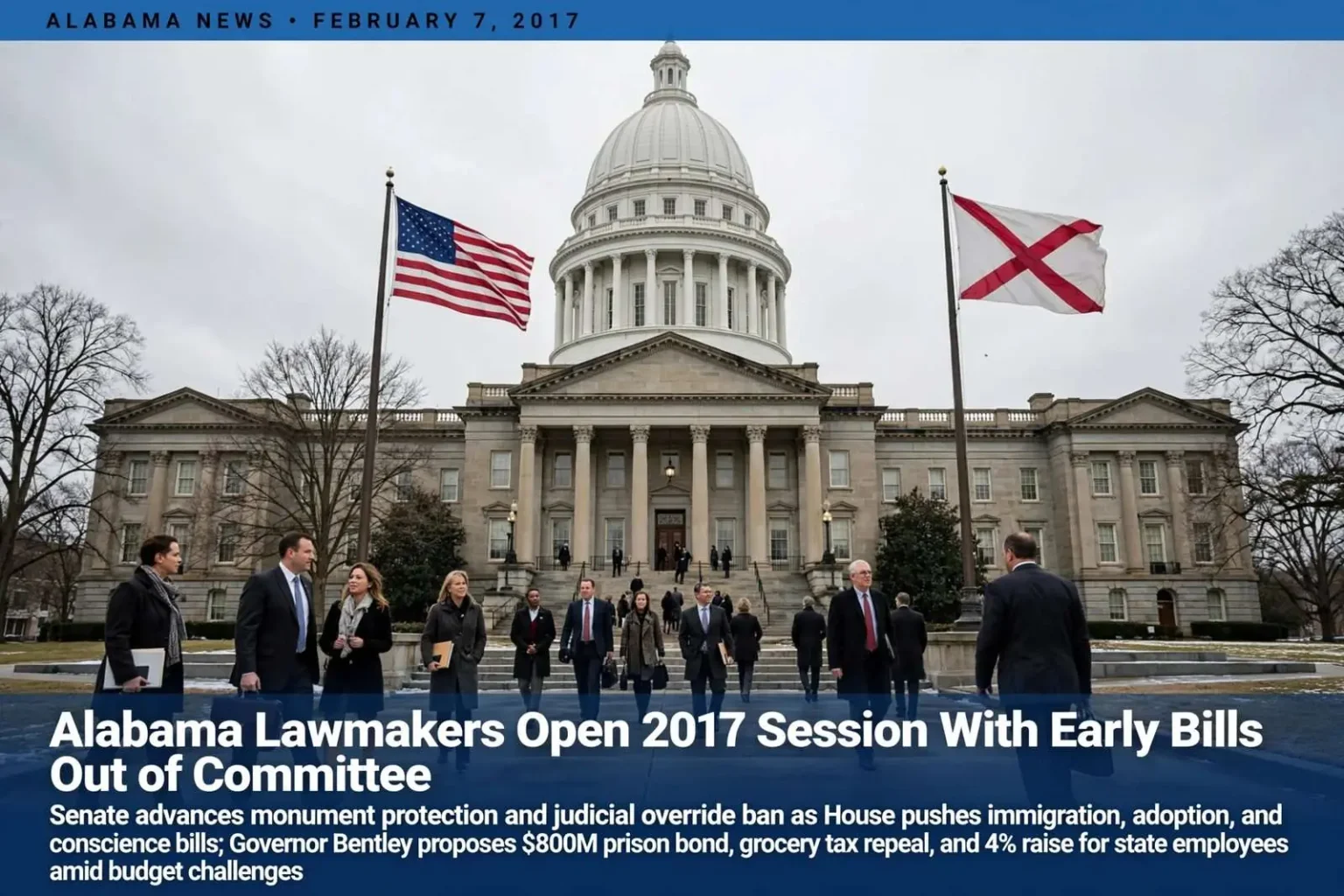
Alabama lawmakers gaveled in their annual legislative session Feb. 7 and quickly pushed a handful of bills through committee, even as the full House and Senate have yet to pass any legislation.
Of the hundreds of bills filed, just over a half dozen have cleared committee and moved a step closer to the governor’s desk. Here is a look at some of the early proposals.
The Senate’s early bills
Senate Bill 60, sponsored by Sen. Gerald Allen, would block the removal of historical memorials at least 50 years old — a response to calls around the state to take down Confederacy-related monuments. Allen, a Republican from Tuscaloosa whose district stretches across West Alabama, has carried monument-protection legislation in multiple sessions, and the measure touched off immediate debate over whether preservation decisions belong with the state or with the cities and counties that own the memorials. Under the bill, local governments that removed protected monuments anyway could face penalties, an enforcement question that critics said would invite litigation and supporters said was necessary to give the prohibition teeth.
Senate Bill 16, from Sen. Dick Brewbaker, a Montgomery-area Republican, would end the practice of judicial override, stripping judges of the power to reject a jury’s recommendation for life or death in a capital case. Alabama stood apart from nearly every other state at the time for allowing judges to impose a death sentence over a jury’s verdict for life imprisonment without parole, and the override power had drawn mounting scrutiny from defense attorneys, national legal organizations, and appellate courts. Brewbaker’s bill would require judges to follow the jury’s sentencing recommendation in capital murder trials, aligning Alabama with the majority of death-penalty states where the jury’s decision is final.
Both Senate bills advanced out of committee in the opening weeks, a faster pace than most legislation achieves in a body where committee calendars routinely swallow hundreds of bills filed each session.
The House lineup
On the House side, Rep. Phil Williams’ House Bill 100 would deny state funding to institutions found violating immigration law. The Etowah County Republican’s measure is aimed at public entities and would make compliance with federal immigration statutes a condition of receiving state money, a funding-lever approach lawmakers have applied in recent years to issues ranging from curricula to building codes.
Rep. Rich Wingo’s House Bill 24 would shield adoption agencies that decline to place children in homes that conflict with their beliefs. Wingo, a Tuscaloosa Republican and a former University of Alabama football standout, has carried similar conscience-clause legislation in past sessions. Supporters argue the bill protects faith-based adoption providers from being forced out of the foster and adoption network; opponents counter that it could narrow options for prospective foster parents at a time when the state’s child-welfare system struggles to find enough homes for children in care.
Other House measures moving early include Rep. Arnold Mooney’s HB 95, allowing medical personnel to refuse any service that violates their conscience; Rep. Mack Butler’s HB 96, which would ban assisted suicide; and Rep. Matt Fridy’s HB 98, a proposed constitutional amendment enshrining the state’s “commitment to the unborn.” The three Republicans — Mooney of Birmingham, Butler of Rainbow City, and Fridy of Alabaster — framed the bills as a priority package on life and conscience issues for the opening session.
Mooney’s conscience bill generated the sharpest early exchanges, with medical groups questioning how broad refusals could affect patient care and emergency situations, while Butler’s assisted-suicide ban largely codified prohibitions already recognized in Alabama common law and Fridy’s amendment would put a statement of principle directly into the state constitution, requiring voter approval on a statewide ballot before taking effect.
Bentley lays out his agenda
Gov. Robert Bentley used his State of the State address to lay out his own priorities: an $800 million bond issue for new prisons, more funding for Alabama’s pre-K program, a 4 percent raise for state employees and — to some surprise — a repeal of the state grocery tax.
The prison proposal was the largest single item on the governor’s list. Alabama’s prisons had operated for years under federal scrutiny over overcrowding, staffing shortages, and conditions, and corrections officials had warned legislators that aging facilities in particular needed replacement rather than repair. A bond issue of that size would be among the largest capital projects in state history and would require legislative authorization for the state to borrow against future revenues. Administration officials pitched the plan as a way to consolidate the prison system into a smaller number of modern facilities rather than spreading maintenance dollars across dozens of aging campuses.
The proposed grocery tax repeal carried obvious appeal across party lines — Alabama is one of the few states that applies its full sales tax to groceries with no significant offset — but it also presented the same budget arithmetic problem that had defeated earlier repeal attempts: the sales tax feeds the General Fund, the same budget that pays for Medicaid, prisons, and public safety, so any repeal has to be paired with replacement revenue or spending cuts of matching size.
The 4 percent raise for state employees addressed a workforce that had gone years without a cost-of-living increase, a factor agencies blamed for difficulty recruiting correctional officers, state troopers, and mental health workers. The pre-K commitment extended the voluntary First Class pre-kindergarten program, which had won national recognition for quality but reached only a fraction of the state’s 4-year-olds because of funding limits.
Redistricting on the docket
Lawmakers also must redraw several House and Senate districts after a court struck down maps that diluted minority voting power. The redrawing obligation hung over the entire session, since the affected districts are concentrated in the Black Belt and in parts of Montgomery and the Tuscaloosa area, and any new map would have to clear both the legislature and federal court review before the next election cycle. Redistricting fights in Alabama have historically ended up before a three-judge federal panel, and members whose districts were redrawn faced the prospect of running in unfamiliar territory or against incumbent colleagues.
The budget remains the biggest lift
But as always, the biggest lift will be passing the multibillion-dollar budget. The legislature actually writes two general fund budgets each year: the Education Trust Fund budget, which pays for schools, universities, and the community college system and is fueled largely by income and sales tax growth; and the General Fund budget, which pays for nearly everything else — Medicaid, corrections, state troopers, mental health, and the courts — from a narrower and historically stagnant set of taxes.
Sen. Tripp Pittman, who chairs the General Fund budget, said he was “as ready as you can be” heading into the session. “We have to balance our budgets in Montgomery,” he said. “We have a tough budget year, but we’ll get up there, and we’ll pass a budget.”
Pittman, a Republican from Daphne in Baldwin County, took the Finance and Taxation General Fund chairmanship at a moment when Medicaid costs alone were consuming a growing share of the budget’s entire revenue base. Every new commitment the governor proposed — the employee raise, the pre-K expansion, the grocery tax repeal — would have to find room inside that same constrained budget, and the prison bond issue would add debt service on top. The one structural cushion was an increase in the General Fund’s interest earnings on the state’s oil and gas trust proceeds, which had been approved by voters in a statewide amendment the previous year and was expected to ease, but not eliminate, the annual shortfall.
The Education Trust Fund side faced its own discipline problem: state law caps budget growth in strong revenue years, and legislators would have to resist the temptation to spend a one-time surge on recurring programs.
The calendar ahead
The Constitution limits the session to 30 meeting days spread across about four months, with May 22 the last possible day. The meeting-day limit shapes everything about how a session unfolds: committees meet on weekdays the full bodies are not in session, and bills that fail to clear committee by the middle of the session face increasingly long odds as leadership protects floor time for budgets and constitutional amendments.
Local legislation, redistricting maps, and the two budgets will consume much of that 30-day allotment, leaving the early-advanced bills like the monument protection measure and the judicial override ban — both of which passed committee while most bills sat waiting — in position to reach the floor in the session’s first months. Whether any of the governor’s proposals survive the arithmetic of the General Fund will be decided by the budget committees Pittman and his House counterpart chair, and history in Montgomery suggests the end-of-session budget conference will again determine what actually becomes law.