Alabama midwives win victory as governor ends 40-year ban
Alabama Gov. Kay Ivey signed a bill ending a 40-year ban on midwifery, giving mothers more options for home birth in rural counties statewide.
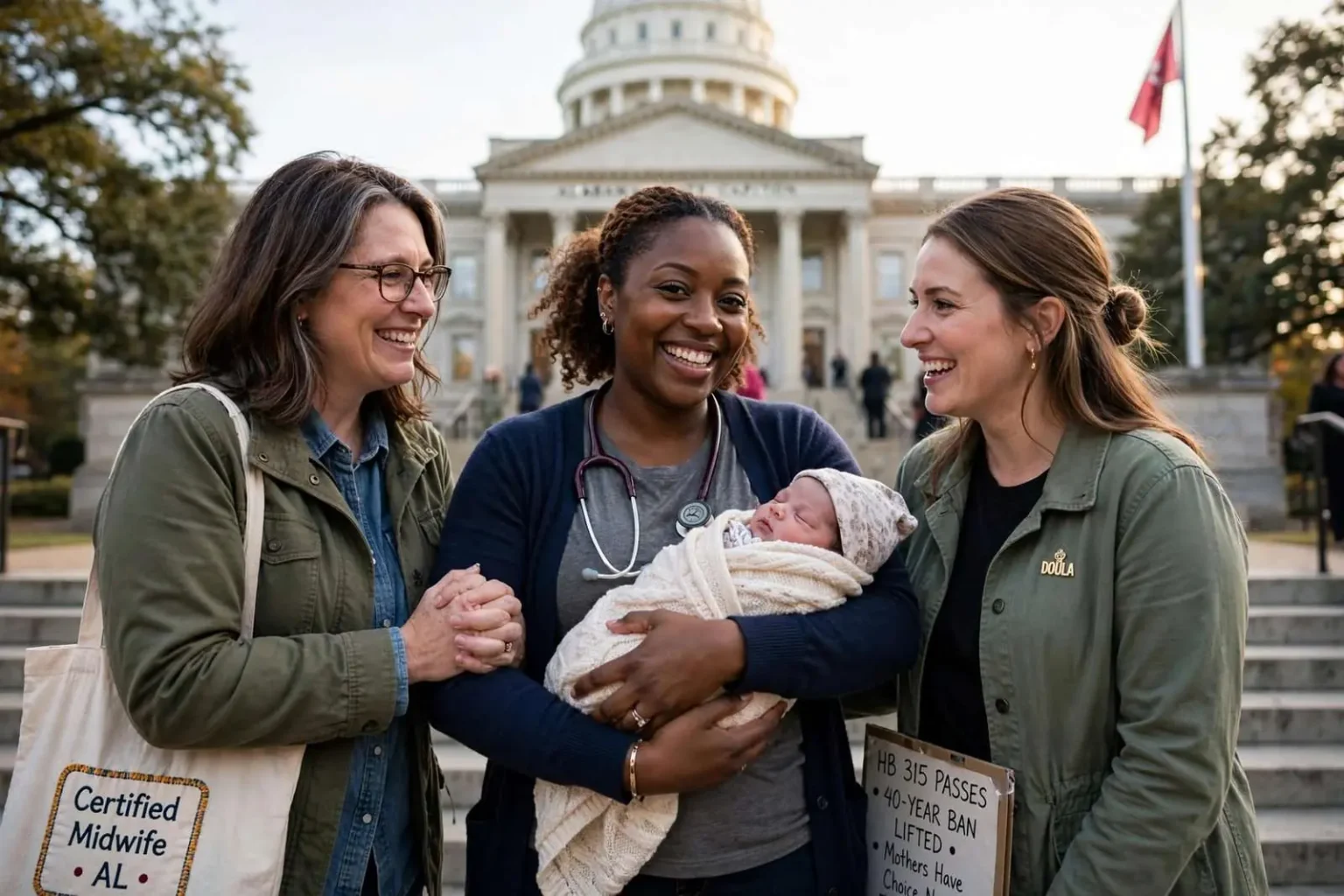
Alabama has overturned a 40-year ban on midwifery after Gov. Kay Ivey signed House Bill 315, a victory years in the making for mothers, doulas and advocates across the state. The bill restores a licensing framework for midwives that had been missing from state law for decades, giving women who want to deliver outside a hospital a legal option in Alabama for the first time in a generation. “I signed the midwifery bill because it gives mothers more options to choose how to deliver their baby, while simultaneously ensuring that those midwives who practice in Alabama are qualified to do so,” Ivey said.
For Courtney Gordon, a certified doula in Mobile who is training to become a midwife, the change is welcome news. “It’s been such a hassle for moms and families who want to have a home birth,” she said, noting that some Alabama families had to cross the Mississippi border to get the care they wanted. Under the old law, a midwife who attended a home birth in Alabama risked criminal charges, so mothers who wanted that experience either hired someone unofficially or drove out of state, adding cost, distance and stress to what is already a demanding event.
Colleen Tullis, a Mobile resident and certified midwife of more than a decade, knew the problem from the other side. She had practiced out of state for years while the profession remained a crime at home, serving families across state lines rather than in her own community. After 13 years of legislation that never made it out of committee, she said this session “just started flying.”
A ban that dates to the 1970s
Alabama’s restrictions trace to the mid-1970s, when the state stopped licensing midwives and left the practice in legal limbo. For decades afterward, Alabama stood among a small handful of states with no regulatory pathway for certified professional midwives, who specialize in attending low-risk, out-of-hospital births. Anyone who assisted at a home birth without a nursing or medical license could face prosecution, and that threat kept most trained midwives from practicing openly in the state.
The consequences showed up in the state’s health picture. Alabama has long ranked near the bottom of national rankings for infant and maternal health, and the problem is sharpest in rural counties where hospital obstetric units have closed and the nearest delivery room can be an hour or more away. Supporters of legalization argued that licensed midwives, working under clear standards with defined physician consultation and transfer rules, would give healthy, low-risk mothers a safe alternative and could bring some maternity care back to communities that had lost it.
Neighboring states took a different approach long ago. Florida, Mississippi, Tennessee and Georgia all license and regulate midwives who attend home births, which is why Gulf Coast families for years crossed state lines to deliver. Advocates said it made little sense that a mother in Mobile could legally hire a midwife an hour away in Mississippi but not in her own neighborhood, and that discrepancy became a recurring argument at the State House year after year.
Thirteen years of trying
The road to House Bill 315 was long and repetitive. Bills to restore midwifery licensing were introduced session after session for 13 years, and each time they stalled, usually in committee without ever receiving a floor vote. The opposition was consistent: organized medicine raised concerns about the safety of out-of-hospital birth, and without the votes to overcome it, sponsors could do little more than refile the measure and try again the next year.
This session was different. The bill cleared the House with few problems and then passed the Senate 30-0, a margin that surprised even longtime supporters. But the unanimous Senate vote came at a price. To win over hesitant members, supporters agreed to a series of concessions that shaped the bill into something more acceptable to the medical community, and those amendments proved decisive in moving the legislation to the governor’s desk.
The concessions fell into three broad categories. Midwives will be required to carry liability insurance, a provision aimed directly at fears that families would have no recourse if something went wrong. The law also places limits on high-risk pregnancies, meaning midwives may attend only births that fall within defined low-risk parameters and must transfer care when a pregnancy moves outside them. Finally, the state will track outcomes, with a mandate to record births, deaths and hospital transfers involving midwife-attended deliveries.
Supporters described those requirements as the price of a 30-0 vote, and most said the trade was worth it. A licensing law with rigorous tracking, they argued, is far better for mothers than the status quo, in which home births happened anyway, off the books and without any state oversight of who was attending them or how those births turned out.
How the new system will work
Under the law, a regulatory board of seven members — most of them midwives — will be appointed by the governor. The board will write the rules that fill in the details of the statute: what training and certification it will accept, which pregnancies fall within the low-risk standard, when a midwife must consult a physician, and what conduct can cost someone a license. That structure mirrors the way Alabama already regulates other licensed professions, from nursing to cosmetology, and puts midwives on the same footing as other practitioners whose work carries health consequences.
The board’s composition matters to advocates. A majority-midwife panel, similar to how other states structure their oversight, means the people writing the clinical standards will understand out-of-hospital birth rather than viewing it from outside. Critics had feared a board controlled by physicians would write rules so restrictive that licensing would exist on paper only, and the bill’s makeup requirement was designed to prevent that outcome.
The tracking mandate is also expected to change the conversation in future legislative sessions. Because the state has never collected systematic data on midwife-attended births in Alabama, debate over the practice has run largely on anecdote and out-of-state studies. Once transfers, births and deaths are recorded, both sides of the argument will have Alabama-specific numbers to work with, and supporters believe the data will show the model is safe when practiced within the law’s limits.
A last-minute champion on the Senate floor
Sen. Vivian Davis Figures, D-Mobile, became a last-minute champion of the bill on the Senate floor, pressing the case as opponents worked to slow its momentum. At one point she challenged a colleague directly, asking, “Who are you working for? Who has you at the mic trying to kill this bill?” The exchange captured the frustration of supporters who had watched the same fight play out for more than a decade, and Figures’ intervention helped hold the chamber’s consensus together through final passage.
The Medical Association of the State of Alabama, a key opponent through the years, said it remained concerned about the safety of at-home births but was satisfied that the amendments added protections. That measured response marked a significant shift from previous sessions, when the association’s opposition was enough to bury the bill quietly in committee. With the state’s most influential medical lobby declining to fight the amended version, the path to final approval was clear.
What happens next
Tullis expects it could be a year before anyone legally practices in Alabama. The governor must appoint the seven-member board, the board must adopt its rules, and midwives must then apply for and receive licenses before any birth can be attended legally under the new framework. That timeline means families hoping for a licensed home birth in the coming year will still need to look across state lines for now, but advocates say the wait is a small price for a permanent legal foundation.
For practitioners like Tullis, the change is also personal. Midwives who spent years serving Alabama families from offices in Mississippi or Florida can finally bring their practices home, and the state’s training pipeline — including doulas like Gordon who have been preparing for midwifery careers — can develop without requiring every aspiring midwife to leave Alabama to build one. “After 13 years, we’ve proven that perseverance pays off,” she said.
The implications reach beyond the Gulf Coast. Rural counties across south and central Alabama have watched their hospitals shed obstetric services for years, and state health officials have repeatedly flagged maternity care access as a growing problem. Licensed midwives are not a substitute for hospital obstetrics in complicated pregnancies, but for the low-risk births that make up most pregnancies, they offer an option in places where the nearest hospital delivery ward has closed or sits far away. Public health researchers in other states have studied whether expanded out-of-hospital options can relieve some of that pressure, and Alabama’s tracking data will eventually let local officials judge the effect here.
For now, the change is being celebrated by the coalition that built it — mothers who shared their birth stories in committee hearings, doulas who drove to Montgomery session after session, and the small group of licensed professionals who kept the issue alive through more than a decade of defeats. The bill’s passage shifted Alabama from one of the most restrictive states in the country for midwifery to one with a standard regulatory framework, and it did so with a unanimous Senate vote that would have seemed implausible even a year earlier.
Families considering a home birth under the new system should expect the details to take shape over the coming months as the board is seated and its rules are published. The requirements for insurance, low-risk screening and outcome tracking will define who qualifies and how care is transferred when complications arise. What is already settled is the principle Ivey cited in signing the bill: mothers in Alabama now have a legal choice about how and where they deliver, and the midwives who serve them will do so with the state’s oversight rather than against its law.