Alabama Music Box Benefit Rally Backers Against Mobile’s 21-Plus Ordinance
In October 2011 Alabama Music Box hosted a benefit to fund the legal fight against Mobile's 21-plus bar-entry ordinance.
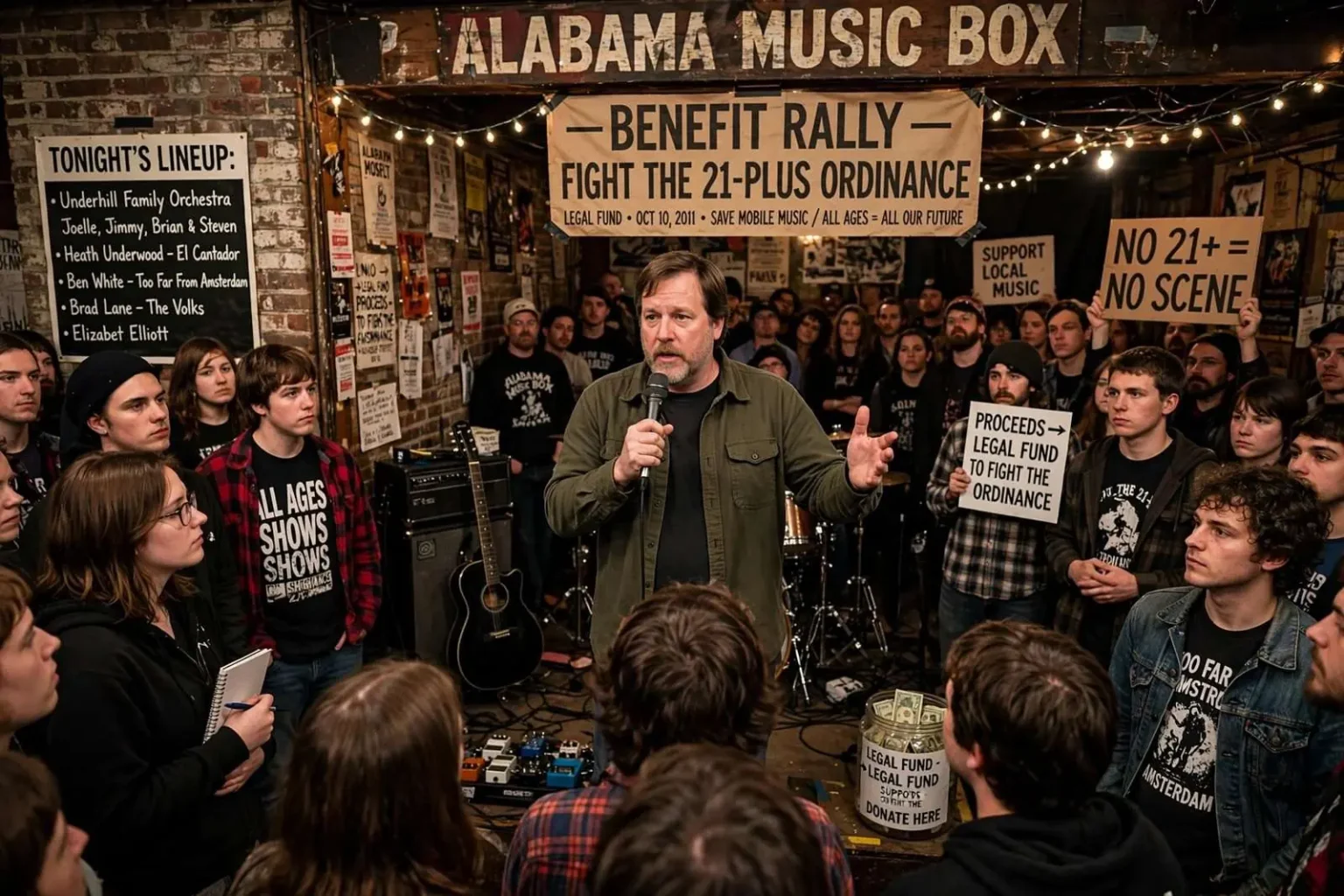
Just hours before Mobile’s controversial “21-plus ordinance” took effect on October 12, 2011, musicians, venue workers and fans packed the Alabama Music Box for a benefit show raising money to fight the new law in court. The ordinance barred anyone under 21 from entering establishments that serve alcohol unless a business secured special dispensation from the Mobile City Council — a rule critics said would gut the city’s house-show circuit and its nationally touring indie acts. Proceeds from the October 10 benefit went toward legal fees for challenging the measure.
Owner David Mathews hosted a night of interviews and music that drew voices from across the downtown scene, including members of Underhill Family Orchestra (Joelle Rosen, Jimmy Lee, Brian Wattier and Steven Laney), Heath Underwood of El Cantador, Ben White of Too Far From Amsterdam and Brad Lane of The Volks, along with artist Elizabet Elliott and a long list of venue regulars. The lineup read like a roster of the bands the ordinance was written, in critics’ view, to exclude: young musicians playing young rooms for mixed-age audiences.
The ordinance’s mechanics were the flashpoint. By requiring any under-21 patron to stay out of a business that served alcohol — unless the council granted that specific business a dispensation — the law inverted the long-standing arrangement that had made Mobile’s small venues possible: bars and music rooms that survived economically by letting all-ages crowds through the door to see the show, with adults buying the drinks that paid the rent.
Why Organizers Said the Ordinance Mattered Beyond Bars
Speakers argued the law reached far past nightclub doors. A thriving music district, they contended, was central to Mobile’s pitch to tourists and cruise passengers, to restaurant and museum traffic downtown, and to any realistic plan to fill vacant Dauphin Street buildings with new venues. Allowing under-21 fans into all-ages shows had long been how the city’s DIY spaces — and the bands that grew out of them — survived.
The argument had an economic spine. Mobile’s downtown revival was built in part on its entertainment corridor, and the touring acts that played the city’s small stages brought audiences into restaurants and shops before and after shows. Bands on national club tours schedule routing around cities that can host them for a night — and a band whose show can only admit adults cuts its potential audience in a college town market that draws heavily on eighteen-to-twenty-year-old fans.
Opponents also warned the dispensation process would effectively freeze new venue openings: few entrepreneurs would gamble on converting an empty downtown building when admission hinged on a case-by-case council exemption. The dispensation model put the future of every new music room in the hands of a political vote rather than a business plan, and speakers argued that investors would simply choose cities where the calculation was simpler.
Two Visions of the Same Street
Supporters of the change had framed it as a public-safety measure aimed at keeping underage patrons out of drinking establishments. The distinction the council drew — between a bar that occasionally admits minors for a show and a venue that minors treat as their club — was meant to protect eighteen-to-twenty-year-olds from environments built around alcohol sales. Businesses that wanted to welcome younger audiences could, in theory, apply and demonstrate that their operations were compatible.
For the crowd at the Alabama Music Box, the benefit doubled as a statement that Mobile’s music community intended to contest the ordinance rather than wait it out. The money raised that night funded the early stages of a legal challenge, and the show itself — interviews between sets, the scene’s veterans telling the story of how the city’s all-ages circuit had grown — was framed as a public record of what the ordinance threatened.
The dispute became one of the defining local culture-war fights of 2011 in the Port City, splitting along a line that ran through the middle of downtown: a city government trying to regulate the drinking age one business at a time, and a music community that heard in the ordinance the sound of its own future being voted away. Both sides agreed on the goal — a safe, busy Dauphin Street — and disagreed completely about which policy would get it there.
The Stakes for Mobile’s Music Scene
What made the fight resonate beyond the bars was the track record the scene had built. Mobile’s independent venues had launched bands that toured nationally, drawn festivals and showcases to the city, and created the kind of cultural identity that economic developers spend real money trying to manufacture. Underhill Family Orchestra, El Cantador, Too Far From Amsterdam and The Volks were part of a wave of Gulf Coast acts whose audiences had grown up in all-ages rooms — and whose members were often too young themselves to walk past the ordinance’s threshold.
The artists who spoke at the benefit made the generational argument explicit. A nineteen-year-old fan who cannot enter a venue at nineteen does not reappear at twenty-one out of loyalty; the habit of live music, once interrupted, often does not resume. Every scene that sustains itself does so on the young — the cheap-rent practice rooms, the first tours in borrowed vans — and a law that cuts off the audience also cuts off the pipeline that produces the next wave of full-time musicians.
Elizabet Elliott and the other speakers also tied the ordinance to the city’s wider struggle with its vacant downtown buildings. Dauphin Street’s empty storefronts were the standing evidence that Mobile needed more reasons for people to come downtown, not fewer. A policy that raised the cost and risk of opening a music venue, they argued, worked directly against the city’s own redevelopment goal of filling those buildings with businesses that brought crowds after dark.
Two days after the benefit, the ordinance took effect on schedule. The legal fight it funded, and the question of how Mobile would balance underage safety against the economics of its music economy, remained open — and the October 10 crowd at the Alabama Music Box had made clear that the scene intended to be part of the answer rather than its casualty.
The Alabama Music Box itself was a case study in what the ordinance regulated. A downtown venue known for hosting touring indie acts and local showcases alike, it operated on the model the law disrupted: booking shows for mixed-age audiences in a room that also poured drinks. Owner David Mathews’ decision to turn the venue into a fundraiser two days before the law took effect — complete with on-stage interviews about the ordinance — turned the club into the scene’s organizing headquarters for the night.
The benefit’s structure reflected the community it came from. Rather than a single headline act, the night wove together short sets and conversations, giving members of Underhill Family Orchestra, El Cantador’s Heath Underwood, Ben White of Too Far From Amsterdam and Brad Lane of The Volks a platform to explain, in their own words, what all-ages rooms meant to their careers. Many of the musicians on stage had come up through Mobile’s house-show circuit — living rooms, warehouses and storefront spaces where the door charge funded the next show and no one checked IDs because no one was drinking.
That house-show economy was the ordinance’s most direct target, critics said. A house show operates entirely outside the alcohol licensing system: no bar, no server, no liquor board. By conditioning venue admission on alcohol service rather than the reverse, the 21-plus rule gave under-21 music fans nowhere to go except exactly those unlicensed spaces — the ones without fire inspections, capacity limits or security — while penalizing the licensed venues that followed the rules.
Nightlife economics across the country support the point that scene advocates made. American cities that cultivate mixed-age live music — from the club corridors of Austin to the warehouse venues of Asheville — rely on the eighteen-to-twenty demographic for early-career show attendance, and studies of music economies have repeatedly identified all-ages venues as the breeding ground for the touring acts that later fill larger rooms. A city that closes those rooms exports its young musicians to the cities that did not.
Mobile’s downtown establishment had reason to take the argument seriously. The cruise industry’s passengers walked from the terminal into a downtown whose evening vitality depended on Dauphin Street’s entertainment businesses, and city leaders had spent years courting the convention and tourist traffic that fills restaurants on weekend nights. A visible, healthy music scene was part of that product. The ordinance’s supporters did not dispute the value of live music — they disputed that under-21 crowds and alcohol service belonged in the same rooms, and they were willing to test the economics.
The court fight that the October 10 benefit funded joined a national pattern. City-by-city age restrictions on venue entry had been challenged elsewhere on due process and constitutional grounds, and the outcomes had varied with each city’s drafting. Mobile’s ordinance, with its dispensation mechanism, gave challengers a specific target: a law that treated identical businesses differently based on a council vote.
Whatever the courts decided, the benefit established the terms of the debate in public. The musicians, venue owners and fans who filled the Alabama Music Box on October 10, 2011 framed the 21-plus ordinance not as a nuisance regulation but as an existential threat to a scene that had taken a decade to build — and they put their money where their argument was, one ticket at a time, before the law took effect at midnight.