
Alabama orders closure of non-essential businesses, close-contact services as coronavirus spreads
Gov. Kay Ivey closed non-essential Alabama businesses and close-contact services on March 27, 2020, as COVID-19 spread; Mobile held off on a.
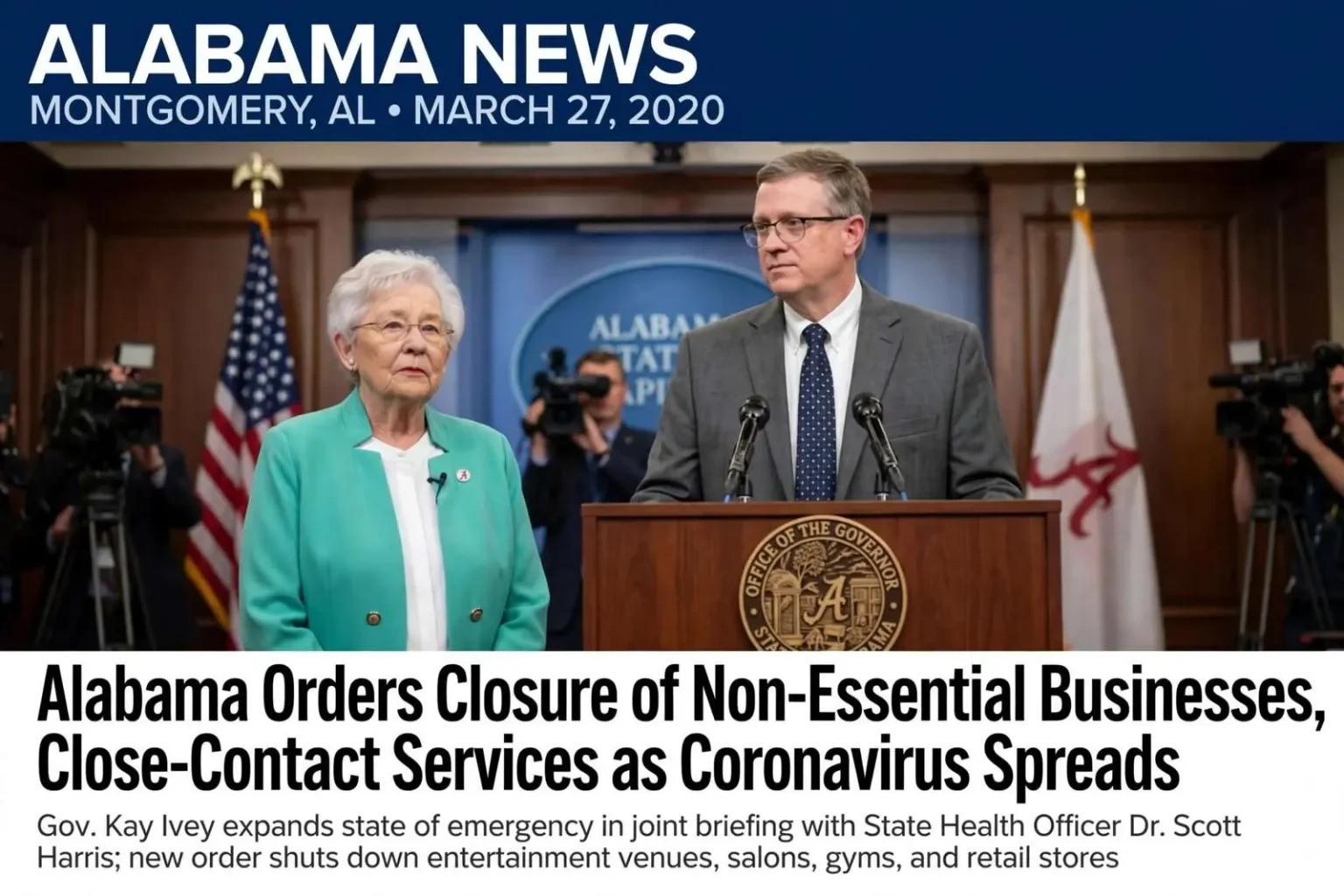
Gov. Kay Ivey expanded Alabama’s coronavirus response on Friday, March 27, with a supplemental state of emergency that shuts down a broad swath of businesses where health officials say the virus can spread easily. The order marked the state’s most aggressive economic intervention of the pandemic’s first month, moving Alabama beyond school closures and restaurant restrictions into a wholesale reordering of daily commerce. It came as case counts climbed and hospital preparedness dominated the state’s emergency planning.
Standing with State Health Officer Dr. Scott Harris, Ivey ordered the closure of entertainment venues, athletic facilities, close-contact personal services and retail stores — a clampdown her administration said is nearly as restrictive as a shelter-in-place mandate. The affected categories covered a wide slice of Alabama’s service economy, from barbershops and salons to theaters, gyms and the arcades and bowling alleys that anchor entertainment districts in Birmingham, Huntsville and Mobile. Retail stores faced closure except where the state’s exemptions allowed limited operations.
“We’re not trying to say what is essential, we’re simply designating what is non-essential,” Ivey said. The formulation was carefully chosen: rather than certifying specific businesses as essential, the order identified activities that must stop, leaving everything else to operate within the rules already in place. That framing allowed the state to avoid the contentious designation fights that played out in other states’ essential-business lists.
The business categories named in the order map closely onto the settings health officials had identified as highest-risk: enclosed spaces where people linger, share equipment or come within arm’s reach of one another. Salons and barbershops involve prolonged close contact by definition, athletic facilities share equipment and heavy breathing in enclosed rooms, and entertainment venues draw crowds that linger for hours. Retail presented the hardest line to draw, since many stores sell goods that are necessities, and the state’s exemptions attempted to accommodate that reality.
Alabama’s emergency framework allowed the governor to move quickly because the state of emergency had already been declared weeks earlier, activating the statutory powers that ordinary lawmaking cannot exercise on a pandemic timeline. Supplemental proclamations build on that base authority, letting the state adjust restrictions as circumstances change without starting the legal process from scratch each time.
Local Officials Keep Room to Go Further
She added that mayors and regional health officials remain free to impose stricter measures of their own, noting that Jefferson County and cities including Birmingham and Tuscaloosa had already done so. Jefferson County, home to Birmingham and the state’s largest population base, had moved first with its own health orders, and college towns such as Tuscaloosa had acted as student populations scattered at the close of the spring semester. The governor’s order effectively set a statewide floor while leaving local officials the authority to build higher.
Mobile holds off on shelter-in-place. Of Alabama’s 67 counties, only Mobile and Jefferson have standalone health departments, a legacy of the state’s public health structure that gives the two counties officers with independent order-making power. That structural difference explains why the pandemic’s early regulatory map in Alabama was so patchy, with Mobile and Jefferson charting their own courses while the other 65 counties relied on state action alone.
Mobile Mayor Sandy Stimpson has declined to issue a shelter-in-place order for the Port City, as has Mobile County Health Officer Dr. Bert Eichold. Stimpson’s administration emphasized guidance and business cooperation over mandates, and Eichold’s department preferred education-driven measures in the outbreak’s early weeks. The decision placed Mobile among the larger Alabama cities without a stay-at-home order even as Birmingham-area residents lived under one.
Ivey acknowledged that 21 other states had issued shelter-in-place orders, but said she did not believe such a step was necessary in Alabama at the time because of the damage it would inflict on workers, employers and small businesses. The economic argument weighed heavily in a state whose budget depends heavily on sales tax receipts and whose rural counties had, at that point, seen few confirmed cases. Ivey repeatedly framed her approach as calibrated to Alabama’s caseload rather than copied from other states.
What the Order Changes
The new order also lowers the limit on non-work gatherings from 25 people to 10, in line with federal health guidance. The tightening tracked the White House’s coronavirus guidelines issued earlier in March, which had moved the recommended gathering limit downward as evidence accumulated about spread at group events. For Alabama, the change affected churches, funerals, civic clubs and the social gatherings that anchor community life across the state.
Prior directives remain in effect, including the closure of public schools, a ban on on-site dining at restaurants and bars, and limits on daycare group sizes. Alabama’s K-12 campuses had already gone dark under an earlier order, forcing districts to assemble remote learning plans on the fly. The dining ban had pushed restaurants toward takeout and delivery models virtually overnight, and daycare limits capped group sizes to slow transmission among children and staff.
The pandemic’s arrival caught Alabama’s public institutions mid-stride. The legislature was in session when the outbreak accelerated, school districts had just administered spring testing preparations, and the state’s tourism season was approaching on the Gulf Coast. Every sector faced the same compressed adjustment: move operations online, cut staff or close entirely, often within a single week.
The closures took effect the following day, giving businesses a final evening to wind down operations, settle accounts with employees and arrange for remote work where possible. Enforcement questions fell to local law enforcement and health authorities, with the state emphasizing compliance by cooperation in the order’s early days.
Cases Climb as Jobless Claims Spike
At the time of the announcement, Alabama had recorded 571 confirmed COVID-19 cases and three deaths, with state investigators examining several additional suspected fatalities, according to Harris. The numbers reflected the outbreak’s early curve in Alabama, where the first cases had appeared only in mid-March. Health officials warned that the true count was certainly higher, given the limits of testing availability nationwide.
He cautioned that the share of confirmed cases requiring hospitalization was likely understated because of the state’s prioritization of testing for the sickest patients. With tests rationed to hospitalized patients, health care workers and symptomatic high-risk groups, the official case count skewed toward the severely ill. That testing strategy made the hospitalization rate look disproportionate and made it difficult to measure community spread directly.
The economic fallout was already visible. After a stretch of record-low unemployment, Alabama saw nearly 40,000 jobless claims filed in a single day, and the Department of Labor reported 10,982 initial claims for the week of March 15-21. The surge overwhelmed the state’s unemployment system in ways that would persist for weeks, as claimants jammed phone lines and websites never built for that volume.
Unemployment claims were only the first economic signal. Sales tax collections, the backbone of state and local budgets in Alabama, were expected to fall as commerce slowed, and municipal governments began preparing for revenue shortfalls even as they bore new public health costs. State economists warned that the second quarter would register the sharpest contraction in memory.
The single-day claims figure alone exceeded whole months of filings in ordinary times, when Alabama’s economy had been producing unemployment rates near historic lows. Service workers bore the brunt in the first wave, as restaurants, bars and entertainment venues closed their doors, but retail and personal service layoffs followed quickly once the governor’s order took effect.
What Comes Next
Hospital systems across the state began canceling elective procedures in the same period, both to conserve protective equipment and to free beds for a potential surge. The cancellations carried their own financial toll, since elective procedures are a major revenue source for hospitals, particularly in smaller communities where the local hospital is also one of the largest employers.
State officials urged Alabamians to treat the order as a test of individual discipline as much as a legal mandate. The gathering limit and business closures would only slow the virus, officials argued, if residents kept their distance in grocery stores, parks and the workplaces that remained open. Compliance in the first days was expected to shape whether the state needed to tighten further.
The supplemental emergency proclamation also positioned the state to access additional federal recovery resources, alongside the disaster declarations and relief packages moving through Washington at the same time. Small businesses in Alabama were beginning to assess federal loan programs that Congress was assembling, and the state’s order gave employers a clearer picture of how long their disruptions might last.
Churches and faith communities, central institutions in Alabama life, adjusted to the gathering limits by moving services online, holding drive-in worship or suspending meetings altogether. The reduction from 25 to 10 people made standard services impossible in most congregations, and pastoral leaders across the state scrambled to maintain connection with members, particularly elderly ones at greatest risk.
For Mobile, the divergence between the governor’s approach and the shelter-in-place orders elsewhere kept the city in the news as a contrasting model. Stimpson and Eichold continued to urge residents to limit gatherings voluntarily, and the city’s business community faced the same closures as the rest of the state under the new order regardless of the absence of a local stay-home mandate.
Health officials reminded residents that the order’s effectiveness would show up in the case numbers over the following two to three weeks, the incubation lag that makes real-time assessment of any restriction nearly impossible. Alabama’s emergency measures would be reviewed and adjusted as data accumulated, with Harris and Ivey promising regular updates as the outbreak evolved.
For now, the state’s message to businesses and families was blunt: the activities that put people in close contact must stop, gatherings shrink to 10, and the schools, restaurant dining rooms and daycare limits already in place remain. Alabama had, in the span of two weeks, moved from no confirmed cases to a near-shutdown, and March 27 marked the point of no return.