Alabama Partners with Apple and Google on COVID-19 Exposure Notification App
Alabama is among the first states to partner with Apple and Google on a COVID-19 exposure notification tool, though key details remain unclear.
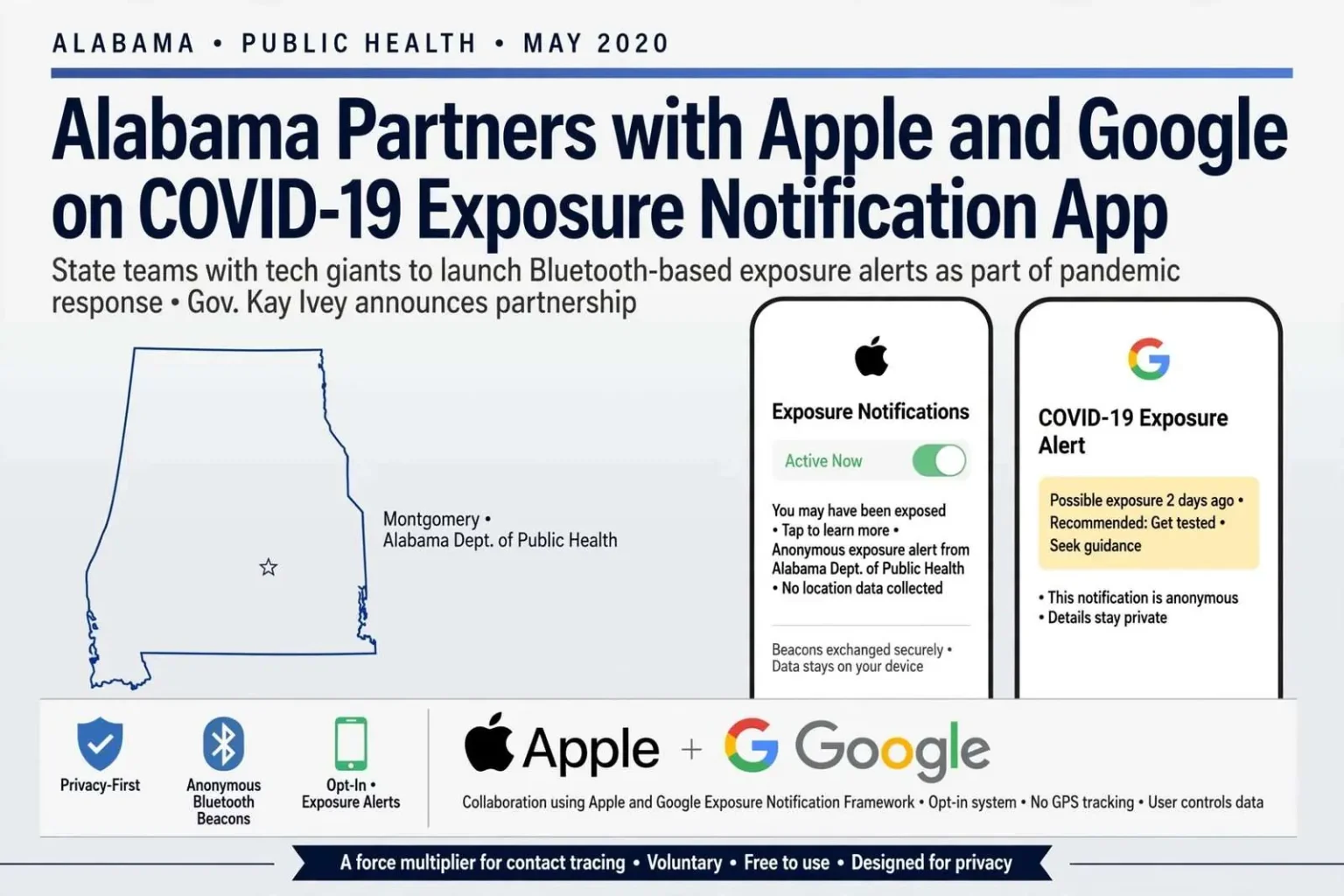
Alabama is among a handful of states partnering with tech giants Apple and Google to build a tool that can notify residents if they may have been exposed to COVID-19, Gov. Kay Ivey announced this week. The announcement placed Alabama alongside a small but growing group of states embracing the exposure notification framework the two companies built into their mobile operating systems during the pandemic, a collaboration between longtime rivals that produced one of the most widely deployed public health technologies of 2020.
The Alabama Department of Public Health has “inked a deal” with the companies to use contact-tracing technology rolled out for iOS and Android devices, Ivey said. The state health department, headquartered in Montgomery with county health offices serving all 67 counties, would oversee how the technology fit into Alabama’s broader response to the pandemic, which by late spring had already included stay-at-home orders, testing expansion and a gradual, phased reopening of businesses across the state.
How the Technology Works
The framework uses Bluetooth signals to log when users come near one another; people who later test positive can consent to share an identifier that alerts others they may have been exposed. The system is built around proximity rather than identity: phones exchange anonymous, rotating Bluetooth beacons whenever they spend time close together, and those records stay on the device itself. When a user tests positive, they choose whether to upload their recent beacon history, and anyone whose phone recorded nearby encounters with those beacons receives a notification with guidance on what to do next.
Because the system relies on Bluetooth rather than GPS, it does not track where a person went — only that two phones were near each other for a long enough window. The beacons rotate every few minutes so they cannot be used to follow a specific individual, and the matching that determines whether an exposure occurred happens on the user’s own phone rather than on a central server. Apple and Google designed the framework to work across both of their platforms, a notable technical feat given that iPhones and Android devices otherwise operate on separate, competing ecosystems.
The design also reflects a lesson public health officials learned early in the pandemic: traditional contact tracing, which depends on interviewers calling each positive case and reconstructing their recent movements by memory, simply cannot keep pace with community spread. An automated system that runs in the background of daily life can reach contacts a tracer would never identify — the stranger at the checkout line, the fellow shopper who lingered nearby — without anyone having to remember names or faces.
A Critical Piece of the Reopening Puzzle
Public health officials have emphasized that widespread testing, contact tracing and exposure notification will be critical as the state works to resume normal activity before a vaccine is available. Until a vaccine or effective treatment arrived, the state’s strategy for controlling the virus rested on finding cases quickly, isolating them and warning their recent contacts — the pillars of public health practice against infectious disease for more than a century, updated with smartphone technology for a pandemic that moved faster than phone calls could.
Alabama’s experience in the spring of 2020 illustrated the stakes. After an initial stay-at-home order slowed the spread, the state began reopening retail, restaurants, beaches and other businesses in phases, and case counts rose as activity resumed. Health officials warned that without the capacity to trace contacts quickly, each new case could seed another round of infections. Exposure notification was promoted as a way to break those chains of transmission faster — not a substitute for testing or tracing, but a force multiplier that could run continuously and at scale.
Privacy Questions and Design Choices
The technology is designed to run without collecting location data, and Apple and Google have said they will disable it once the pandemic is contained. Those commitments were central to the companies’ pitch: the framework is opt-in, stores exposure records only on the user’s own device, does not record location or movement, and is intended to be switched off entirely when the crisis ends. The companies also pledged not to use the system for advertising or commercial purposes, and public health authorities remain the only entities able to trigger exposure notifications through the framework.
Privacy advocates have raised questions about what data will be collected and who will have access to it. Some worries centered on the potential for abuse — whether employers or others might pressure people to reveal a positive status, or whether the system could be expanded beyond its pandemic purpose. Others questioned the accuracy of Bluetooth-based detection, since signal strength varies with walls, pockets and phone models, meaning the system can both miss real exposures and flag encounters that posed little risk. State officials adopting the framework have generally responded that the opt-in, decentralized design answers the most serious privacy objections, though skeptics have urged continued scrutiny as apps roll out.
Effectiveness Depends on Adoption
Dr. Laura Cepeda, medical director at the Mobile County Health Department, echoed a common caution: such apps could be a game changer only if enough people choose to use them. Public health modeling has consistently shown that exposure notification systems deliver their benefit at scale — when a large share of the population participates, the app can flag exposures faster than any manual process and prompt users to test and isolate before they spread the virus further. With low participation, the same technology catches only a small fraction of transmission events and produces little measurable effect on the outbreak.
That threshold problem has shaped every state rollout of the framework. Officials have leaned on schools, employers and community organizations to encourage downloads, and have stressed that the app is voluntary, private and free. In Mobile County, the health department’s role in local outreach was expected to be significant, as the county office serves a population spread from downtown Mobile to the Baldwin County line and handles a large share of the state’s coastal caseload.
Still an Unfinished Effort
Many details remain unknown. As of late May, no app using the framework was available to download, and state health officials said they were still in discussions with the companies about who is building the app, what it will cost and when it might launch. The gap between announcement and launch reflected the reality that states were negotiating with a technology only weeks old, without established templates for procurement, cost-sharing or public communication.
Those unresolved questions also came at a moment when Alabama’s neighboring states were moving at different speeds. Some states in the region had already committed to the Apple-Google framework, while others were pursuing their own exposure notification tools or waiting to see how early adopters fared. The patchwork approach meant that an exposure notification system built for Alabama would work most effectively when travelers crossed state lines — a daily occurrence in the Huntsville, Columbus and Pensacola commuting zones — only if neighboring states adopted compatible systems built on the same framework.
Cost was part of those negotiations as well. Building a consumer-facing app, integrating it with the state’s case investigation systems and running public outreach campaigns all carry real expenses, and health departments operating on emergency budgets were careful about commitments made without a clear picture of the total price. Officials also had to weigh who would maintain the app after launch, respond to user questions and keep it updated as Apple and Google revised the underlying framework during the pandemic.
What Residents Should Know
For Alabamians, the practical takeaway was straightforward: when an app launched, using it would be voluntary and free, and turning it on would mean allowing their phone to exchange anonymous Bluetooth beacons with nearby phones. Anyone who received an exposure notification would be advised to get tested and isolate per state health guidance, and the alert itself would not reveal who exposed them, where the encounter happened or even which day it occurred beyond a date range.
Health officials also cautioned that the app would complement, not replace, the basics that had defined the response all year. Washing hands, wearing face coverings in public, keeping distance where possible and staying home when sick remained the most effective tools available to individuals. Testing remained free or low-cost at county health departments and community sites across the state, and residents who tested positive could expect a call from a contact tracer regardless of whether they used the app.
The partnership with Apple and Google put Alabama among the states betting that smartphone technology could add a layer of protection no other intervention could match: a quiet, automatic warning delivered in the window between exposure and symptoms, when the virus spreads most easily and the person carrying it has no reason to suspect anything is wrong. Whether that promise became reality depended on the details still being worked out — and, above all, on how many Alabamians chose to opt in when the app finally arrived.