
Alabama Power customers to see 5% rate increase starting in August
The Alabama Public Service Commission approved a 5% Alabama Power rate increase tied to fuel costs, adding about $6 a month to typical bills starting in.
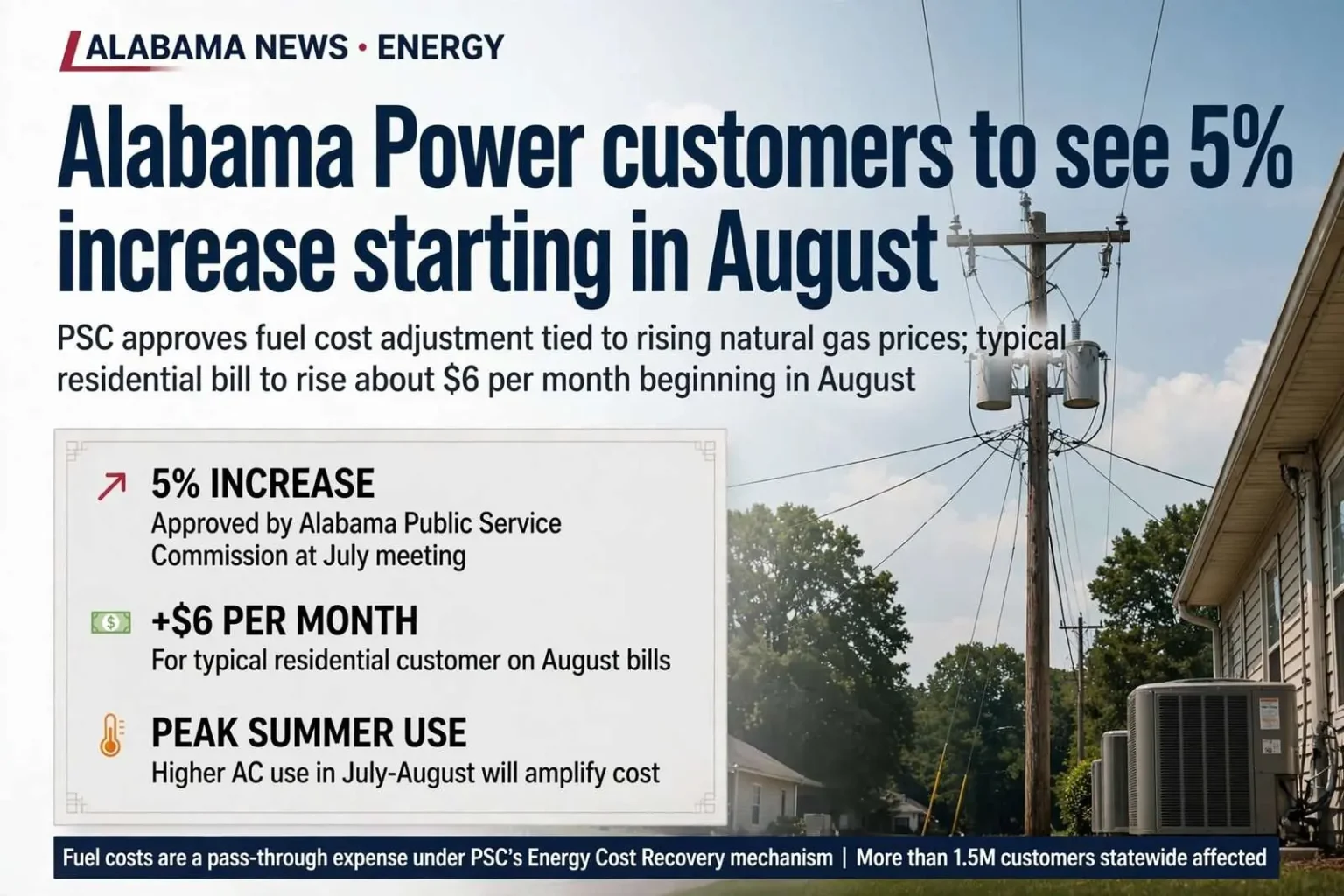
Alabamians will pay more to keep the lights on this summer after the state Public Service Commission approved a rate adjustment tied to rising fuel costs. The PSC granted Alabama Power a 5 percent increase during its July meeting, and the higher charges will show up on customer bills in August. The utility pegged the change at about $6 more per month for the typical residential customer.
The increase arrives during the heaviest usage stretch of the Alabama year, when air conditioning drives residential consumption to its annual peak and a per-kilowatt-hour change is felt at its fullest in monthly totals. A typical household running window units or a central system through July and August heat can easily see the $6 figure climb higher, since the adjustment applies to usage rather than arriving as a flat fee.
Commissioners blamed the increase on the sharply higher cost of natural gas and other fuels used to generate electricity. Natural gas plays a major role in the Southeast’s generation mix, setting the market price for power across the region during most hours, and when gas prices spike, the effect ripples through every utility that buys or burns it. Alabama Power’s fleet also includes coal and nuclear and hydroelectric resources, but fuel-sensitive generation remains a large enough share of the stack that global commodity swings show up directly on residential statements.
PSC President Twinkle Andress Cavanaugh said fuel is a pass-through expense that rises and falls with the market and that Alabama Power is not permitted to profit from it. The distinction matters to how the increase should be understood: this is not a general rate hike that adds to the utility’s earnings. It is a recovery mechanism for the actual cost of coal, gas and other inputs the company purchases on the open market, and under the regulatory framework those dollars are supposed to move through the company to fuel suppliers without margin attached.
Alabama Power External Affairs Manager Beth Thomas said the company worked to keep costs low but was forced to adjust the rate because of fuel prices. “Beginning in August, the typical residential customer bill will increase by about $6 a month to cover this higher cost of fuel,” she wrote. The company’s position is that hedging, long-term contracts and fuel-mix management can only cushion so much when the underlying commodity moves as sharply as it has, and that the pass-through mechanism exists precisely so fuel volatility does not have to be absorbed in the base rates that fund plants, poles and lines.
How the increase works
Each month the PSC calculates Alabama Power’s Energy Cost Recovery figure — essentially what the company pays for the fuels it uses to make electricity. Because the PSC guarantees the utility a set rate of return, Alabama Power can request a rate increase to pass higher fuel costs along to customers when they spike. The monthly recalculation is designed to work in both directions: when fuel is cheap, the recovery factor is supposed to fall and customers are supposed to see the benefit on their bills.
That mechanism is a defining feature of how Alabama regulates its largest electric utility. Rather than waiting for a formal rate case — a lengthy process that examines the company’s whole cost structure and can take a year or more — the fuel factor allows quicker adjustments tied narrowly to commodity prices. Critics of the arrangement have long argued that it moves increases onto bills faster than it moves decreases, while defenders say it protects the utility’s credit rating and shields base rates from volatility that no company can control.
For customers, the practical effect is that two line-item forces shape the bill each month: the base rate covering infrastructure and operations, and the fuel component that tracks the market. The August increase lands entirely in the second category, which is why commissioners and company officials alike have framed it as a cost-of-fuel change rather than a change in what Alabama Power earns.
With more than 1.5 million customers, a $6-per-month increase across residential accounts works out to roughly $9 million in additional revenue each month, or about $108 million a year. Those aggregate figures illustrate the scale behind a number that looks modest on a single statement: multiplied across every household in the company’s service territory — which stretches from the Gulf Coast through central Alabama and includes most of the state’s population centers — the adjustment becomes one of the larger single-year revenue shifts the utility has sought through the fuel mechanism in recent memory.
Neither the PSC nor Alabama Power released the underlying figures on which the latest increase was based, and the company did not say whether the adjustment would be rolled back if fuel prices fall. That lack of detail has frustrated customer advocates, who note that the pass-through mechanism’s credibility depends on symmetric treatment — increases arriving promptly when fuel is expensive and decreases arriving just as promptly when it is not. Whether the August figure is revisited downward in the months ahead will be the test customers can actually observe on their own bills.
The timing compounds the sting for households already managing summer budgets. Gulf Coast and central Alabama summers routinely produce months of heavy air conditioning use, and a customer whose August usage runs 30 to 40 percent above a mild-month baseline would feel both the usage and the rate change at once. For fixed-income households, the seasonal peak plus a 5 percent fuel adjustment can push a monthly electric statement into territory that forces trade-offs elsewhere in the budget.
Fixed-income households can also find assistance beyond the utility itself. Community action agencies across Alabama administer federal energy assistance programs during the hottest and coldest months, and church and charitable funds in many counties help bridge emergency shut-off situations. None of those resources erase the fuel increase, but for households closest to the margin, they can make the difference in keeping service connected through the peak season.
What customers can do
Customers looking to blunt the increase have a handful of standard options. Levelized billing, which averages usage across the year so summer peaks do not produce single outsized statements, spreads the seasonal burden rather than reducing it. Weatherization — sealing ductwork, adding attic insulation, shading windows and maintaining air conditioning units — addresses the largest driver of Alabama residential consumption directly, since cooling typically dominates the household electric load here far more than heating does.
Alabama Power also operates efficiency programs that offer home energy evaluations and rebates for qualifying upgrades, and the company has an interest in helping customers manage usage even as it recovers fuel costs. Simple behavioral changes carry real weight in a climate like South Alabama’s: raising thermostat settings a couple of degrees when the house is empty, running washers and dryers in cooler evening hours, and keeping filters changed all trim kilowatt-hours that would otherwise be billed at the new, higher fuel rate.
For customers who believe their bill reflects an error or an unexplained jump, the PSC maintains a consumer affairs function that takes complaints and can review billing disputes with the utility. It is worth noting that a fuel-factor increase applies uniformly across the residential class — a higher bill in August compared with July may simply reflect both heavier usage and the new rate together.
The bigger regulatory picture
The July approval is a reminder of how Alabama’s utility regulation differs from neighboring states. The Public Service Commission’s three elected commissioners set rates for the state’s investor-owned utilities, and Alabama Power — part of the Southern Company system — is by far the largest entity under its jurisdiction. The combination of a guaranteed return on infrastructure and a monthly fuel mechanism gives the company a stable financial footing that its bond ratings reflect, while leaving customers exposed to commodity markets through the fuel line on their bills.
Natural gas markets, in particular, have been volatile in recent years, swinging with production levels, export demand and weather across the country. Utilities throughout the Southeast have sought similar fuel recoveries as the commodity price moved, meaning Alabama customers are not experiencing something unique — but the state’s heavy summer cooling load means the swings tend to be felt here with particular force.
Customers will see the new charges beginning with August statements. Whether the PSC adjusts the fuel factor downward in future months — as the mechanism is designed to allow — remains the open question, and the one that will determine whether the August increase is remembered as a one-summer adjustment or the start of a longer stretch of elevated bills. In the meantime, the line to watch on the statement is the fuel component itself: it is the piece that moves month to month, and it is where any future relief would have to appear first.