
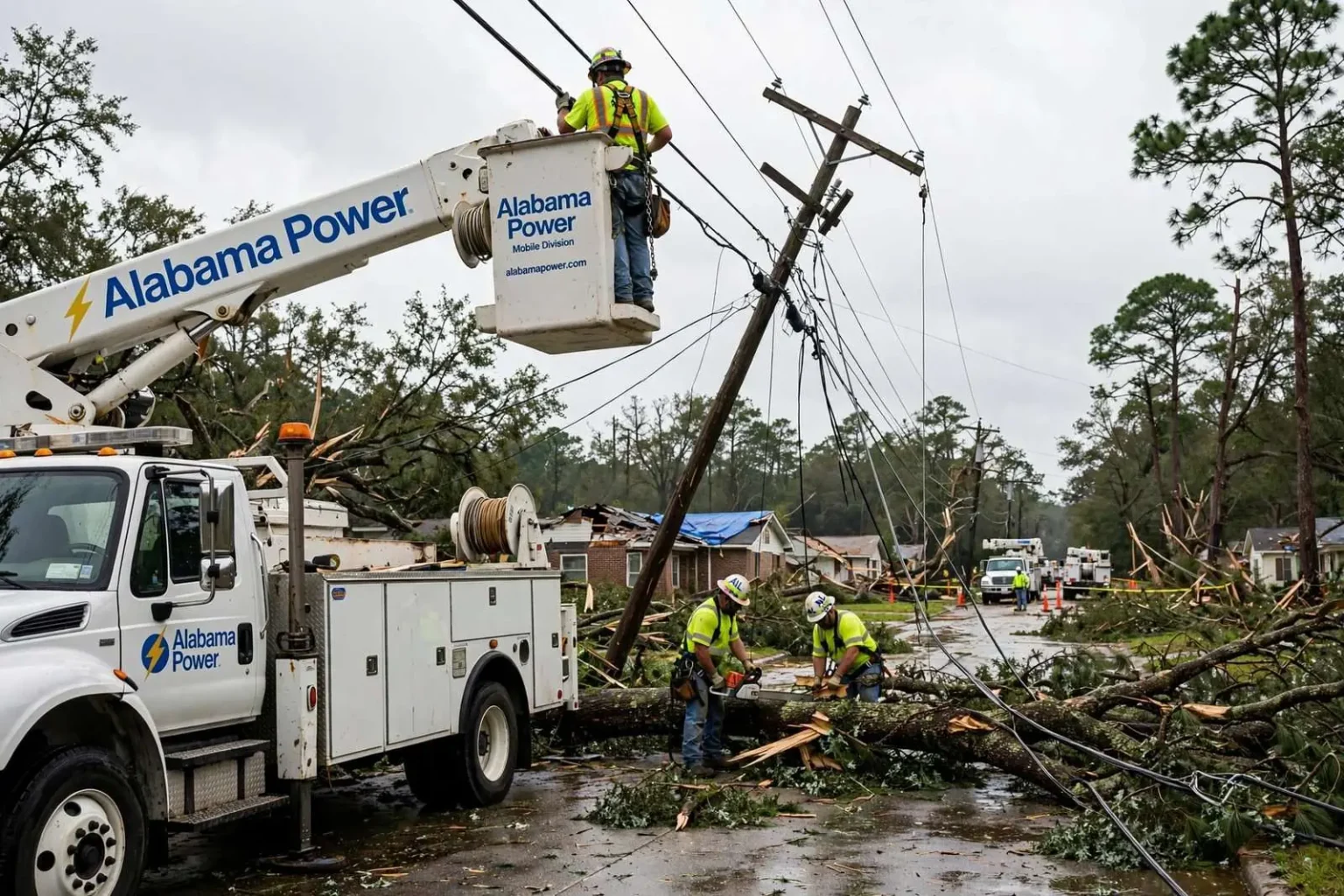
MOBILE, Ala. — Alabama Power said Saturday that roughly 21,000 customers across its Mobile Division remained without electricity, a figure the utility described as less than 15 percent of the customers who lost service when Hurricane Sally battered the Gulf Coast earlier in the week. In a noon update issued from Mobile, the company said crews were continuing to make significant progress restoring power throughout the region, working across Mobile County as well as in Bay Minette, Atmore, Brewton and Monroeville.
The Saturday numbers told a story of steady, hard-won progress. In the days immediately after Sally’s landfall, hundreds of thousands of customers across south Alabama sat in the dark — traffic lights dark at major intersections, gas stations unable to pump, grocery stores running on generators or shuttered entirely. By the weekend, the utility could report that the overwhelming majority of its storm-affected customers had been returned to service, with the remaining work concentrated in the neighborhoods where damage proved most severe.
Crews Spread Across Multiple Counties
Sally came ashore near Gulf Shores on September 16, 2020 as a Category 2 hurricane, and its slow movement knocked down trees and power lines across a wide swath of south Alabama. The storm’s crawling pace — it drifted inland at little more than a walking speed — meant that communities along and north of the coast endured hours of destructive winds on top of heavy rainfall, and the damage pattern reflected it: mature oaks and pines toppled onto homes, roads and above all onto the power lines strung along nearly every street.
That tree damage is what made Sally’s restoration effort so labor-intensive. Unlike a windstorm that simply tears lines from poles, a major tree-fall event requires crews to clear debris before a single line can be restrung, and in older coastal neighborhoods where oaks arch over the streets, almost every span had something across it. Line workers from across the region converged on the damaged areas, working sixteen-hour days in steamy late-September heat to cut, clear and rebuild.
Restoration work after such a storm typically proceeds in stages, with damage assessments first, then repairs to transmission lines, substations and main distribution lines before individual services are reconnected. The sequence is deliberate and sometimes frustrating to customers watching crews pass their house without stopping. Transmission lines and substations come first because they carry power for entire communities; until they are repaired, restoring individual homes accomplishes nothing, since there is no electricity to deliver to them.
Assessment itself is a massive undertaking after a storm like Sally. Utilities deploy helicopters, drones and ground patrols to catalog broken poles, downed spans and damaged equipment, feeding the results into a restoration model that estimates how many customers each repair will bring back online. That triage process is why some neighborhoods get power back within a day while others wait a week or more — the repairs are sequenced by the number of customers each one restores, not by the order in which complaints arrive.
The Mobile Division serves customers across southwest Alabama, an area where tens of thousands of residents saw outages at the height of the storm. The division’s territory reaches from Mobile and Baldwin counties north into communities like Atmore near the Florida line, Brewton along the Escambia County line, and Monroeville, the Monroe County seat best known as the hometown of “To Kill a Mockingbird” author Harper Lee. In the small towns and rural stretches between them, overhead lines run for miles through pine forest, and every mile of storm-damaged line has to be patrolled on foot or by truck.
Rural restoration poses its own challenge. In city neighborhoods, one repaired main line may return service to hundreds of homes; along a rural route, the same repair might benefit a dozen families. That arithmetic means outlying communities — farmhouses, small towns, volunteer fire department districts — are often among the last restored, even when crews are working at full tilt, and it explains why towns like Atmore, Brewton and Monroeville remained on the utility’s active restoration list days after the lights were back on in much of Mobile.
Utility officials have repeatedly urged residents to stay clear of downed lines and to treat every fallen wire as energized while crews work. The warning is not boilerplate: after a hurricane, lines that appear dead can be re-energized without warning as repairs upstream restore current, and lines tangled in fallen trees or standing water can energize fences, gutters and puddles far from the break itself.
What Customers Were Told
Saturday’s update put the remaining outage count at about 21,000, meaning crews had already restored service to the vast majority of customers affected by the storm in the days since landfall. Less than 15 percent of those originally in the dark remained without power — a figure that translates the week’s work into plain terms: for every hundred customers who lost electricity when Sally came ashore, fewer than fifteen were still waiting by Saturday noon.
Alabama Power encouraged customers still without electricity to report their outage and to watch for line crews working along roadsides. Reporting matters even when neighbors have already called, because utility outage maps rely on customer reports to pinpoint where problems persist and to confirm whether a repair has actually returned service. The company also reminded customers to give repair crews room to work — a matter of both safety and speed, since a crew that must stop to move spectators or clear a blocked lane is a crew that is not restoring power.
For customers still in the dark, the weekend update carried practical weight. Residents running portable generators were reminded to keep them outdoors and away from windows, since improper generator use produces carbon monoxide that has killed more people after Gulf storms than the storms themselves in some years. Food safety is the other recurring concern: a refrigerator keeps food safe for roughly four hours unopened, a full freezer for about two days, guidance that becomes urgent for households entering their fourth or fifth day without power.
A storm that tested the grid
Sally was the second hurricane to strike the Alabama coast in the span of a few years, and its slow, drenching passage joined a list of Gulf storms — Ivan, Katrina, Dennis, Frederic before them — that have shaped how coastal utilities build and restore their systems. Each major storm drives the same cycle: hardening projects that strengthen poles and trim vegetation, followed by the discovery that no amount of hardening fully protects overhead lines from falling trees in a Category 2 landfall.
The damage Sally inflicted fell hardest on Baldwin County, where the storm’s core came ashore, but the effects reached well inland. Pensacola, just across the state line, took a severe hit from the same circulation, while Mobile — on the storm’s western side — still saw days of outages. Rivers and creeks across south Alabama flooded for days after the winds had passed, complicating repair access to lines along low-lying corridors and forcing crews to reach some work sites by alternate routes.
Local governments spent the same week clearing roads and opening distribution points for food, water and ice, work that runs on a parallel track to power restoration. Schools that lost electricity closed until systems could be restored, and businesses without power lost revenue at the height of the shrimp and tourist seasons. For communities along the coast, the economics of a power outage after a hurricane compound quickly — which is one reason utilities measure their performance in restoration hours and communicate progress with daily updates like the one issued from Mobile on Saturday.
The noon update was, in the end, a progress report on the last mile of a long effort. The customers still without electricity as the weekend began were concentrated where the storm hit hardest and where the repair work is most detailed — the individual service lines that connect homes to the restored network around them. Utility officials said work would continue through the weekend until every customer who could take power was restored, and asked for continued patience from the neighborhoods where the lights had not yet come back on.
The restoration timeline also reflects the scale of the workforce involved. After a landfalling hurricane, utilities routinely call on mutual assistance networks that move line crews, bucket trucks and material convoys from unaffected states toward the damage zone, staging them at assembly points before fanning out along the feeders with the most customers out. Coordinating that influx — housing, fuel, security, meals — is itself a logistics operation that runs around the clock from mobile command posts.
Weather cooperation matters too. Crews cannot work from elevated buckets when lightning or high gusts threaten, and Sally’s slow exit was followed by days of typical Gulf Coast heat and afternoon storms that periodically suspended work. Every pause extends the timeline, which is why utilities build weather contingencies into their public estimates and why customers are urged to plan for outages that may run longer than the storm itself.
As repairs wrap up, the utility begins the accounting that follows every major storm: thousands of poles, transformers and spans of wire replaced, and millions of dollars in restoration costs that are eventually detailed in regulatory filings. For the customers of the Mobile Division, though, the number that mattered on Saturday was simpler — about 21,000 neighbors still waiting, and crews still on the ladders and in the buckets until the last of them were restored.