Alabama Power Outlines Plan to Close Coal Ash Ponds at Plant Barry During Public Meeting in Satsuma
At a public meeting in Satsuma, Alabama Power detailed plans to excavate and relocate coal ash at Plant Barry, reducing the pond footprint by 45%.
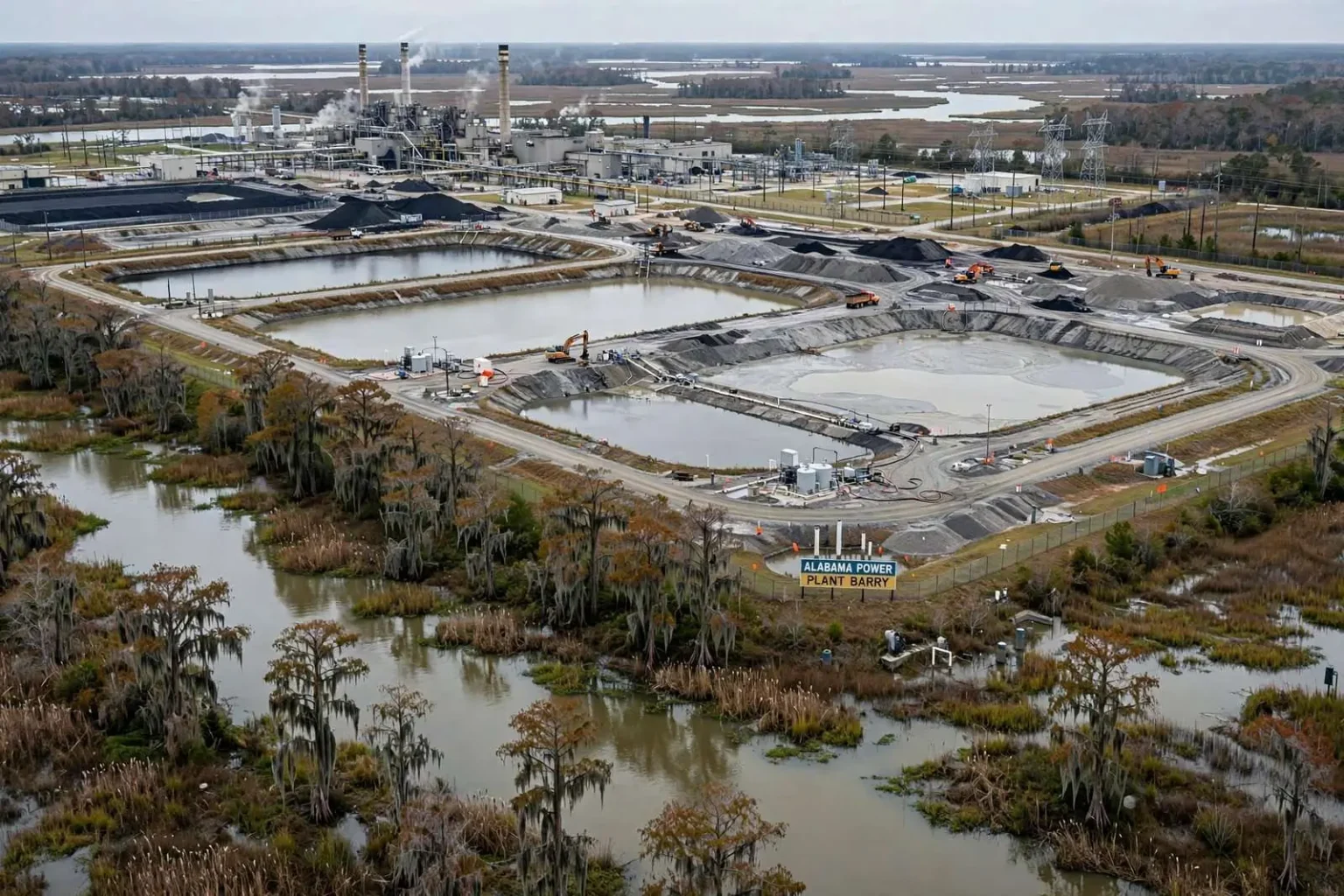
SATSUMA, Ala. — Alabama Power held a public meeting Tuesday in Satsuma to discuss its plans for permanently closing the coal ash ponds at Plant Barry, the company’s coal-fired generating station on the Mobile River near Bucks.
Under the plan outlined at the meeting, the utility said it would treat and remove all water from the ponds, then excavate the remaining coal ash and relocate it at least 750 yards away from nearby waterways. The company also said the footprint of the ponds would be reduced by roughly 45 percent.
Years of Scrutiny
Coal ash — the residue left after coal is burned to generate electricity — contains heavy metals including arsenic, mercury and selenium that can leach into groundwater if stored in unlined ponds.
Environmental groups have long raised concerns about the proximity of Plant Barry’s ash storage to the Mobile River and the Mobile-Tensaw Delta, one of the largest river delta systems in the United States.
The closure plan presented at the Satsuma meeting represented the company’s stated approach to addressing those concerns, though environmental advocates have continued to push for full excavation and removal of all ash from the site rather than any partial measures.
Plant Barry, located in northern Mobile County, has operated since the 1950s and has been one of the focal points of coal ash storage debates in Alabama.
What the Plan Would Do
The sequence described by the company begins with water: treating and removing all of it from the ponds that currently hold decades of ash in slurry form. Removing water is the first structural step in closing a wet ash pond, reducing the pressure and the risk that carried contaminants pose to nearby waterways.
Excavation of the remaining ash follows, with the material relocated to a position at least 750 yards from nearby waterways and the pond footprint reduced by roughly 45 percent. The company presented the plan at the Satsuma meeting as the permanent closure path for the ponds, the point at which ash storage at the site stops relying on open impoundments.
For residents of Satsuma, Axis, Bucks, Mount Vernon and the other communities that surround the plant in northern Mobile County, the details of that sequence are not abstract. The groundwater beneath the area, the fishing waters of the Mobile River and the reaches of the Mobile-Tensaw Delta are the resources at stake in how, and how fully, the ash is ultimately contained.
Why the Location Is So Contested
Plant Barry’s ash ponds sit beside the Mobile River near Bucks, upstream of the delta system that connects Mobile Bay to a vast network of rivers, wetlands and bottomland forest. The Mobile-Tensaw Delta is among the largest river delta systems in the United States and is widely regarded as one of the most ecologically significant landscapes in Alabama, supporting extraordinary biodiversity and feeding the estuary at the head of Mobile Bay.
It is that proximity — millions of tons of coal ash stored in unlined ponds next to the waterway that feeds the delta — that has made Plant Barry the center of Alabama’s coal ash debate. Heavy metals in the ash, including arsenic, mercury and selenium, are the specific concern: if they leach into groundwater or reach surface water, they move into the same system that supplies the region’s fisheries and recreation.
Environmental groups have pressed for years for the ash to be fully excavated and removed from the site entirely, arguing that in-place or near-in solutions leave the material where the risk began. The company’s plan, as outlined Tuesday, stops short of that full removal, which is why advocates said after the meeting that their push will continue.
The Plant and Its Ash Ponds
Plant Barry has generated electricity on the Mobile River since the 1950s, burning coal for much of that history and accumulating ash in the pond system at the site. The facility has long been one of the largest generators in the state’s fleet and one of the defining industrial presences on the upper reaches of the Mobile River, alongside the paper and chemical operations that line the corridor north of Mobile.
The ponds where that ash has been stored are the legacy of decades of wet ash handling: ash mixed with water and piped into impoundments, where solids settle and water is discharged under permits. Regulators nationwide have required utilities to close those impoundments, and the Satsuma meeting presented Alabama Power’s plan for doing so at Barry.
The scale of the storage is what makes closure a years-long undertaking. Treating and removing all water, excavating ash that accumulated over generations of generation, relocating it 750 yards or more from waterways, and shrinking the pond footprint by roughly 45 percent each represent major construction campaigns on their own.
What Residents Asked and Heard
Public meetings like the one in Satsuma are where the neighbors of an industrial site get to hear the plan directly and press on the details: where the relocated ash will sit, how groundwater will be monitored, what happens during extreme weather, and how long the work will take. The company’s answers Tuesday centered on the plan’s stated safeguards — water treatment and removal, excavation, the 750-yard buffer from waterways and the reduced footprint.
Community members in the communities nearest the plant, including Satsuma, Axis, Bucks and Mount Vernon, have lived with the ash ponds as a backdrop for decades. For them, the measure of the plan will be what it does to protect the groundwater under their homes and the river at their backs.
Environmental advocates attending the meeting repeated their long-standing position that partial measures do not go far enough, and that full excavation and removal of all ash from the site — away from the Mobile River and the delta — remains their goal. The company’s plan will now be measured against that standard as it moves forward through regulatory review and construction.
Coal Ash Regulation in Brief
Coal ash is regulated federally as coal combustion residuals, with rules governing how ponds are closed, how groundwater is monitored and what standards the closed sites must meet. Utilities across the country have responded by closing unlined impoundments, either by removing ash to lined landfills or by capping ash in place, and the choice between those approaches has driven most of the disputes.
In Alabama, Plant Barry’s ponds have been the most closely watched case, because of the volume of ash stored there and the sensitivity of the surrounding environment. The plan outlined in Satsuma — treat and remove all water, excavate, relocate at least 750 yards from waterways, cut the footprint by about 45 percent — puts the company on the path of moving ash rather than capping it where it lies, a distinction advocates say matters even as they continue to call for the ash to leave the site entirely.
The permanent closure of the ponds, once completed, will end the era of open impoundment storage at the plant and settle, at least structurally, a debate that has run for years in northern Mobile County.
The Stakes for the Delta
The Mobile-Tensaw Delta is the ecological heart of southern Alabama: hundreds of thousands of acres of rivers, creeks, marshes and bottomland forest where the Alabama and Tombigbee rivers meet and wind toward Mobile Bay. Its species counts rank among the richest of any delta system in the country, and it anchors the fisheries, hunting and recreation that define life along the Gulf Coast’s northern rim.
That is why the location of Plant Barry’s ash storage, on the Mobile River near Bucks, has drawn scrutiny far beyond the neighborhoods nearest the plant. Contaminants that reach groundwater or surface water at the site have a direct path into the delta’s watershed, and the heavy metals in coal ash — arsenic, mercury and selenium among them — are exactly the class of pollutants that accumulate in the food chain.
The company’s closure plan, with its 750-yard relocation buffer and 45 percent footprint reduction, is presented as the way to secure the material while it remains in the area. Environmental groups’ full-removal position is presented as the way to secure it by taking it away. Between those positions sit the regulators, the monitoring data and the years of construction the plan will require.
What Comes Next
The Satsuma meeting was a step in a longer process. Closing a pond system of this scale involves regulatory approvals, groundwater monitoring regimes, and construction phases that unfold over years, with the public meetings giving residents a window into the plan as it advances.
For the company, the stated commitments are fixed: treat and remove all water from the ponds, excavate the remaining coal ash, relocate it at least 750 yards from nearby waterways, and reduce the pond footprint by roughly 45 percent. For the advocates, the commitment they want added is simple: take all of the ash away from the Mobile River and the delta entirely.
Residents of northern Mobile County will be watching both, because the outcome will determine how the upper Mobile River — and everything downstream of it — coexists with decades of coal ash from a plant that has operated since the 1950s.
The meeting in Satsuma was part of that reckoning, and the plan it presented now moves forward under the scrutiny of the communities and conservation groups who have followed Plant Barry’s ash ponds longer than the closure plan has existed.