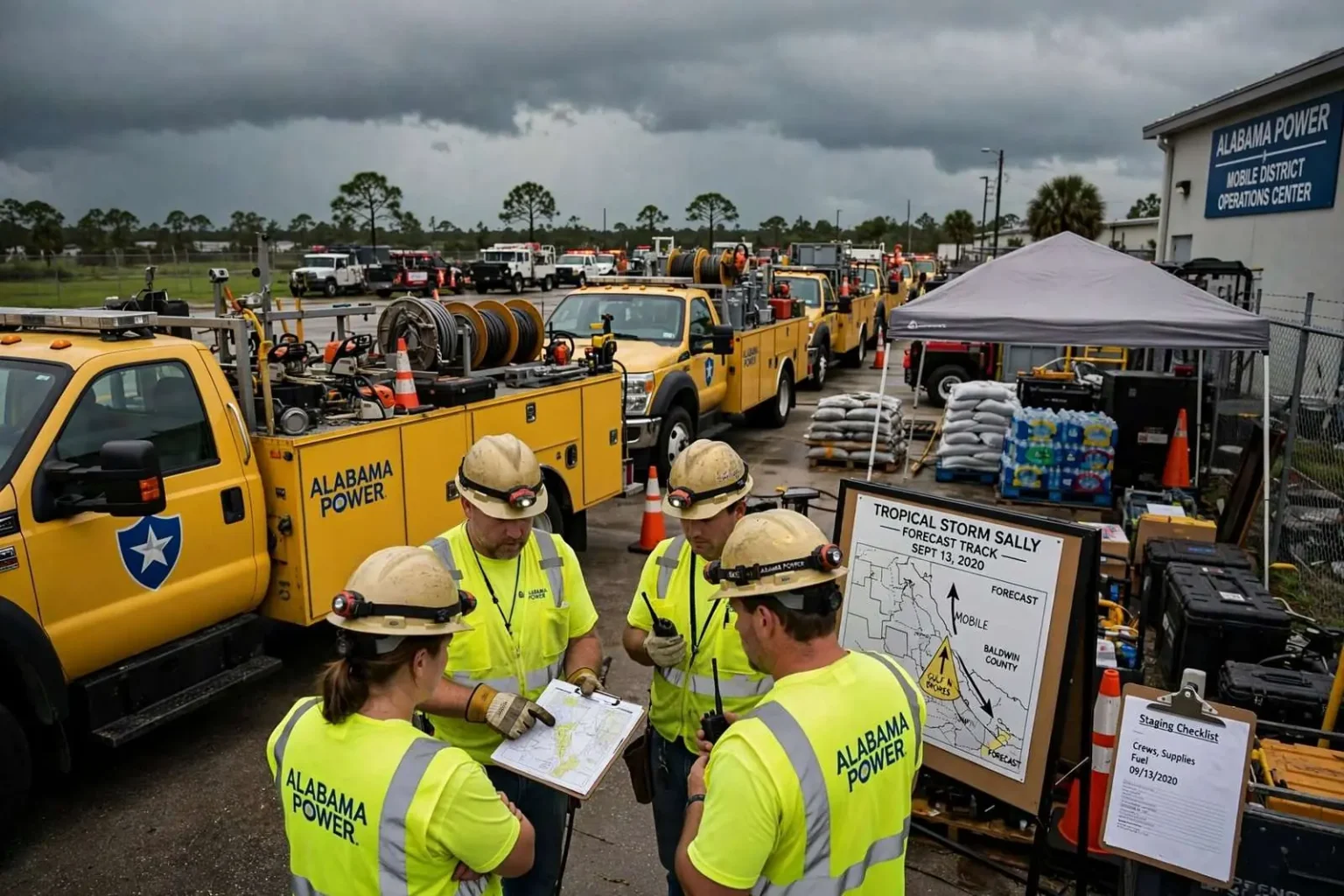
MOBILE, Ala. — Alabama Power said Sunday that it was preparing for Tropical Storm Sally and urged south Alabama residents to do the same, as the storm was expected to strengthen and move toward the Gulf Coast. In a news release issued September 13, 2020, the utility said it was staging crews and equipment and monitoring the storm’s track, while encouraging customers to review their own disaster plans and make sure they had supplies on hand.
The preparations came during an already active hurricane season for the utility. Tropical Storm Cristobal had dumped heavy rain on the Mobile area in June, and more than 350 Alabama Power employees had just returned from Louisiana and Texas, where they helped restore electrical service after Hurricane Laura made landfall in late August.
Sally would go on to strengthen into a Category 2 hurricane before making landfall near Gulf Shores on September 16, knocking out power to tens of thousands of customers across Mobile and Baldwin counties and causing widespread wind and flood damage. The utility reminded residents to have a personal disaster plan, keep emergency supplies available and stay informed about the storm’s progress. Alabama Power also encouraged customers to report outages through its online tools once the storm passed and to stay away from downed power lines.
The utility’s staging operations ahead of landfall follow a playbook the company has refined through years of Gulf storms. Crews and repair equipment are pre-positioned at yards near the expected impact zone so restoration can begin as soon as winds drop to safe levels; linemen, tree crews and assessors are scheduled in waves; and mutual-assistance agreements with other utilities can bring in hundreds of additional workers when damage outstrips local crews. Alabama Power serves roughly 1.5 million customers across the southern two-thirds of the state, with its service territory covering Mobile, Baldwin and the rest of south Alabama — exactly the area Sally’s forecast cone covered as the storm drifted north through the Gulf.
The company’s storm communications run alongside the official emergency network. Mobile County’s emergency management agency and its Baldwin County counterpart coordinate evacuation recommendations, shelter openings and local alerts, while the National Hurricane Center’s advisories provide the forecast baseline. Utilities, hospitals, school systems and municipal governments all make their own staging decisions from the same advisories, which is why residents hear consistent guidance in the days before landfall — and why a utility statement like the September 13 release is both a company announcement and a piece of the region’s broader warning system.
For customers, the hours before landfall are also the last chance for household-level protection. Trimming or clearing damaged tree limbs before a storm, securing patio furniture, photographing property for insurance, charging devices and filling bathtubs all happen in that window. After the storm passes, the utility’s guidance picks up again: check for electrical damage before restoring power to a wet home, never run generators indoors or in attached garages because of carbon monoxide, and let line crews work without interference near damaged equipment.
Sally’s slow crawl toward the coast was the defining challenge of the storm. Forecasters watched the system meander in the north-central Gulf for days, shifting the forecast track east and west before settling on the central Gulf Shores landfall, and the storm’s sluggish forward speed after landfall meant hours of sustained tropical-force winds rather than the brief punch of a faster hurricane. Prolonged winds are what break poles, snap crossarms and uproot trees into power lines — and Sally delivered hours of them across the populated coastal counties.
A storm season that kept the utility busy
The 2020 Atlantic hurricane season was among the most active on record, and Alabama Power’s summer had already been shaped by it. Tropical Storm Cristobal came ashore in Louisiana in June and sent bands of heavy rain into the Mobile area, soaking ground that Sally’s September rains would later saturate further. Then came Hurricane Laura, one of the strongest hurricanes on record to strike Louisiana, and Alabama Power’s mutual-aid response sent more than 350 employees west to help restore power in Louisiana and Texas — the kind of long-distance deployment the industry’s mutual-assistance network makes routine, and the kind that a company must absorb before its own storm arrives.
That shared-crew arrangement runs both directions. Utilities across the Southeast and Gulf Coast pool labor and equipment through regional mutual-assistance groups, and Alabama Power has both sent crews to distant disasters and hosted out-of-state crews during its own storms. When Sally struck, that network meant line workers from neighboring states joined the restoration effort, moving subdivision by subdivision through Mobile and Baldwin counties as damage assessments came in.
What the utility told customers to do
The company’s pre-storm guidance to customers followed the standard Gulf Coast checklist. A personal disaster plan means knowing whether a home is in an evacuation zone, deciding in advance where the household would go, and arranging for pets and medications. Emergency supplies mean water, non-perishable food, flashlights, batteries, a battery-powered radio and phone chargers — enough for several days without power. Staying informed means monitoring National Weather Service forecasts and local officials rather than relying on word of mouth as the track shifts.
The warnings about downed power lines carried particular weight. After a hurricane, lines that look dead can be energized, and energized lines can charge fences, tree limbs, standing water and other metal objects nearby. The utility’s standing instruction is to treat every downed line as live, stay far away, and report it rather than approach it. Customers were also reminded to report outages through the company’s online tools — the Alabama Power app and website — which feed outage maps that help dispatchers prioritize restoration work.
Restoration after landfall proceeds by triage. Critical facilities — hospitals, water systems, emergency operations centers — come first, followed by the transmission lines and substations that serve large numbers of customers, then distribution feeders and finally individual service drops. In coastal counties like Mobile and Baldwin, where Sally’s wind damage was concentrated, the damage assessment that precedes that work takes its own time, because assessors must see every feeder before the true scope is known.
What Sally became
The storm the utility was watching on September 13 made landfall before dawn on September 16 near Gulf Shores as a Category 2 hurricane, with the eyewall’s strongest winds driving ashore in coastal Baldwin County. The combination of wind and water was severe: trees and power lines came down across the two coastal counties, signs and roofs failed along the beach highways, and the storm’s slow passage pushed exceptional rainfall into the rivers and bays of southern Alabama and the western Florida panhandle. Tens of thousands of Alabama Power customers lost electricity, and some of the hardest-hit neighborhoods remained without power for days as crews cut their way through blocked roads.
Flooding compounded the wind damage well inland from the beaches. Rivers including the Styx and the Perdido system rose over their banks in the days after landfall, flooding homes in communities like Seminole and Lillian that had taken little wind damage, and closing roads across southern Baldwin County. For the utility, that geography matters: restoring power to a flooded neighborhood is not only a line-repair problem but a safety question, since energized equipment in standing water cannot be re-energized until floodwater recedes and equipment is inspected.
The September 13 announcement — issued while Sally was still a tropical storm expected to strengthen — captured the interval in which coastal residents make their most important decisions. Storm experts repeatedly stress that the window between a watch and landfall is when supplies should be bought, plans finalized and evacuation decisions made, because conditions deteriorate well before the center arrives and roads begin flooding as the storm approaches. Alabama Power’s Sunday message, urging customers to prepare rather than wait, was part of that coordinated effort by utilities, emergency management agencies and local officials to move the public ahead of the storm.
For south Alabama, the sequence of the 2020 season — Cristobal’s June rains, Laura’s late-August devastation to the west, and Sally’s September landfall — served as a case study in why preparedness has to be continuous. Utilities stage crews, and families keep plans current, because the Gulf offers no off-season guarantee: a quiet August can be followed by a September that rewrites a county’s map. Sally proved the point from Gulf Shores to the Styx River, and the restoration effort that followed — local crews reinforced by mutual aid from neighboring states, working subdivision by subdivision through Mobile and Baldwin counties as assessments came in — showed the system the utility had staged for, doing the work it was staged to do. It was the same system that had carried crews to Louisiana and Texas only weeks earlier, now pointed at Alabama’s own coastline.