
Alabama Power Restores Service After Transmission Failure Blacks Out 3,000 Downtown Mobile Customers
An Alabama Power transmission system failure cut electricity to about 3,000 downtown Mobile customers on Oct.
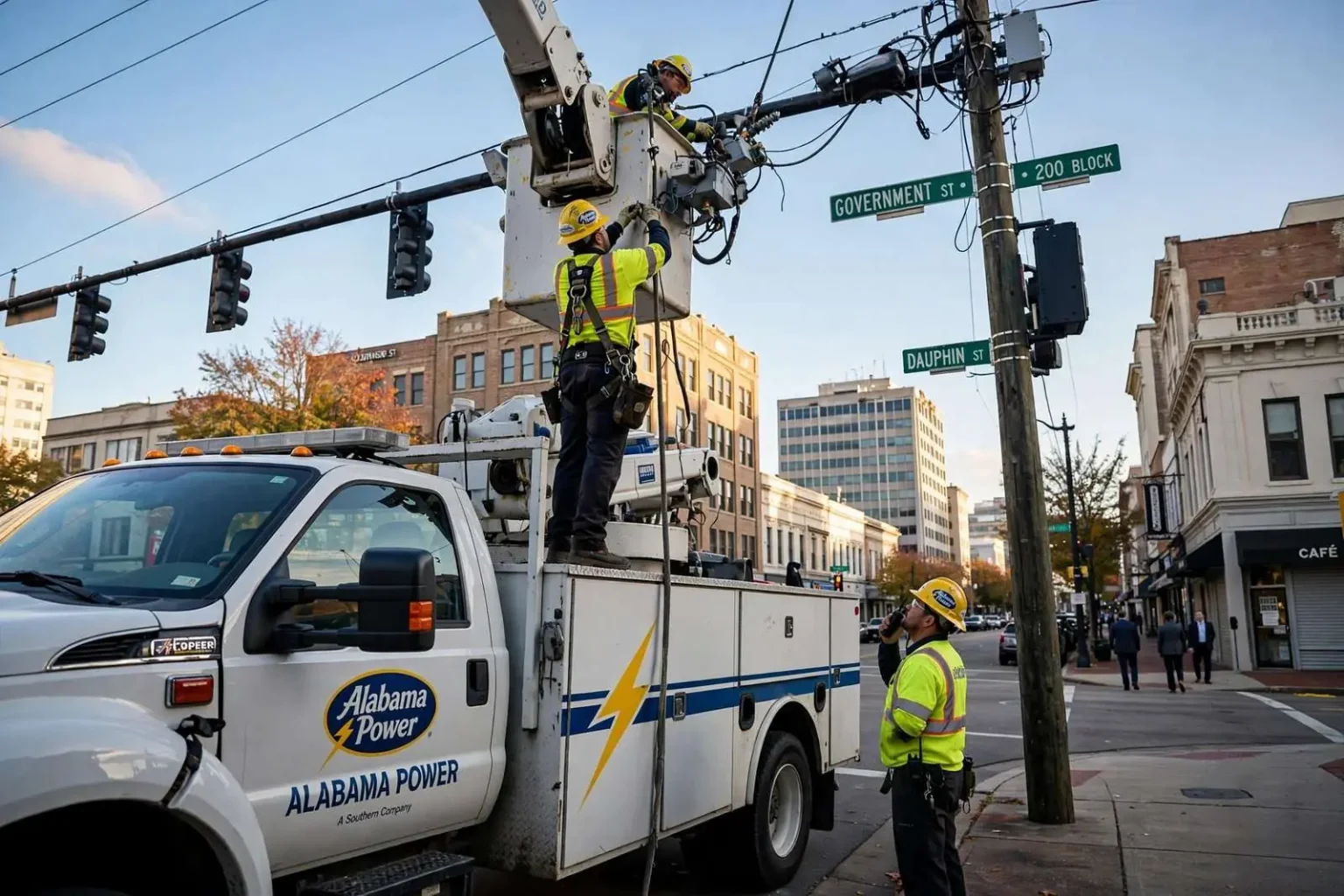
Alabama Power crews restored electricity to roughly 3,000 customers in downtown Mobile on the afternoon of Oct. 29, 2019, about an hour after a failure in the utility’s transmission system cut service to the area. The company reported the outage shortly after 4 p.m. and attributed it to equipment failure within its transmission network rather than weather — a bright, otherwise ordinary autumn afternoon in the city’s business district, interrupted without warning when a piece of the high-voltage grid gave way.
Response was swift. Crews targeted full restoration within the hour, and by 4:30 p.m. Alabama Power confirmed that all downtown customers were back online. Downtown businesses experienced only a brief interruption thanks to the quick turnaround — long enough for office workers to notice their monitors flicker and for traffic signals to go dark at some intersections, but short enough that the disruption left little lasting trace on the business day.
What happened on the grid
The failure occurred in Alabama Power’s transmission system, the high-voltage backbone that moves electricity from generating plants toward communities. That network is distinct from the distribution system — the neighborhood-level poles and wires that deliver power to individual homes and businesses. Transmission failures are less common than storm-related distribution outages, but they can knock out service to large numbers of customers at once because they interrupt power before it ever reaches neighborhood-level lines. When a transmission component fails near a concentrated load center like downtown Mobile, thousands of customers can go dark simultaneously, as happened on this afternoon.
Restoring service after a transmission failure is a different operation from storm repair. Rather than clearing limbs and rebuilding lines across a wide area, crews must isolate the failed equipment, reroute power around it where possible, and bring substations and circuits back in a controlled sequence. When the fault can be isolated quickly and alternative paths exist, restoration can happen remarkably fast — which is exactly what the one-hour turnaround reflected. The crews’ targeted goal of full restoration within the hour was met with roughly ten minutes to spare.
Why downtown matters to the grid
Downtown Mobile concentrates a demanding mix of electrical load in a small footprint: high-rise offices, banks, restaurants, the city and county government buildings, courthouses, and hotels, all packed into the streets near the intersection of Government Street and the historic districts that step down toward Mobile Bay. A sustained outage there would have ripple effects — traffic signals along Government and Convention streets, businesses dependent on refrigeration and computing, and the daily operations of courts and municipal offices. The brief duration meant none of those systems faced serious strain, but the event offered a visible reminder of how much daily commerce depends on the grid’s reliability.
Alabama Power, the state’s largest electric utility and part of the Southern Company system, serves more than a million customers across Alabama, including the Mobile area. Utilities of that scale build redundancy into their transmission networks precisely so that a single equipment failure does not become a prolonged blackout. The quick restoration downtown reflected that design: once the faulted equipment was isolated, the system had alternative routes available to feed the area, and crews could switch customers back without waiting for physical repairs.
Equipment failure versus storm damage
The distinction between equipment failure and weather damage matters to customers for practical reasons. Storm outages — the Gulf Coast has experienced its share, from hurricanes to severe thunderstorms and ice events — typically damage distribution infrastructure across broad areas and take hours or days to repair, because crews must physically rebuild what the weather destroyed. Equipment failures on clear days are usually contained and fast to resolve, because the infrastructure around the fault remains intact.
For the roughly 3,000 affected customers on Oct. 29, 2019, the outcome was the best possible version of a bad situation: a failure in the most consequential part of the network, resolved before the workday ended. By 4:30 p.m., lights were back on across downtown, and the episode passed into the category of brief, well-handled interruptions — the kind most customers remember as a flicker and a pause rather than a disruption.
How the grid is built to recover
The speed of the downtown restoration was no accident. Modern utility grids are engineered with switching capabilities and alternate feed paths that allow operators to work around failed components. Control room operators monitor the network continuously, and when a transmission fault trips a substation or feeder offline, their first task is diagnosis: identifying which component failed and which customers can be restored through unaffected paths. Each step is deliberate, because re-energizing lines too quickly or in the wrong order can damage equipment or endanger crews working on the system.
That sequence — fault detection, isolation, rerouting, verification, and restoration — compressed into about an hour on Oct. 29, 2019, reflects both the design of the network and the training of the crews and operators behind it. Customers saw only the result: a dark hour downtown, then lights on.
For utilities, events like this one also feed maintenance and planning. Equipment failures on clear days identify components that need inspection, replacement, or upgraded protection, and each incident refines the models operators use to keep the system stable. The alternative — waiting for failure during the next hurricane — is the scenario Gulf Coast utilities invest heavily to avoid, given the region’s exposure to tropical weather.
A brief interruption in a busy district
The practical effect on downtown Mobile was minimal. Businesses along Dauphin, Government, Royal, and the surrounding streets lost power for under an hour on a Tuesday afternoon in late October 2019. Some workers stepped outside into the warm afternoon air while computers rebooted; traffic officers or four-way-stop etiquette handled the affected intersections; and by the time most offices closed for the day, the outage was a topic for conversation rather than a loss of revenue. The roughly 3,000 customers affected represented a fraction of Alabama Power’s service territory, concentrated in a few blocks of the city’s core.
Episodes like this one are worth recording precisely because they are rare in their outcome. A transmission-level failure — the kind of fault that can black out large areas for extended periods — was isolated and routed around within the hour, exactly as the utility’s response plan targeted. Downtown Mobile got its afternoon back, and the grid’s engineers got a small, clean demonstration that their redundancy and their crews’ speed work as designed.
The takeaway for customers
For customers, the event of Oct. 29, 2019, carries a couple of practical lessons. First, not all outages are equal: the same number of affected customers can mean a ten-minute switching operation or a multi-day storm rebuild, and the cause determines which. Second, downtown and other concentrated districts sit at the end of the most robust parts of the network, which is why urban outages from equipment failure tend to be short compared with rural storm outages along miles of exposed distribution line.
Alabama Power crews restored the roughly 3,000 downtown Mobile customers that afternoon about an hour after the transmission failure, meeting their restoration target and confirming by 4:30 p.m. that everyone was back online. The failure was equipment, not weather; the response was measured in minutes rather than days; and the interruption, in the end, was barely a comma in the business district’s day — a demonstration of the grid recovering from its own rare hardware fault, exactly the way it was designed to.
Downtown Mobile and its power supply
Downtown Mobile sits on the western bank of the Mobile River where it widens toward Mobile Bay, and its electrical needs have grown with its skyline. The district includes the Renaissance towers, the convention center along the waterfront, Bankhead Tunnel approaches, historic offices on St. Francis and Conti streets, and government buildings including Mobile County’s courthouses. Feeding that mix requires substantial capacity delivered through multiple paths, because a district that concentrates thousands of workers by day cannot tolerate the exposure of a single line serving it. The transmission equipment that failed on Oct. 29, 2019, was part of that high-capacity layer, one level above the distribution feeders that run through the streets and up into the buildings.
When a transmission fault drops that capacity offline, substations lose their source and the feeders go dark, which is why the outage’s footprint covered so much of the business district at once rather than striking a single street. The same concentration that makes downtown an economic engine makes it a visible bellwether for grid health — when something fails upstream, everyone notices together.
October weather and the outage’s timing
The timing of the failure, on a late-October afternoon, underscored its non-weather origin. Late October in Mobile typically brings some of the year’s mildest temperatures, with humidity easing and air conditioning demand falling from its summer peak. There was no storm line, no tropical system, and no ice — conditions that would explain widespread damage. The fault was inside the equipment itself, the kind of internal failure that can happen in transformers, breakers, or other transmission components regardless of the day’s weather.
That context shaped the response as well. With no storm damage to clear and no unsafe conditions slowing crews, technicians could move directly to diagnosing and isolating the fault. Compare that with a hurricane restoration, where crews may spend the first day simply assessing damage across a destroyed network. The hour-long restoration was a product of that difference: a single faulted component in an otherwise intact system, and teams positioned to respond immediately.
Communication during the outage
Utilities also measure themselves on how they communicate during events, and the Oct. 29, 2019, episode followed the modern pattern: the company reported the outage to customers shortly after 4 p.m., identified the cause as transmission equipment failure rather than weather, and announced the restoration target before confirming by 4:30 p.m. that service was fully back. For the businesses and residents affected, that sequence — cause, plan, confirmation — transformed an unexplained blackout into a bounded, managed event.
Customers who experienced the outage saw the standard guidance apply: treat dark traffic signals as all-way stops, check on neighbors in elevators or confined spaces, and avoid calling 911 for information rather than emergencies. In an outage measured in minutes, most of that guidance goes unused — but the framework exists because the same failure type, in worse conditions or with slower repairs, can last far longer.
Two years of perspective
Viewed from years later, the Oct. 29, 2019, transmission failure remains a useful reference point for what a well-handled urban outage looks like: 3,000 customers dark, an hour of disruption, a restoration target met with time to spare, and a downtown that resumed its afternoon as if little had happened. The grid’s high-voltage backbone will always carry the risk of equipment failure — no utility can eliminate it — but the combination of network redundancy, practiced crews, and clear communication determines whether that risk becomes an hour’s interruption or a multi-day crisis. On that Tuesday afternoon in Mobile, it was an hour.