Alabama Power Whittles Mobile, Bayou La Batre Outages Down to Dozens
Alabama Power says outages affecting about 2,500 customers in Mobile and Bayou La Batre are down to roughly 60 remaining.
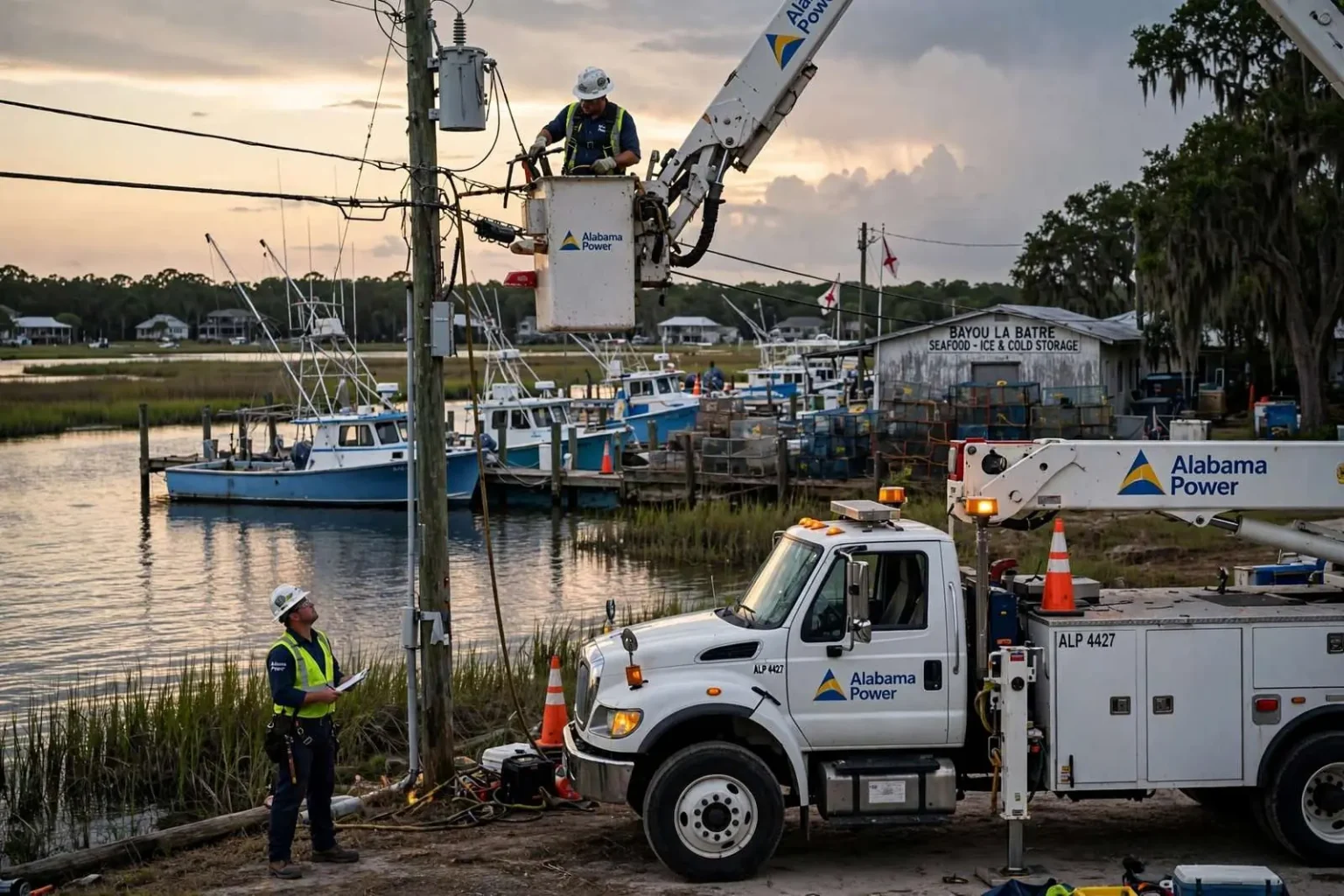
Power has been restored to nearly all of the customers affected by Saturday’s outages in the Mobile and Bayou La Batre areas, according to Alabama Power. The utility reported that line crews made steady progress through the evening, steadily shrinking an outage footprint that had stretched across two south Mobile County communities. For residents who had spent part of their weekend without electricity, the return of service came before the night was out, sparing households a longer disruption during one of the hottest stretches of the summer.
About 2,500 customers were in the dark as of roughly 5:30 p.m. on July 13, when the outages were at their widest. The affected areas covered portions of Mobile and the Bayou La Batre area, a working waterfront community where a loss of electricity is felt well beyond the living room. Seafood processors, ice houses, marinas and cold-storage operations along the bayou all depend on a constant power supply, and even a few hours of darkness can complicate a day’s catch and the schedules of the crews who bring it in.
By late that evening, crews had brought service back for nearly all of those customers, leaving only about 60 still without electricity across the two communities. That remaining figure continued to fall as line technicians moved through the last trouble spots, and Alabama Power said customers still without service at the time were expected to be reconnected as crews finished working through the remaining repairs. The pace of restoration meant most households saw outages measured in hours rather than days.
What the utility said — and what it did not
Alabama Power did not immediately detail what caused the outages. That is a common posture in the hours after a service disruption, and it reflects the practical realities of restoration work. The initial trouble reports that pour in while an outage is underway usually describe symptoms — flashing lights, a loud pop, lines on the ground — rather than the underlying failure, and utilities generally wait until crews have physically inspected damaged equipment before identifying a cause publicly.
Outage causes across south Alabama in mid-July typically include equipment failures, vegetation coming into contact with lines, vehicles striking poles, and damage from summer thunderstorms, which build quickly over Mobile Bay and inland communities on hot afternoons. The utility did not say whether any of those factors were involved in the Saturday disruption, and it did not issue a formal statement beyond its restoration updates.
Company officials did confirm the basic outline of the event: a large cluster of outages on Saturday afternoon, a concentrated repair effort through the evening, and a small number of customers remaining as night settled in. The utility’s public outage information and its customer service channels were the primary sources for updates as the numbers dropped.
Why Bayou La Batre feels outages differently
Bayou La Batre, a small city on the western shore of Mobile Bay, has long been known as the Seafood Capital of Alabama. Its economy is built around commercial fishing fleets, processing plants and boatyards, industries in which electricity is not a convenience but a core input. Refrigeration failures can mean spoiled product, and ice production matters as much to the docks as lighting does to the neighborhoods nearby.
That makes even a short outage more consequential there than in some other communities. When power drops on a July afternoon, processors race to keep cold rooms cold, and households face the same race in miniature as refrigerators warm and freezers begin to thaw. The town has rebuilt repeatedly after hurricanes and coastal storms over the years, and residents are generally practiced at the routines of a disruption, but nobody mistakes that practice for a preference.
In the residential sections of both affected areas, the timing of the outage added ordinary summer inconveniences. Air conditioners cycle almost continuously in south Alabama’s heat, so homes warm quickly when compressors go silent. Mobile-area households typically respond by seeking shade or air-conditioned spaces, closing curtains, and keeping refrigerator and freezer doors shut to preserve food while crews work.
How restoration work proceeds
Restoration after an outage like Saturday’s generally follows a triage approach that utilities across the Gulf Coast have refined over decades of storm response. Crews first repair damage to transmission lines and substations, then energize the distribution feeders that serve the largest number of customers, and only then move to smaller branch lines and individual service connections. That sequence explains how a total of 2,500 customers can fall to 60 in a single evening: most customers come back in large batches as mainlines are re-energized, while the final accounts often wait on localized repairs at a single pole or transformer.
Field crews identify those trouble spots through system monitoring, customer reports and physical patrols of suspected damage areas. In a two-community outage footprint, technicians typically split into small teams and work from the top of the list downward, restoring the largest blocks of customers first. Working near damaged electrical equipment imposes its own pace; linemen follow strict clearance and grounding procedures, and repairs cannot be rushed without compromising safety.
Weather plays a role in the timeline as well. Summer storms in the Mobile area can force crews to pause while lightning is in the area, and darkness slows visual inspections of spans and poles. The fact that Alabama Power reported nearly complete restoration by late evening suggests conditions cooperated with the repair effort and that the damage, while widespread, was concentrated on equipment that could be reached and fixed quickly.
Safety guidance during and after an outage
Utilities and emergency officials in Alabama repeat a standard set of precautions whenever outages occur, and they apply to events of any size. Downed or sagging lines are treated as energized regardless of appearance, and residents are urged to stay well away and report them rather than approach. Generator owners are reminded to run units outdoors and far from windows, doors and vents, because carbon monoxide from an improperly placed generator can be as dangerous as the outage itself.
Food safety becomes a quiet concern during any extended interruption. Refrigerators keep food safely cold for several hours if the door stays closed, and a full freezer holds its temperature considerably longer, guidance that food safety agencies publish and local officials echo during widespread events. For customers whose service was out only part of an evening, those thresholds were unlikely to be reached.
There is also a neighborhood dimension. Checking on elderly neighbors or residents who rely on electrically powered medical equipment is standard advice during any outage, and in a close-knit community such as Bayou La Batre those informal networks tend to be well established. Officials also encourage households to keep phones charged and basic supplies on hand through hurricane season.
What happens after the lights come back
The utility did not announce any formal review of the Saturday event, and outages of this size are typically folded into routine reliability tracking rather than treated as standalone incidents. Utilities log the duration of interruptions, the number of customers affected and the probable cause, and that data feeds maintenance planning for the lines and equipment that serve the area.
For customers, the practical step after a large outage is simply to confirm that service is fully restored. A small number of individual accounts can be missed after a bulk restoration if the problem sits on the customer’s side of the meter or on a short service drop, and utilities ask anyone who remains without power after crews have cleared the area to report it again rather than assume the issue is already known.
Alabama Power serves customers across southern Alabama and maintains crews, contractors and mutual-assistance arrangements that scale up during hurricane season, when the same restoration playbook is applied at far larger scale. The Saturday event in Mobile and Bayou La Batre ended as a routine demonstration of that playbook: a significant afternoon outage, a concentrated evening repair effort, and a return to normal for nearly every affected customer before the day was over. The small number of customers still awaiting reconnection late in the evening were expected to have service back as the remaining trouble spots were cleared.
Staying ready for the next one
South Mobile County residents do not need much reminding that outages are a seasonal fact of life. The Gulf Coast hurricane season runs through November, and even years without a major landfall bring the kind of afternoon thunderstorm activity that can knock out feeders for hours at a time. Local emergency management agencies publish preparedness checklists each spring, and utilities follow with their own reminders about reporting outages and staying clear of damaged equipment.
For the businesses along the bayou, preparedness often means hardware as much as habits. Generators, backup refrigeration and surge protection are common investments for processors and retail shops alike, and the months after any significant outage typically bring a round of questions about which equipment failed and what can be hardened before the next event. Utility customer programs that advise on efficiency and outage preparation are available to residential and business customers alike.
Saturday’s event closed without injuries reported and without a confirmed public cause, which is the outcome every restoration effort aims for. The numbers told the story of the evening: roughly 2,500 customers dark at about 5:30 p.m. on July 13, about 60 remaining by late evening, and crews finishing the last trouble spots in Mobile and Bayou La Batre as the community settled back into its weekend. For a stretch of the Gulf Coast that measures its summers in storms big and small, it was the kind of outage that ends the way everyone hopes — quickly, safely, and with the lights back on.