Alabama prison official placed on administrative leave
An Alabama Department of Corrections associate commissioner was placed on administrative leave pending an investigation into misconduct allegations.
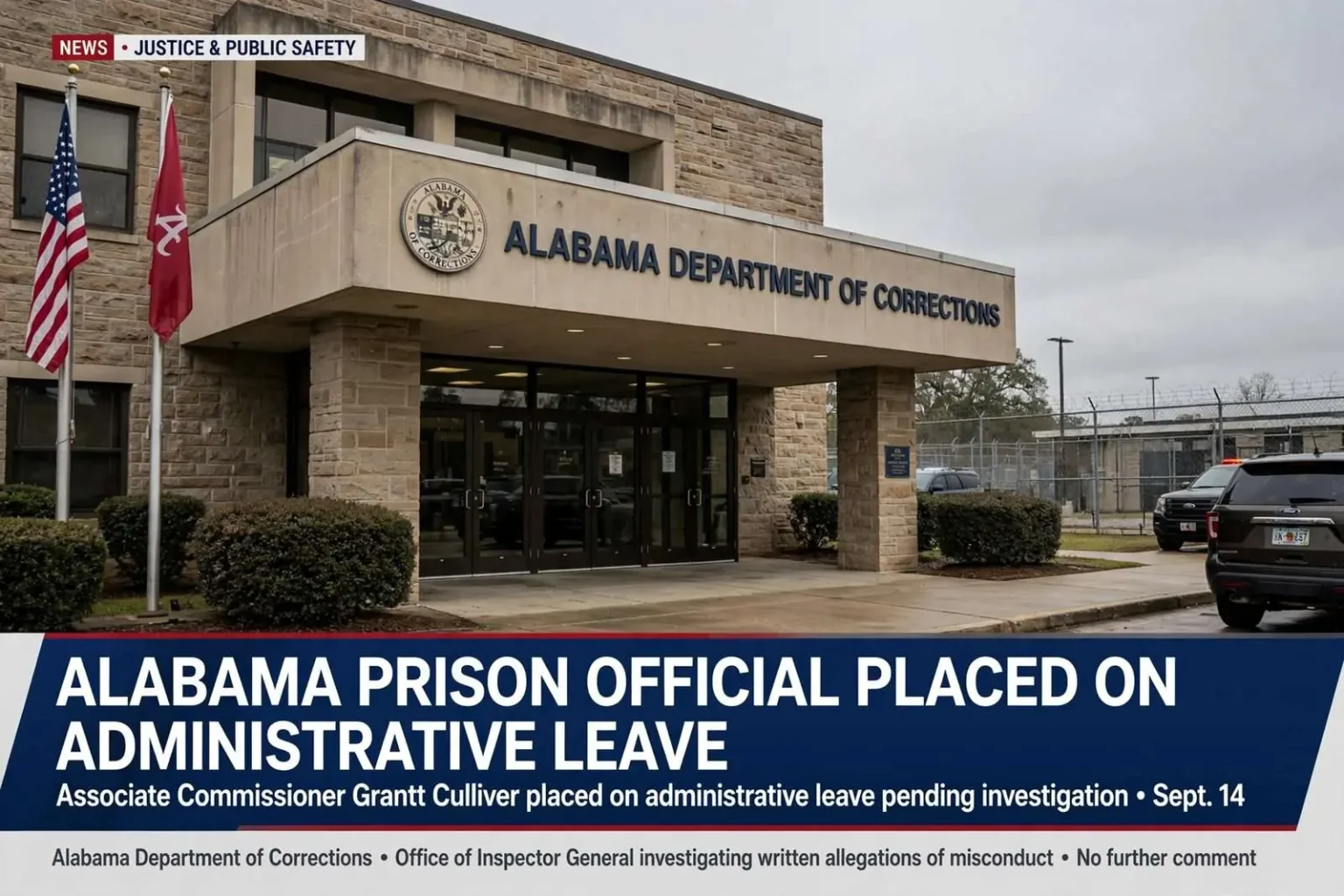
An associate commissioner at the Alabama Department of Corrections has been placed on administrative leave pending the outcome of an investigation, the agency said Tuesday. Prison system spokesman Bob Horton said Associate Commissioner Grantt Culliver was placed on leave on Sept. 14.
In a statement, Horton said written allegations of misconduct were filed with the department’s office of inspector general, prompting the investigation. The department did not disclose the nature of the allegations and said it would have no additional comment. The attorney general’s office also declined to comment.
The placement of a senior administrator on leave while allegations are investigated follows the standard sequence for such cases inside a state agency. Administrative leave is not a finding of wrongdoing; it is a personnel status that removes the employee from day-to-day authority while the facts are gathered, protecting both the integrity of the investigation and the agency’s operations.
According to the department’s website, Culliver is responsible for ensuring the effective daily operations of male correctional facilities — a portfolio that reaches into every major prison in the state system — and has served as warden at several state prisons, including Holman Correctional Facility.
A senior post in a large prison system
The Alabama Department of Corrections operates one of the largest prison systems in the United States relative to its population, housing an inmate population that has run to roughly thirty thousand in recent years across a network of prisons scattered from the Tennessee Valley to the Gulf Coast plains. The system has long been among the most crowded in the nation, operating under court oversight and federal litigation over medical and mental health care, and its leadership structure carries responsibility for institutions that are chronically understaffed.
An associate commissioner sits near the top of that structure. Beneath the commissioner, associate commissioners oversee the system’s major operational divisions, and the position described on the department’s website — responsibility for the effective daily operations of male correctional facilities — places the job over the institutions that hold the overwhelming majority of Alabama’s prisoners. Wardens at the individual prisons report upward through that chain, and policy decisions made at the associate-commissioner level reach every unit in the system.
Culliver’s career path followed the classic route of the Alabama prison system: warden at several state prisons, including Holman Correctional Facility, before elevation to central office. Holman, located in Atmore in south Alabama, is one of the system’s oldest and most consequential institutions — a close-custody prison that has housed death row and the state’s execution chamber, and a facility whose conditions have drawn sustained scrutiny over the years. Experience as a warden at multiple institutions is the standard preparation for system-level administration: direct management of staffing, security, contraband and inmate discipline before any exposure to the budget and policy work of the central office in Montgomery.
The office of inspector general
The allegations in the case went to the department’s office of inspector general, the internal unit charged with investigating misconduct and corruption within the prison system. Inspectors general in corrections agencies handle a wide range of matters: allegations against staff, contraband smuggling, use-of-force reviews, and referrals from other agencies. Their work is typically confidential while an investigation proceeds, which is consistent with the department’s decision not to describe the allegations.
The attorney general’s office’s decision to decline comment is a familiar posture when a state investigation may carry criminal implications. Prosecutors do not typically confirm or deny the existence of a matter under review, and silence protects both the process and the person under investigation. The department’s own refusal to characterize the allegations follows the same logic.
What administrative leave means
Administrative leave occupies a precise place in public employment. It is a paid or unpaid suspension from duty, imposed by the employer, pending the resolution of an inquiry. It carries no implication of guilt, and it is designed to accomplish two things at once: to separate the employee from the workplace while the matter is examined, and to prevent any interference with records, witnesses or systems the investigation may touch.
For a senior official whose duties span an entire class of institutions, the separation matters more than it would for a line employee. An associate commissioner responsible for the daily operations of the state’s male prisons holds authority over wardens, policies and priorities across the system. Placing that authority on hold while allegations are examined prevents any question about whether official power was used to influence the inquiry.
The Sept. 14 date of the leave, disclosed by the spokesman along with the fact that written allegations had been filed, is the kind of specific detail agencies release when they acknowledge a personnel matter publicly: the status, the date, and the existence of an investigation — and nothing about the substance. The department’s statement that it would have no additional comment closed the door on further detail for the duration.
Public disclosure itself is notable. State agencies handle personnel matters privately as a rule, and senior officials under investigation are commonly shielded from public identification until charges or formal findings emerge. Confirming the leave and the investigation by name, through the system’s spokesman, reflected the reality that the matter would become public — and that the agency chose to state the bare facts itself rather than have them emerge piecemeal.
The prison system under scrutiny
The investigation unfolded against a backdrop of long-standing external scrutiny of the Alabama prison system. The state’s prisons have operated for years under court findings and litigation over overcrowding, staffing levels, medical and mental health care, and violence, and the Department of Justice has examined conditions across the system. Any investigation touching a senior operations official draws attention in that environment, because the operations side of the agency is precisely where the system’s chronic problems live.
Daily operations in Alabama’s prisons involve managing institutions designed for far fewer inmates than they hold, with officer ranks that have been persistently difficult to fill and retain. Wardens and the officials above them spend their time balancing those pressures — moving staff to cover posts, restricting movement when short-handed, and trying to maintain security with resources that fall short of the need. The associate commissioner for male facilities was the official positioned over that daily balancing act.
Corrections leadership in Alabama also faces legislative scrutiny, with lawmakers responsible for funding the system and for the borrowing, construction and staffing decisions that follow. When allegations arise against a senior administrator, they are examined not only internally but in the broader political environment where the system’s budget and its reform commitments are debated.
The inspector general’s investigation, whatever its subject, moves through that environment. Written allegations become the case file; interviews and records follow; and the outcome — substantiated, unsubstantiated, or referred onward — lands on the desk of the commissioner, with potential further referral to prosecutors if the facts warrant. Until then, the department’s public record consists of the few facts stated: a senior official, on leave since Sept. 14, under investigation prompted by written allegations of misconduct, with no further comment from the department or the attorney general.
Accountability structures in corrections
The case illustrates how accountability is meant to work inside a corrections agency. Written allegations are filed with an internal investigative office; the subject is removed from operational authority while the inquiry proceeds; the agency acknowledges the status publicly but withholds the substance; and outside agencies, including prosecutors, decline to comment while anything might still reach them. Each step exists to protect the process from pressure — and to protect the official from prejudgment.
Corrections is a field in which the accountability question is unusually sharp. Prison employees hold authority over people who cannot walk away, and the difference between lawful supervision and abuse is a matter of rules, training and oversight. That is why systems maintain internal investigative units, why use-of-force and contraband incidents are reviewed, and why senior officials are held to the same or higher standards than line staff.
The written form of the allegations matters in that framework. A written complaint creates a record, a date and a set of specific claims that can be tested; it also triggers the formal processes — case numbering, investigative assignment, documentation requirements — that informal reports may not. The department’s statement that written allegations were filed with the inspector general therefore tells readers not just that an inquiry exists but that it began in a documented way.
Holman and the institutions behind the title
The institutional biography attached to the title — warden at several state prisons, including Holman — is worth understanding on its own terms. Holman Correctional Facility in Atmore has been the setting of some of the most consequential events in Alabama corrections: it has housed the state’s male death row and hosted its executions, and its general population has been the scene of repeated disturbances and violence examined by investigators and reporters over the years.
Warden at Holman is, by any measure, one of the hardest jobs in the system, and service there is a credential that follows an official through a career. The other institutions a warden serves add to that preparation: each Alabama prison has its own age, layout, custody level and culture, and an administrator who has run several of them has seen the system’s full range of conditions.
From those institutions the step to associate commissioner is a step from one prison’s operations to the system’s — from staffing one compound to setting priorities, allocating resources and supervising wardens across the male facilities. It is the level at which operational decisions become system-wide, and at which the federal litigation over prison conditions lands most directly, because the courts’ findings concern the very operations the position oversees.
What the public record contains
The public record of the case, as stated by the department, is short by design. An associate commissioner was placed on administrative leave on Sept. 14, pending the outcome of an investigation. Written allegations of misconduct were filed with the department’s office of inspector general. The department did not disclose the nature of the allegations and said it would have no additional comment. The attorney general’s office also declined to comment. The department’s website described the official’s responsibilities — ensuring the effective daily operations of male correctional facilities — and his background as warden at several state prisons, including Holman Correctional Facility.
Each of those elements is a fixed fact, and the discipline of the story is in not exceeding them. The nature of the allegations is unknown. The outcome of the investigation is unknown. Whether the matter ends in exoneration, discipline or referral cannot be inferred from what was announced, and the department’s silence is consistent with every such inquiry it has acknowledged.
What the record does establish is the process. The agency separated a senior official from the operations of its male prisons on a specific date, in response to a documented complaint, and handed the matter to its internal investigative arm. The attorney general’s office, informed or consulted, declined to add anything. Those are the mechanics of a system checking itself, visible in public only at the points where policy requires disclosure.
For the state’s prison system, the case sits within a longer story of scrutiny — of overcrowded and understaffed institutions, of federal court oversight, of the daily pressures that define Alabama corrections. An investigation touching the official responsible for daily operations across the male facilities is a reminder that the accountability machinery reaches the top of that operational chain, not just its ranks.
And for the public, the account is a study in what a personnel disclosure can and cannot say. The dates, titles and process are facts; the substance is withheld; and the proper reading of the record ends where the department’s statement ends — a senior corrections official, on leave since Sept. 14, under investigation on written allegations of misconduct, with the outcome left to the process now underway.