Alabama Senate narrowly approves lottery bill, sending it to the House
The Alabama Senate narrowly approved a paper-ticket lottery bill on a 21-12 vote, sending the constitutional amendment to the House.
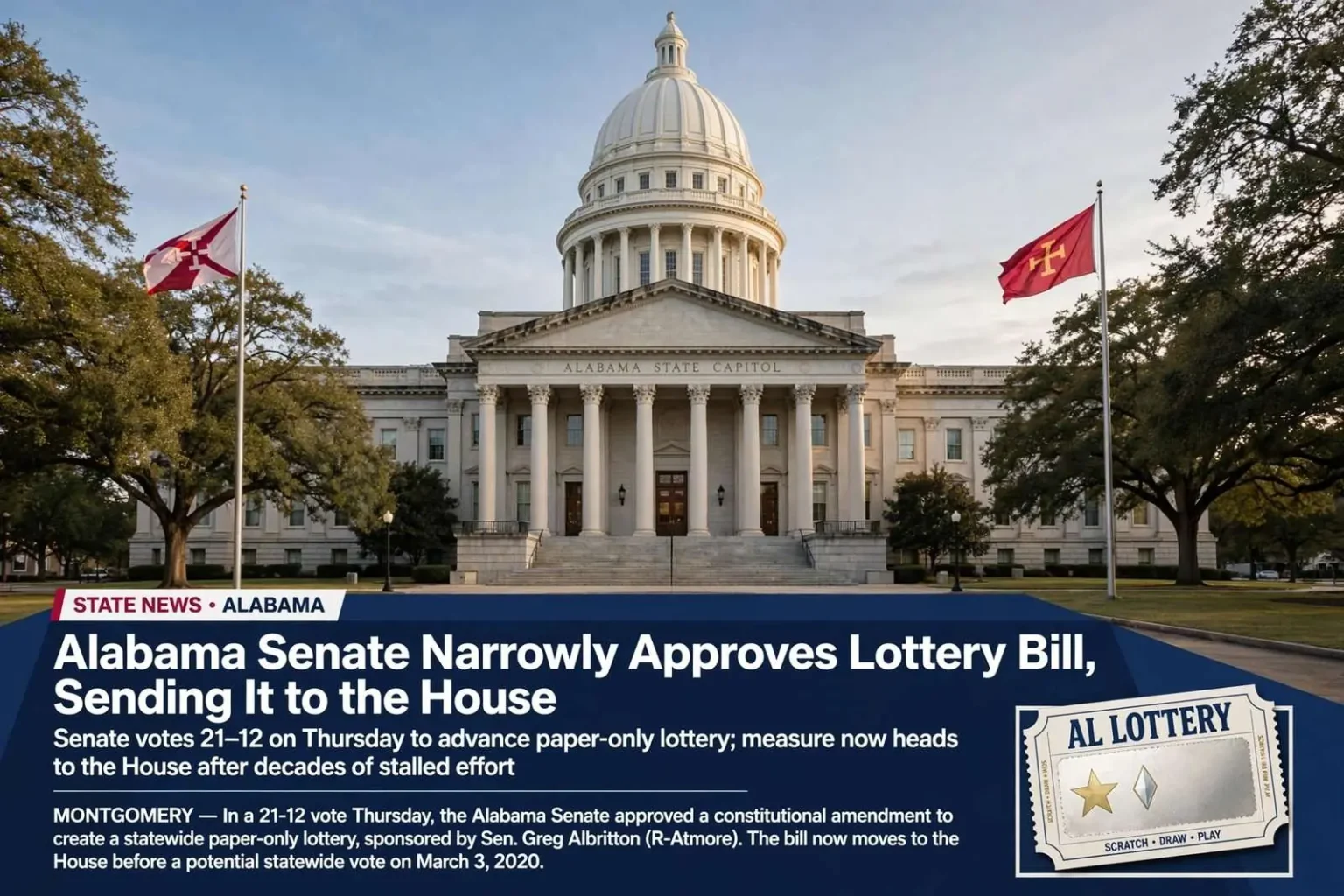
The Alabama Senate has narrowly approved a lottery bill, voting 21-12 on Thursday to advance a proposal that would let voters decide on a state lottery. The vote came after years of stalled efforts to put a statewide gambling question before Alabama voters, and the narrow margin reflected a chamber that has split for decades over whether the state should join its neighbors in operating a lottery.
The measure, carried by Sen. Greg Albritton (R-Atmore), would create a lottery limited to paper tickets and would not allow video lottery terminals. The paper-only design was central to the bill’s appeal for lawmakers wary of expanding gambling machines, drawing a bright line between a traditional draw-and-scratch lottery and the electronic gaming that has fueled years of legal and political fights in the state. Albritton, whose district includes the Atmore area near the Mississippi line, had spent sessions arguing that Alabama was letting lottery money flow to neighboring states while its own roads and budget went unfunded.
Senators added amendments aimed at preventing the paper-only requirement from being used to shut down electronic bingo operations at the state’s dog tracks. The amendments responded to a long-running anxiety in parts of rural Alabama, where greyhound tracks in Macon, Greene, and Mobile counties and the Birmingham Race Course have operated electronic bingo machines under local amendments and court rulings, and where owners feared a state lottery written the wrong way could become a legal weapon against their operations. By carving out protection for the tracks, the Senate tried to keep the lottery question separate from the state’s broader and unsettled bingo wars.
Because the proposal is a constitutional amendment, it must clear the House and the Senate again before going before voters. Alabama’s constitution can only be amended through a statewide vote, so even after the Senate’s first passage the bill faced the full length of the legislative tunnel: approval by both chambers in identical form, and then a place on the ballot. If approved, it would appear on the ballot March 3, 2020, giving the state a little more than a year to stand up a lottery commission and framework if voters said yes.
Alabama’s Long Lottery Debate
Alabama is one of just five states without a state lottery. The distinction has never sat comfortably with many Alabamians, who can drive a short distance to buy tickets in Florida, Georgia, Tennessee, or Mississippi’s casinos, and who watch neighboring states fund scholarships and pre-kindergarten programs with lottery revenue. Georgia’s HOPE scholarship, built on its lottery, is the example most often cited in Montgomery, and every legislative session brings renewed argument about why Alabama’s border counties lose that money across the line.
The state has come close before. In 1999, Gov. Don Siegelman staked his administration on a lottery referendum devoted to college scholarships and school technology, only to see voters reject it after a well-funded opposition campaign raised concerns about gambling’s social costs and the fine print of the proposal. The defeat froze the issue for years, and subsequent legislatures debated lottery bills repeatedly without ever again sending one to a statewide vote, making the Senate’s 21-12 vote a threshold moment by Alabama standards.
The politics of the vote cut across usual alliances. Some lawmakers opposed gambling on principle and rejected the bill regardless of structure; others supported a lottery but resisted the paper-only limits or the bingo protections; still others wanted a broader gaming package that would address casinos and a statewide compact with the Poarch Band of Creek Indians, whose operations in Atmore, Wetumpka, and Montgomery already anchor gaming in the state. Albritton’s narrow bill was built to thread those needles, betting that a simple lottery question had the best chance of surviving the process and winning voter approval.
What the Paper-Only Design Meant
The decision to exclude video lottery terminals shaped nearly every debate about the bill. Video terminals generate far more revenue than paper tickets because they keep players playing at electronic speed, and every lottery in the region leans heavily on machines. A paper-only Alabama lottery would produce less money for the state, but its sponsors argued that the limit was the price of passage: a lottery that looked like slot machines would unite social conservatives and some anti-gambling Democrats against it, while a scratch-off and draw-game lottery kept the question simple for voters.
The bingo amendments addressed the other side of that same tension. Electronic bingo has existed in a legal gray area in Alabama for decades, with machines at the dog tracks and smaller bingo halls operating under constitutional amendments passed at the county level, then challenged in state and federal court over whether they truly played bingo as the law defines it. Raids, injunctions, and rulings left the industry in limbo, and track owners worried that a new constitutional lottery provision could be read as the state’s final word on gambling, expressly authorizing paper tickets and nothing else. The Senate’s amendments were written to prevent exactly that reading, preserving the tracks’ existing operations from legal attack by lottery opponents.
The Road From the Senate to the Ballot
The Senate’s first passage was only the opening step of a constitutional process. The bill would have to pass the House of Representatives, and because any amendment the House changes must return to the Senate for agreement on identical text, the two chambers would need to converge on one version. Twenty-one votes represented exactly the three-fifths majority the Senate requires for constitutional amendments, leaving no cushion: a single defection on a later vote could have killed the measure without any help from the House.
If both chambers agreed, the question would go before voters on March 3, 2020, the date Alabama shared with its presidential primary. A yes vote would authorize the lottery in the constitution and set the state to creating a lottery commission, hiring operators, and establishing game rules, a process that takes a year or more in states starting from scratch. Revenue projections for a paper-only lottery suggested tens of millions of dollars annually for the state, modest by neighboring standards but meaningful for a budget that has stretched for years.
Supporters framed the measure in practical terms: Alabamians already play lotteries, they just do it in Georgia, Florida, Tennessee, and Mississippi, taking the proceeds with them. Opponents raised the familiar concerns about gambling’s effects on low-income households and the regressive nature of lottery spending, along with skepticism that a simple lottery would satisfy gambling advocates for long. The March 2020 ballot question would have settled the argument for the first time in two decades, and the Senate’s 21-12 vote was the step that made that vote possible.
For Sen. Albritton and the bill’s backers, the Senate’s action converted a decade of talk into a live legislative prospect, with the House now holding the deciding card before voters got their say on a state lottery for the first time since 1999.
The Dog Tracks’ Stake in the Outcome
The fate of the greyhound tracks explains why a lottery bill carried bingo amendments at all. Live greyhound racing has faded across the country, and the tracks in Macon County, Greene County, Mobile County, and Birmingham long ago came to depend on electronic gaming machines for their revenue. Those machines employ hundreds of Alabamians and contribute tax revenue to small rural counties that have few other large employers, which is why their legislators guarded the operations so carefully in the lottery debate. An amendment that inadvertently outlawed the machines could have emptied the largest employer in some of the state’s poorest counties.
The tracks’ situation also illustrates the patchwork nature of Alabama gambling law. Because the state constitution requires local amendments for many gambling questions, the legality of electronic bingo varies from county to county, shaped by votes taken years apart and interpreted through ongoing litigation. A statewide lottery layered onto that patchwork without protection for the tracks risked reopening every old fight, so the Senate’s amendments functioned as a peace treaty, keeping the lottery question and the bingo question out of each other’s way.
What Voters Would Have Been Deciding
The constitutional amendment on the March 2020 ballot would have asked a single question: whether Alabama should have a state lottery limited to paper tickets. Voters would not have been approving specific games, retailers, or revenue uses, since those details would fall to the lottery commission the state would establish after passage. Supporters argued that simplicity was the point, a clean yes-or-no on a concept that polls had shown Alabamians broadly willing to consider; opponents countered that voters deserved to know exactly where the money would go before amending the constitution.
The Senate’s 21-12 vote on Thursday represented the closest the state had come to that question since the 1999 referendum. Whether the House would send the issue to voters remained the open question after the Senate acted, and the bill’s path through the final weeks of the session would determine whether Alabama’s voters finally got to weigh a lottery, or whether the issue would settle back into the familiar pattern of debate without a decision that has defined the topic in Montgomery for twenty years.