
Alabama Shakes Bring Their Retro Soul to Callaghan’s as the EP Spreads
Alabama Shakes played Callaghan's Irish Social Club and sat for an interview in November 2011, touring the self-titled EP behind 'Hold On.'
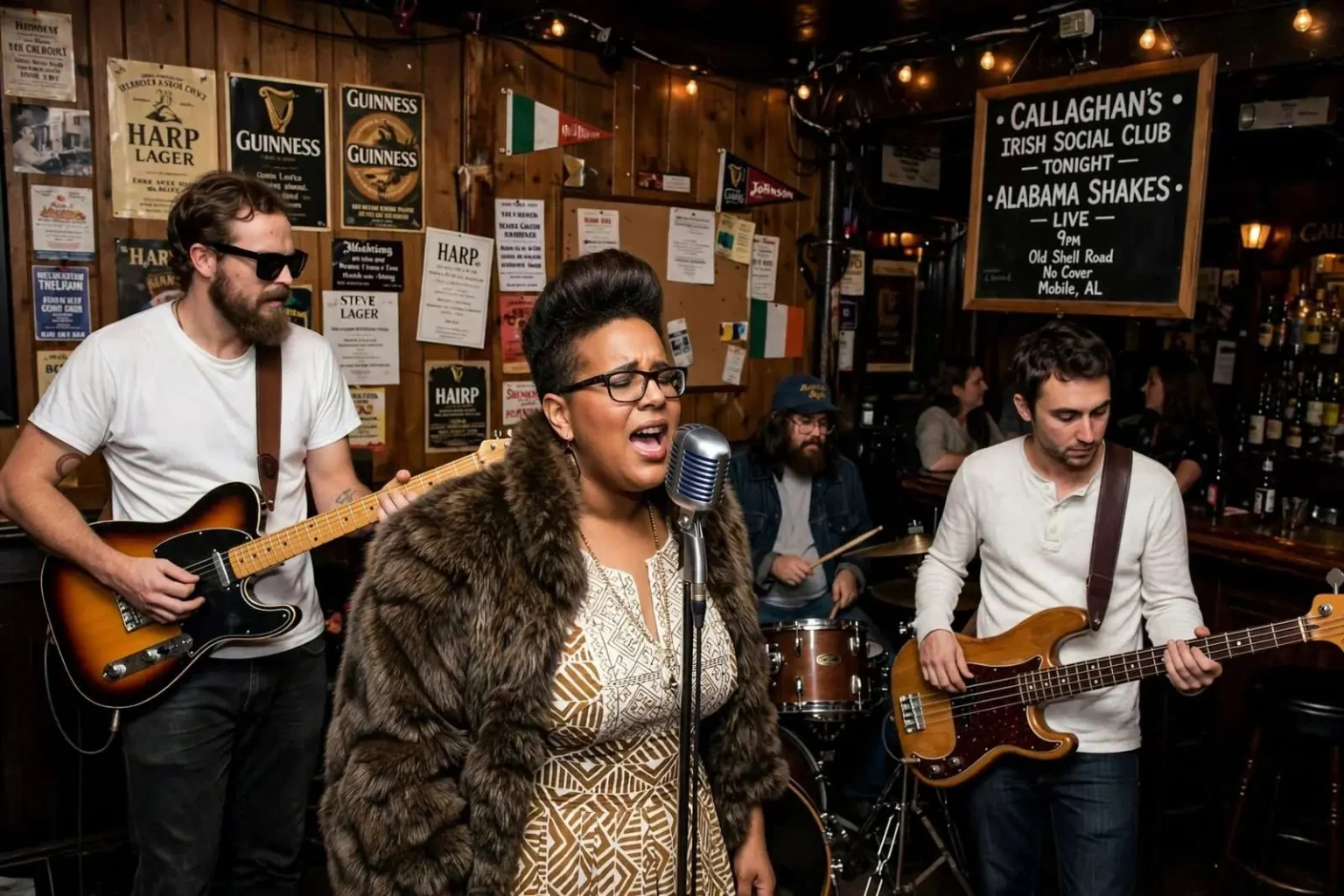
Alabama Shakes — Brittany Howard, Heath Fogg, Steve Johnson and Zac Cockrell, out of Athens in north Alabama — followed a set at Mobile’s Callaghan’s Irish Social Club by sitting down for a candid interview about the band’s fast rise, capping a visit that underscored how quickly the group was winning over South Alabama audiences. At the time, the band was still touring behind its self-titled debut EP, anchored by the slow-burning single “Hold On,” which was available through Bandcamp.
For the uninitiated, a night at Callaghan’s is about as intimate as live music gets. The Irish Social Club on Old Shell Road has spent decades as one of Mobile’s favorite small rooms — a neighborhood bar known as much for its burgers as its booking, with a stage close enough to the tables that the front row is practically in the band’s lap. Rooms that size have a way of sorting great acts from good ones quickly, and the Shakes passed the test the way they had been passing it all over the Southeast: by simply playing loud, playing honest, and letting Howard’s voice do the rest.
A Band on the Verge
The Mobile stop came during the stretch when Alabama Shakes were playing small Gulf Coast rooms months before festival bookings and late-night TV appearances would make them a national name. Local listeners who caught them at Callaghan’s got the same unpolished, high-voltage live show that was becoming their calling card. There were no pyrotechnics and no pretense — just four musicians from a small Tennessee Valley town playing soul-infused rock and roll with the urgency of a band that knew it had something to prove and not much time to prove it.
The four-track release had begun drawing attention well beyond the Shoals, with Howard’s voice — equal parts Otis Redding and Janis Joplin — doing most of the persuading night after night in rooms the size of Callaghan’s. “Hold On” was the song doing the heavy lifting, its slow-building verses giving way to a chorus built for repetition, but the EP’s other tracks made the case that the single was no accident. Word was spreading the way it does now: through online streams, word of mouth from showgoers, and the kind of industry buzz that follows a band capable of turning a bar gig into a revival meeting.
The band’s route to that moment ran through the classic small-town circuit. The four musicians came together in Athens, west of Huntsville, in a region whose musical pedigree runs deep — the Shoals area just to the west produced some of the most celebrated soul and rock recordings of the twentieth century, and northwest Alabama has long punched above its weight in American music. Howard, who worked at the post office and delivered drugs for a pharmacy before the band took off, fronted the group with a voice and stage presence that audiences and critics alike struggled to compare to anyone working today.
From Athens to the Gulf Coast
By the time the Shakes rolled into Mobile, they had graduated from bar nights in Athens and Huntsville to a touring schedule that stretched across the Southeast. Gulf Coast stops like Callaghan’s mattered in that build-out. South Alabama’s coastal towns have long supported live original music in small venues, and a band building a following show by show could count on rooms like this one to deliver attentive crowds who would tell their friends the next day.
The set itself delivered what the EP promised. Howard sang as if the room might collapse under her, Fogg’s guitar work answered her lines, and the rhythm section of Johnson and Cockrell locked into the kind of groove that owes as much to Muscle Shoals soul as to classic rock. Audiences who had come out of curiosity left as believers, and many of them would soon be able to say they saw the band in a bar before the arenas, festivals, and awards shows arrived.
The interview that followed the Callaghan’s set gave the band a chance to reflect on a rise that was happening faster than any of them had planned. They talked about the strangeness of hearing their music played outside Alabama, about the logistics of four working-class musicians suddenly spending their weeks on the road, and about the pressure and excitement of writing new material while the EP kept finding new listeners. The tone, by all accounts, was candid — a band still close enough to its garage origins to be honest about how surreal the moment felt.
Company From the Eastern Shore
Also circulating that week from the same corner of the Alabama scene: “There’s a Hole” from El Cantador, the Fairhope rock band then building its own regional following. The Fairhope outfit had been making the rounds of Gulf Coast venues with a driven, atmospheric brand of indie rock, and the new single kept up the momentum. Together they made a case that late 2011 was a rich moment for Alabama guitar music, with the Shakes at the front of the pack.
That pairing said something about the health of the state’s music scene at the time. From the Shoals to the Eastern Shore, Alabama bands were producing original work that traveled on its own merits — passed between fans online, spun by college radio, and carried room to room by acts willing to play four sets a weekend in towns like Mobile, Fairhope, Birmingham, and Huntsville. For a long stretch, the state’s national musical reputation had rested on its storied past; suddenly its present was making noise again.
El Cantador’s rise ran on a similar fuel to the Shakes’ — relentless gigging, a distinctive sound, and a home scene small enough that success was measured in packed rooms rather than chart positions. The band became a fixture on the Gulf Coast club circuit, and songs like “There’s a Hole” gave Fairhope a spot on the state’s musical map alongside its better-known identity as a bayside arts colony. For local listeners, the week’s news made for a satisfying one-two: the state’s most buzzed-about band passing through Mobile, and one of its own hometown favorites pushing new material at the same time.
What Came Next
Hindsight has made the Callaghan’s stop look like a checkpoint on the way to something much larger. Within a short time, the Shakes would step up from bar stages to festival mainstages, make the late-night television rounds, and carry Alabama rock to audiences nationwide, with Howard emerging as one of the most celebrated singers of her generation. The debut EP on Bandcamp would be remembered as the starting gun — the four tracks that got a band from Athens heard beyond its region in the first place.
For Mobile, the night remains a small point of pride: the city got the interview, the intimate show, and the chance to claim an early look at a band the rest of the country would soon discover. It is a recurring story along the Gulf Coast — national acts passing through small rooms on the way up — but it never gets old for the crowds who are there. The people packed into Callaghan’s that night heard “Hold On” from a few feet away, in a bar on Old Shell Road, months before the rest of the world caught up.
The episode also stands as a snapshot of how music careers change shape in the streaming era. The EP spread through Bandcamp and word of mouth rather than a major-label campaign, and the band’s growing audience built itself show by show across the Southeast. Small venues like Callaghan’s, which have long given Alabama acts their first stage and their first real audience, remain the proving ground where that kind of rise begins — and where a band’s early fans first understand what they are watching.
The Callaghan’s visit also underscored the venue’s unusual role in Mobile’s cultural life. The Irish Social Club has functioned for decades as a crossroads for the city’s music lovers, hosting touring acts and local bands alike in a room that holds only a few dozen people comfortably. National touring artists regularly speak fondly of the place, and for bands on the way up, a well-attended night there often signals that a Gulf Coast audience has adopted them. The Shakes’ stop fit squarely into that tradition: a fast-rising act, a packed room, and a local crowd that would soon be telling the story for years.
The Bigger Picture for Alabama Music
Looking back, the stretch that included the Callaghan’s show marked a turning point for the state’s image in American music. The Shoals had long been revered for the studios that shaped classic soul and rock, but the new wave of Alabama bands was building something different — a living, touring scene that drew on that heritage without being trapped by it. The Shakes’ blend of Southern soul, blues, and garage rock was unmistakably rooted in north Alabama, yet it played as fresh rather than nostalgic, and audiences far beyond the state line responded.
For South Alabama listeners, the moment carried its own meaning. Mobile and Fairhope often watch national music culture pass by on interstate corridors far to the north, but that week the region sat squarely on the map: a band on the verge of national fame playing a bar in midtown Mobile, and a hometown favorite releasing new music at the same time. It was proof that the Gulf Coast’s small venues could attract and nurture acts of genuine consequence.
The lesson of the night has held up well. Great bands still have to start somewhere, and more often than not that somewhere is a room the size of Callaghan’s, in front of an audience small enough to hear the singer breathe between lines. Alabama Shakes brought their retro soul to that room at exactly the right moment, and the people who were there got what every music fan hopes for — a chance to hear something great before everyone else knows about it.


