
Alabama Supreme Court sides with Airmont neighborhood in Azalea Road closure fight
Alabama Supreme Court sides with Airmont neighborhood in Azalea Road closure fight Reported by South Alabama News from local coverage of the Mobile and.
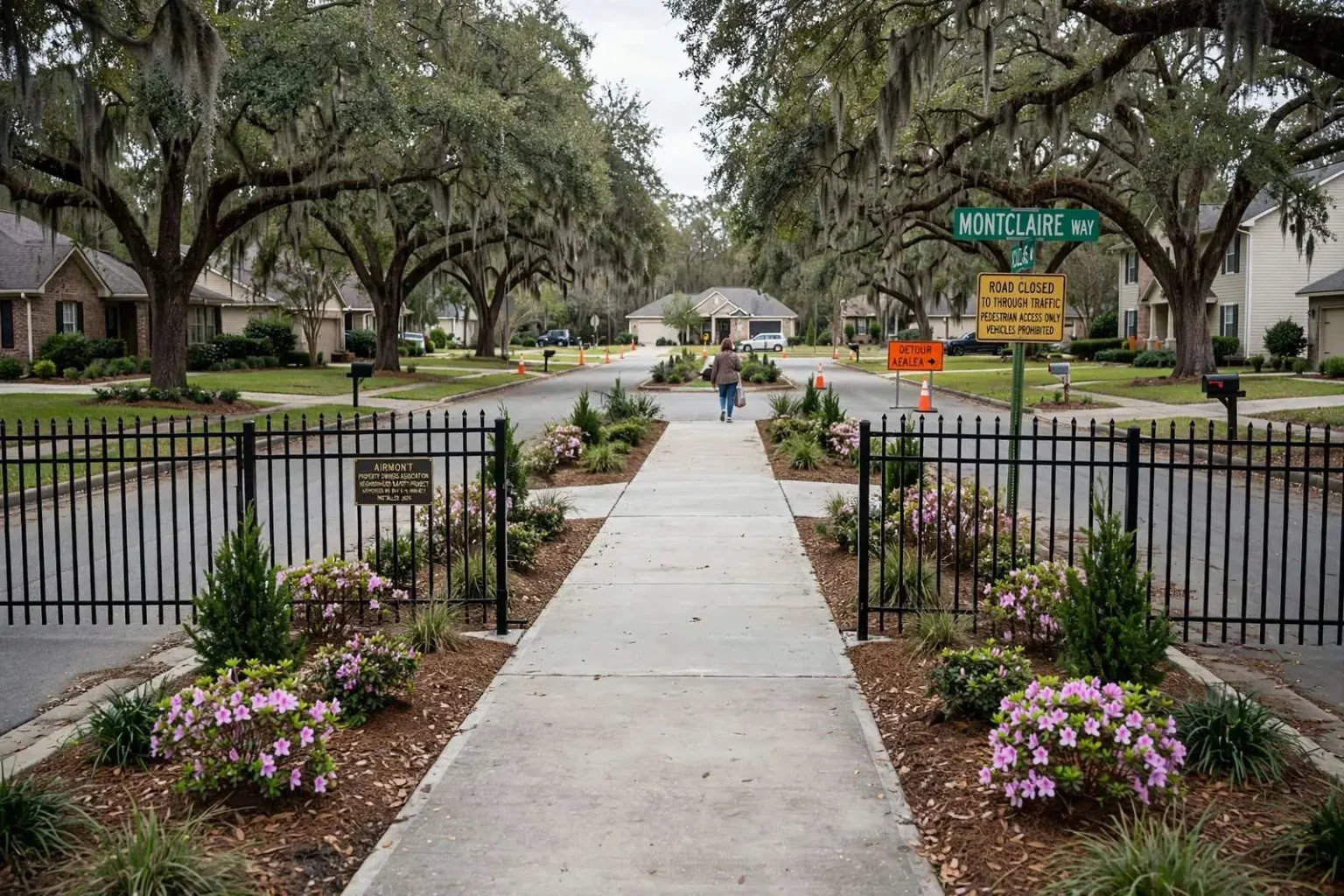
A group of Mobile residents has won a yearlong legal fight to limit access to their neighborhood, after the Alabama Supreme Court declined to overturn a lower-court ruling allowing the closure. The decision ends — at least for now — a dispute that tested how far a neighborhood association can go in reshaping the streets around it.
The dispute centered on a proposal by the Airmont Property Owners Association to close a cut-through connecting Azalea Road and Montclaire Way. The City Council approved the request in January 2015, and the Alabama Supreme Court affirmed it Friday without issuing a written opinion, leaving the lower court’s ruling in place and the closure free to proceed.
Association president Eaton Barnard said the effort was driven by safety concerns. “Mobile will be safer because of this ruling,” he said.
For the residents who pushed the case, the ruling ratified a simple proposition: that a neighborhood bearing the daily costs of cut-through traffic — speeders, strangers, litter and, they argued, crime — has a legal path to do something about it, even over the objections of drivers who have long used the shortcut.
A Cut-Through and a Community Divided
Opponents in adjoining communities argued the closure would inconvenience them and create its own safety issues, longer emergency detours among them. Dr. Janice Morton Hunte, the named plaintiff in the case, had questioned how much crime the neighborhood actually faced, pressing the premise on which the closure request rested.
Cut-through fights are among the most durable conflicts in municipal government, and the Airmont case carried the usual stakes on both sides. To the streets that feed it, a shortcut is a convenience that saves minutes on every trip to Azalea Road’s commercial strip. To the streets that bear it, the same traffic is an endless stream of vehicles that neither live nearby nor answer to the neighborhood when they speed through it.
The legal fight that followed the council’s 2015 approval stretched over a year, with opponents asking the courts to undo what the city had sanctioned. When the Supreme Court declined to intervene without a written opinion, it did not write new law — but it settled this dispute, and signaled to Mobile neighborhoods on both sides of the question that a council-approved closure, lawfully granted, will stand.
What Gets Built
The ruling clears the way for the association to build a roughly three-foot fence across a portion of Montclaire Way, with a pedestrian walkway and landscaping on either side. The design matters: this is not a gate for vehicles, but a barrier calibrated to stop the shortcut while keeping the street walkable for neighbors, mail carriers and emergency personnel on foot.
Barnard said the group must pay for the work itself and had already coordinated with the Mobile Police and Fire-Rescue departments and city utilities. That coordination is the quiet backbone of any street closure — fire apparatus need turnarounds, utility crews need access to lines and meters, and police need the ability to reach a street even when cars cannot.
The arrangement reflects a compromise Mobile has struck in cases like this: the city keeps title to and responsibility for its rights-of-way, while neighborhood associations that want a closure front the cost of construction and accept the maintenance that follows. A three-foot fence with landscaping is far cheaper than a gated installation, and cheaper still than the litigation that preceded it.
How a Street Gets Closed in Mobile
The path Airmont followed ran through City Hall, not around it. Associations seeking a closure petition the city, which weighs the request through its traffic engineering and legal departments before any ordinance reaches the council. Council members whose districts contain the streets in question must weigh neighbors’ pleas against the city’s interest in a connected, navigable street grid.
The January 2015 council approval gave the association the legal foundation for the closure, but the lawsuit demonstrated that approval is only the beginning. Opponents retained their day in court, and the ensuing year of litigation tested the city’s process. The Supreme Court’s affirmance without opinion is, in effect, a statement that the process held.
For other neighborhoods watching the case, the lesson is procedural as much as practical: organize as an association, build a documented case — traffic counts, incident records, coordination with police and fire — pay your own way, and expect a court fight if adjoining streets object.
The Ripples Through West Mobile
Councilman Joel Daves, who represents the area, said the case has already prompted other neighborhoods to request similar treatments, including a temporary closure of Andover Boulevard in Regency Oaks for a traffic study.
Daves’ observation captures the demonstration effect at work in municipal government. A single successful closure — especially one that survives court review — becomes a template that other associations study and emulate. Traffic engineers, meanwhile, treat a temporary closure with study as the prudent first step: data on what actually happens to vehicle movements carries more weight at the council table than either side’s predictions.
Azalea Road itself threads through some of West Mobile’s busiest territory, a commercial spine lined with shopping centers, offices and medical facilities that draw traffic from every direction. The streets behind it, including the Airmont area, absorb the overflow — and it is that relationship between the corridor’s commerce and the neighborhoods’ quiet that the fence on Montclaire Way now arbitrates.
The Broader Debate Over Street Closures
Mobile is not alone in wrestling with these questions. Cities across the country have spent decades navigating requests from neighborhoods to close, gate or otherwise interrupt streets that carry cut-through traffic, and the research on the results is genuinely mixed. Closures can reduce speeds and some categories of crime on the treated street; they can also push that traffic onto the next street over, shifting the burden rather than eliminating it.
Traffic planners generally prefer solutions that manage cut-through volume — speed humps, traffic circles, targeted enforcement — over full closures, which redraw the map for everyone else. But for residents who have watched the volume grow year after year, the engineering alternatives can feel like half measures, and the association that fought this case to the state’s highest court clearly concluded that only a barrier would do.
The safety arguments cut both ways, as opponents warned. A closed segment changes emergency response: fire apparatus and ambulances must approach from approved routes, and every second of detour matters in a medical emergency. That is why departments review and bless these installations before they are built, and why the Airmont association’s coordination with Police and Fire-Rescue was a necessary step rather than a courtesy.
There is also the equity question that Dr. Hunte’s challenge raised. Street closures tend to succeed where neighborhoods have the organization and resources to hire lawyers and fund construction, and critics of the practice note that the traffic diverted usually lands on streets whose residents have less capacity to fight back. The court’s ruling settles the lawfulness of Airmont’s fence; it does not settle that larger argument.
What the Ruling Means Going Forward
For Airmont, the decision means the association can now spend its energy on landscaping rather than litigation, building the fence and walkway it promised and maintaining them in the years ahead. For the opponents who lost, the procedural options have narrowed considerably; affirmance without a written opinion leaves little to appeal and no roadmap for a second challenge.
For the City of Mobile, the ruling is validation of the process the council used in 2015 — and, given the interest Daves described from other neighborhoods, likely a preview of more closure requests to come. Each will bring its own geography, its own advocates and its own objections, but they will arrive now with Airmont as precedent: approved by the council, coordinated with the safety agencies, funded by the neighborhood, and upheld by the courts.
Whether Mobile becomes safer, as Barnard put it, will be measured on streets like Montclaire Way in the years ahead — in traffic counts, incident reports and the experience of the families on both sides of the new fence. The neighbors who fought for the closure believe the answer will favor them. The region’s drivers, and the next neighborhood down the cut-through, will be keeping score.
The Airmont case also illustrates how much patience neighborhood organizing demands. From the council vote in January 2015 to the Supreme Court’s affirmance, more than a year passed in filings and hearings, with association volunteers absorbing legal costs while the fence they sought existed only on paper. Advocates for neighborhood associations often warn newcomers about exactly this timeline: the courthouse, not the council meeting, is where most of these disputes are actually decided.
With the litigation behind it, the association can turn to the details that will determine whether the closure works as promised — the placement of the walkway, the species chosen for the landscaping strips and the upkeep schedule that keeps a three-foot fence from becoming a neighborhood eyesore. Neighbors on both sides, meanwhile, will learn to live with a new map.