
Alabama vs. Georgia: The 21st Century Water War Over the Chattahoochee
A quarter-century water war among Alabama, Georgia and Florida over the Chattahoochee has stakes for southwest Alabama water and Mobile Bay.
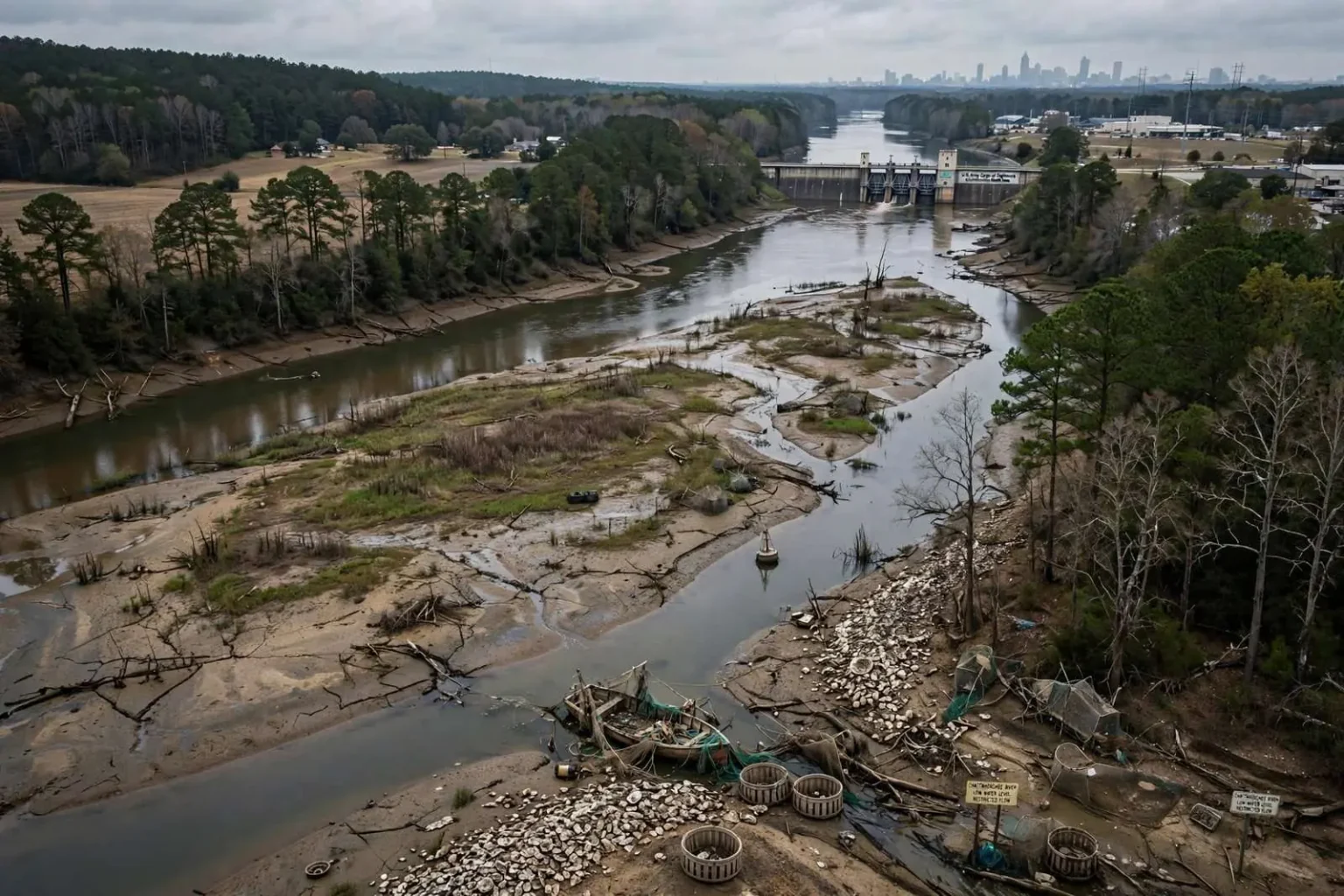
For roughly a quarter century, Alabama, Florida and Georgia have been locked in a legal and political fight over the water flowing down the Chattahoochee River — a dispute with direct consequences for southwest Alabama’s drinking water, agriculture, fisheries and industry. What began as a fight over metropolitan Atlanta’s thirst has become one of the longest-running interstate water conflicts in American history, and its next chapter is being written in federal offices far from the riverbanks it will affect.
The conflict traces to 1990 and to the explosive growth of metropolitan Atlanta, whose rising water demands have strained the Chattahoochee-Flint-Apalachicola River Basin, which forms part of the Alabama-Georgia border before draining toward the Gulf. As the Atlanta metro area added hundreds of thousands of residents over the decades, the reservoirs and rivers that serve it became the subject of litigation, negotiation and legislation that has never fully resolved the underlying question: who is entitled to how much of the water, and who decides?
The U.S. Army Corps of Engineers, which operates the dams along the river, determines how much water continues downstream. That federal role sits at the center of the dispute — the states cannot allocate the water among themselves, so each has spent decades trying to influence the Corps through Congress, the courts and the regulatory process.
What’s at Stake Downstream
The effects are felt most sharply far from Atlanta. The Apalachicola oyster, once shipped to restaurants across the country, is now found mainly in the region itself as the bay’s oyster industry has struggled with reduced freshwater flows. Apalachicola Bay depends on the brackish mix of river water and Gulf water that historically made it one of the most productive oyster grounds in the nation; when upstream flows shrink, the salinity shifts and the ecosystem that sustained generations of Florida fishermen changes with it.
For Alabama, the stakes run the length of the river system: municipal water supplies, agricultural withdrawals, industrial users and the fisheries that depend on steady flows all hang on how much water crosses the state line. Communities along the Chattahoochee and the connected river systems have watched the dispute with the understanding that whatever formula ultimately emerges will govern their water for decades.
An Unusual Alliance in Washington
In Washington, the fight has produced an unusual alliance between Alabama’s and Florida’s congressional delegations against Georgia’s. The two downstream states, whose interests align even when their industries do not, have repeatedly teamed up on legislation aimed at limiting what the Corps can do to reallocate water while the states negotiate.
Sen. Richard Shelby won insertion of a clause into a Senate energy and water appropriations bill that would bar the Corps from changing water allocation in the Alabama-Coosa-Tallapoosa basin while the states negotiate. The provision was a defensive move: as long as the legal fight continues, Alabama wants the existing allocations frozen in place rather than changed by federal action mid-negotiation.
But Sen. Johnny Isakson of Georgia succeeded in stripping that language from the House version, leaving the measure likely headed to President Barack Obama’s desk without the protection Alabama sought. The maneuver was a reminder that the water wars are fought not only in courtrooms but in the appropriations process, where a single clause can shift the battlefield.
“Because the short-term [continuing resolution] is simply a stop-gap continuation of Fiscal Year 2015 spending policy, Senator Shelby did not request, nor was he expecting, the ‘water wars’ language from the Fiscal Year 2016 Energy and Water Appropriations bill to be included,” a Shelby spokeswoman said, adding that the senator “will continue to fight to ensure that the committee-approved language is incorporated in any final appropriations measure.”
A New Corps Proposal That Pleases No One
The latest chapter arrived when the Corps released a draft proposal for regulating Chattahoochee flows, now in a 90-day public comment period. Draft proposals of this kind translate the Corps’ reservoir operations into written rules — how much water is held, how much is released, and under what conditions — and this one drew objections from every direction the moment it was published.
Georgia argues the flows fall short of its water needs; Alabama says the plan still tilts toward Georgia; and Florida contends it does little to restore Apalachicola Bay and its ailing oyster industry. A proposal that leaves all three parties unhappy is, in the arithmetic of the water wars, a sign of how narrow the room for compromise has become after twenty-five years of fighting.
“The Corps’ draft proposal is just another step by federal bureaucrats to tip the balance of the ‘water wars’ in Georgia’s favor,” Shelby’s office said. “Sen. Shelby will continue to fight to ensure the governors of Alabama, Georgia and Florida — not bureaucrats in Atlanta — are empowered to work out an agreement.”
The public comment period gives the region’s cities, industries and environmental groups a formal channel to weigh in before the proposal is finalized, and downstream Alabama interests have used such windows to press the case that reservoir operations upstream ripple all the way to Mobile Bay.
Why the Precedent Matters for Mobile
The precedent matters well beyond the Chattahoochee. Mobile exists because of Mobile Bay, and its fragile ecosystems depend on steady flows; a comparable upstream dispute on the Tombigbee River could one day pose similar questions for the Port City. The Tombigbee drains a vast swath of Mississippi and west Alabama before joining the Alabama River to form the Mobile River, and every municipal, industrial and ecological user along that system depends on the same principle at stake in the tri-state fight — that upstream growth cannot claim downstream water without limit.
For southwest Alabama, the Chattahoochee case is a dress rehearsal. The legal doctrines, the congressional tactics and the Corps’ regulatory frameworks being tested there would all come into play if a similar conflict emerged on the river systems that feed Mobile Bay, and Alabama’s delegation has treated the fight as a defense of principle as much as of a particular river.
Decades of Failed Negotiations
The states have tried, repeatedly, to settle the dispute among themselves. Compacts signed in the late 1990s were meant to produce an allocation formula the three governors could agree on, and each attempt collapsed — leaving the courts and the Corps as the only remaining venues. Federal judges have heard and reheard the central claims, and Congress has periodically intervened on one side or the other, but the fundamental question of allocation remains unanswered a quarter century after it was first pressed.
Each failed negotiation has raised the stakes of the next one. Population growth in metro Atlanta has continued, downstream ecosystems like Apalachicola Bay have continued to decline, and the reservoirs that serve the region have been stress-tested by droughts that exposed how thin the margin really is.
The Water Systems Behind the Fight
Understanding the dispute requires understanding the plumbing. The Apalachicola-Chattahoochee-Flint basin carries water from the north Georgia mountains down through metropolitan Atlanta, along the Alabama-Georgia line, and across the Florida panhandle to Apalachicola Bay. The Alabama-Coosa-Tallapoosa basin, the subject of Shelby’s legislative protection, runs west of it, feeding the rivers that eventually reach Mobile Bay. The two systems are separate, but the legal principles established in one fight inevitably shape the other — which is why Alabama defends its interests in both.
The Corps’ dams on the Chattahoochee, built over decades for flood control, hydropower and navigation, are the valves that control the whole downstream flow. Metro Atlanta’s principal reservoirs sit behind those dams, and the question of how much of that stored water must be released for the benefit of oyster beds, power plants and municipalities hundreds of miles away is the dispute’s irreducible core.
The Economics of a River
Both sides frame the fight in economic terms. Georgia argues that the water is essential to the continued growth of a metropolitan economy that anchors the southeastern United States — a region whose businesses, universities and airports depend on reliable water supply. Alabama and Florida counter that their river-dependent economies — the Gulf seafood industry, the industries along the Alabama river systems, the fishing communities of Apalachicola — are already paying the price for upstream consumption.
The oyster collapse in Apalachicola Bay has become the fight’s most visible casualty. A fishery that once supplied oysters across the nation has been reduced to a fraction of its historic harvest, and Florida points to that decline as evidence of what unrestricted upstream withdrawals can do. Alabama watches the same evidence and sees its own future if the principle is not defended now.
What Comes Next
The 90-day comment period will end, the Corps will finalize its proposal, and the litigation that has defined the dispute for a quarter century will continue. For now, the three governors remain deadlocked, and the eventual resolution appears destined for the Supreme Court.
For residents of southwest Alabama, the water wars can feel distant — fought in Atlanta courtrooms and Washington committee rooms over rivers that touch the state’s eastern edge. But the issue they decide is as local as the tap: how much water flows downstream, who gets to say so, and whether the ecosystems and economies that depend on those flows have a voice equal to the growing cities upstream. The answer will bind all three states, and Alabama’s position in the fight is a bet on the principle that the rivers reaching Mobile Bay belong to more than the people who live nearest their headwaters.
Until the courts or the governors produce an answer, Alabama’s congressional delegation will keep pressing the case it has pressed for decades — that the Corps should change nothing while the states negotiate, and that the water flowing toward the Gulf should be allocated by agreement among the states rather than by default of federal operations. It is a long game, played one appropriations bill and one comment period at a time, with Mobile Bay as the ultimate stakeholder.

