
Alabama Wildlife Agency Expands Online Classes to Help Hunters and Anglers Get Ready for Fall
ADCNR's Wildlife and Freshwater Fisheries Division is expanding online classes, virtual public-lands workshops and a new gear-discount program to help Alabamians prepare for fall hunting and fishing seasons.
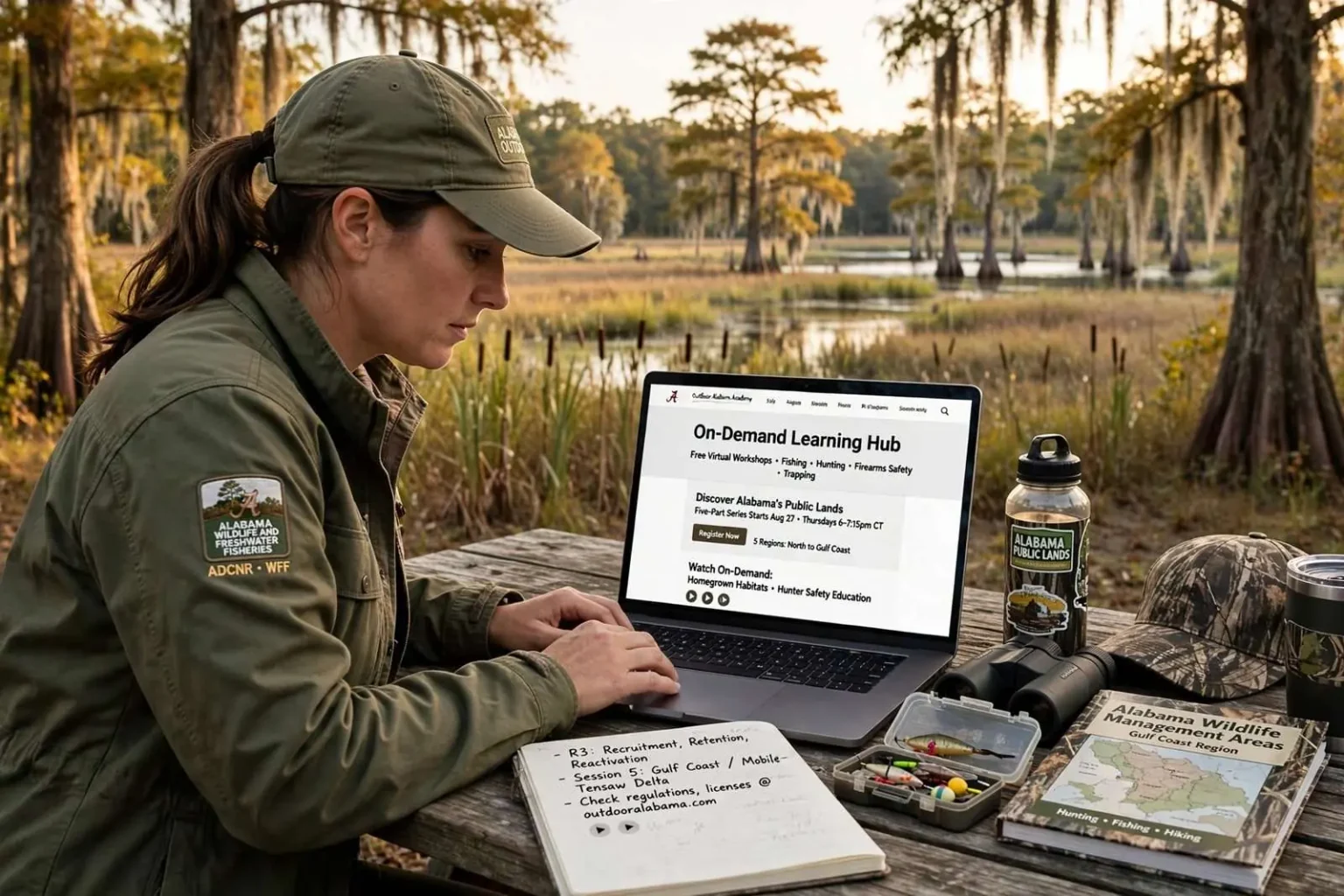
With fall approaching, the Alabama Department of Conservation and Natural Resources’ (ADCNR) Wildlife and Freshwater Fisheries (WFF) Division is rolling out new outreach tools designed to help residents prepare for hunting, fishing and other outdoor activities once cooler weather arrives.
Justin Grider, WFF’s R3 Assistant Chief, said the agency’s Outdoor Alabama Academy webpage now offers a full slate of learning opportunities for fishing, firearms, hunting and trapping, along with a new On-Demand Learning hub featuring recorded webinars and classes that residents can access online. R3 refers to the agency’s efforts around recruitment, retention and reactivation of outdoor participants.
The R3 shorthand has become standard across the country’s wildlife agencies, which have watched participation rates flatten as their traditional base ages. Recruitment brings newcomers in, retention keeps them licensed year over year, and reactivation pulls back the lapsed license-buyers who hunted or fished as children and drifted away. License sales fund a large share of what state wildlife agencies do, so the outreach is not simply public relations — it is the financial base of the agency itself.
Moving classes online extends that work to an audience the traditional model missed: parents who cannot commit to a Saturday classroom, young adults who learned to hunt digitally, and residents in counties far from the agency’s district offices. Recorded webinars also let the division reach its busiest seasons — dove season’s opening weeks, deer season’s ramp-up — with material people can consume on their own schedule.
‘Discover Alabama’s Public Lands’
One new offering beginning soon is a series of virtual workshops called “Discover Alabama’s Public Lands,” which will walk participants through the hunting, fishing and hiking opportunities available on public land across the state.
The free workshops, which require registration, will run each Thursday from 6 to 7:15 p.m. starting Aug. 27 and continuing through Oct. 1, with each of the five sessions covering a different region, moving from north Alabama down to the Gulf Coast.
The regional structure matches how Alabamians actually use the state’s land. North Alabama’s public holdings sit in the hill country of the Tennessee Valley; the middle of the state carries the Black Belt’s river bottoms and the large wildlife management areas around them; and south Alabama’s public lands run toward the piney woods and the delta wetlands above Mobile Bay. Each region hunts, fishes and hikes differently, and the weekly format lets participants attend the sessions nearest them — or all five, building a statewide picture.
Grider said the sessions will also provide historical context about the land to help build a “deeper appreciation” among participants.
That framing reflects a quieter purpose behind the series. Public land in Alabama has a layered history — federal acquisitions, state purchases, the long private-ownership tradition that makes the state’s public acreage modest by national standards — and users who understand how the land came to be public tend to treat it better and defend it more effectively.
The public lands series follows a spring program called “Homegrown Habitats,” which focused on habitat management for private landowners and was developed in partnership with the National Wild Turkey Federation to highlight land management practices that benefit wild turkeys and other ground-dwelling bird species. Both series are archived on the agency’s Online Learning Hub.
The pairing is deliberate. Most of Alabama’s wildlife habitat is in private hands, so landowner education reaches farther than anything the agency can do on its own holdings, while the public-lands series points new participants toward places they can go without owning an acre. Archived access means both series keep working after their live dates pass.
The division is also introducing new webinars for fishing and hunting workshops that allow families to learn basic skills from home rather than attending an in-person class, while continuing to offer traditional in-person options.
The family angle is where the agency sees its future. Children’s introduction to hunting and fishing has traditionally run through relatives with the time, gear and land to teach them, and families without that inheritance often never start. Virtual workshops that walk through the basics — what equipment to buy, how to find a place to go, how to handle the first outing — lower the barrier for exactly those households.
Hunter education expands into retail
Separately, the agency’s long-running Hunter Safety Education Program — mandatory in Alabama since 1993 for anyone born on or after Aug. 1, 1977 — is expanding into every Bass Pro Shops location in the state, with plans to add a class in the Huntsville area in partnership with Cabela’s.
Hunter education has been one of the quiet success stories in American wildlife management since Alabama made it a licensing requirement. Certification courses cover firearm handling, tree-stand safety, ethics and wildlife law, and the state credits the training with the long decline in hunting incidents since the requirement took effect. Bringing the classroom into the retail stores where new hunters already shop meets students where they are, and gives parents an easy errand-bound way to get their children certified before the season.
Sgt. Katie Burks, WFF’s Senior R3 Coordinator, said the program is also partnering with the International Hunter Education Association to launch IHEA PathPerks in Alabama, giving newly certified hunter education graduates a year of access to discounted gear from more than 200 outdoor brands at no cost to the state, the agency or the student.
Alabama becomes only the second state, after Iowa, to offer the program. Graduates will receive an email from ADCNR with a link to enroll, and Grider said even previously certified hunters may want to retake the course to qualify for the discounts.
The perk structure turns certification into a purchase, and the agency is candid about that. A new hunter’s first season is the most expensive one — a rifle or bow, ammunition, clothing, licenses — and a year of gear discounts arrives at exactly the moment when cost most often kills the hobby. That early spending is also what the retail industry watches, which is why the brands underwrite the program without charging the state a dime.
The suggestion that previously certified hunters might retake the course shows how the agency is thinking about its lapsed base. A refresher costs a weekend, sharpens skills that fade, and comes bundled with a year of discounts — an easier sell to a forty-year-old who last hunted in college than any traditional recruitment campaign has managed.
Taken together, the fall rollout signals a division trying to modernize its outreach without abandoning its core audiences. The classroom courses continue; the webinars, the public-lands series and the retail partnerships layer on top of them, aimed at the families, the newcomers and the lapsed license-buyers whose participation the next generation of Alabama’s hunting and fishing traditions will depend on.
What it means for South Alabama
For residents of the southern counties, the fall lineup arrives at the height of the outdoor calendar. Dove season opens in the same weeks the public-lands series is running, deer season follows through the fall and winter, and the Gulf Coast’s bays and rivers sustain a year-round fishing culture that makes the division’s programs as relevant in Baldwin and Mobile counties as anywhere in the state.
The Thursday evening webinar format suits the region’s routines as well. A hunter in Foley or a bass angler on the Mobile-Tensaw Delta can join from home after work, and the Gulf Coast session of the public-lands series will walk participants through the public tracts that south Alabamians actually use — the wildlife management areas of the delta country and the pine lands north of the bay.
The timing also reflects the agency’s fiscal calendar. Alabama’s hunting and fishing licenses fund much of what the Wildlife and Freshwater Fisheries Division does, and the fall months are when the year’s license decisions get made. Programs aimed at first-time participants and returning ones are investments in the license base that pays for the enforcement, the hatcheries and the habitat work of the years ahead.
How to take part
Registration for the “Discover Alabama’s Public Lands” workshops runs through the agency’s Outdoor Alabama Academy webpage, where the On-Demand Learning hub also hosts the archived webinars from both series. Families interested in the fishing and hunting webinars, or in the traditional in-person courses, will find the full schedule on the same page.
Hunter education candidates — required in Alabama for anyone born on or after Aug. 1, 1977, before they can buy a hunting license — can now choose among Bass Pro Shops locations statewide, with the Huntsville-area Cabela’s class expanding the retail footprint further. New graduates should watch for the ADCNR email carrying the PathPerks enrollment link, and previously certified hunters who want the gear discounts can sign up for a course to requalify.
The division’s message through the rollout is that the old paths into the outdoors remain open — the classroom course, the in-person workshop, the mentorship of a relative — and that new ones now run alongside them. For a state with Alabama’s outdoor traditions and its lengthening seasons of opportunity, the agency is betting that more ways in means more people in, and that the future of hunting and fishing here depends on who the outreach reaches this fall.

