Alabama’s COVID-19 Death Projections Drop Sharply as New Models Factor in Social Distancing
IHME models cut Alabama's projected COVID-19 deaths by about 80 percent in days, crediting social distancing and early school closures.
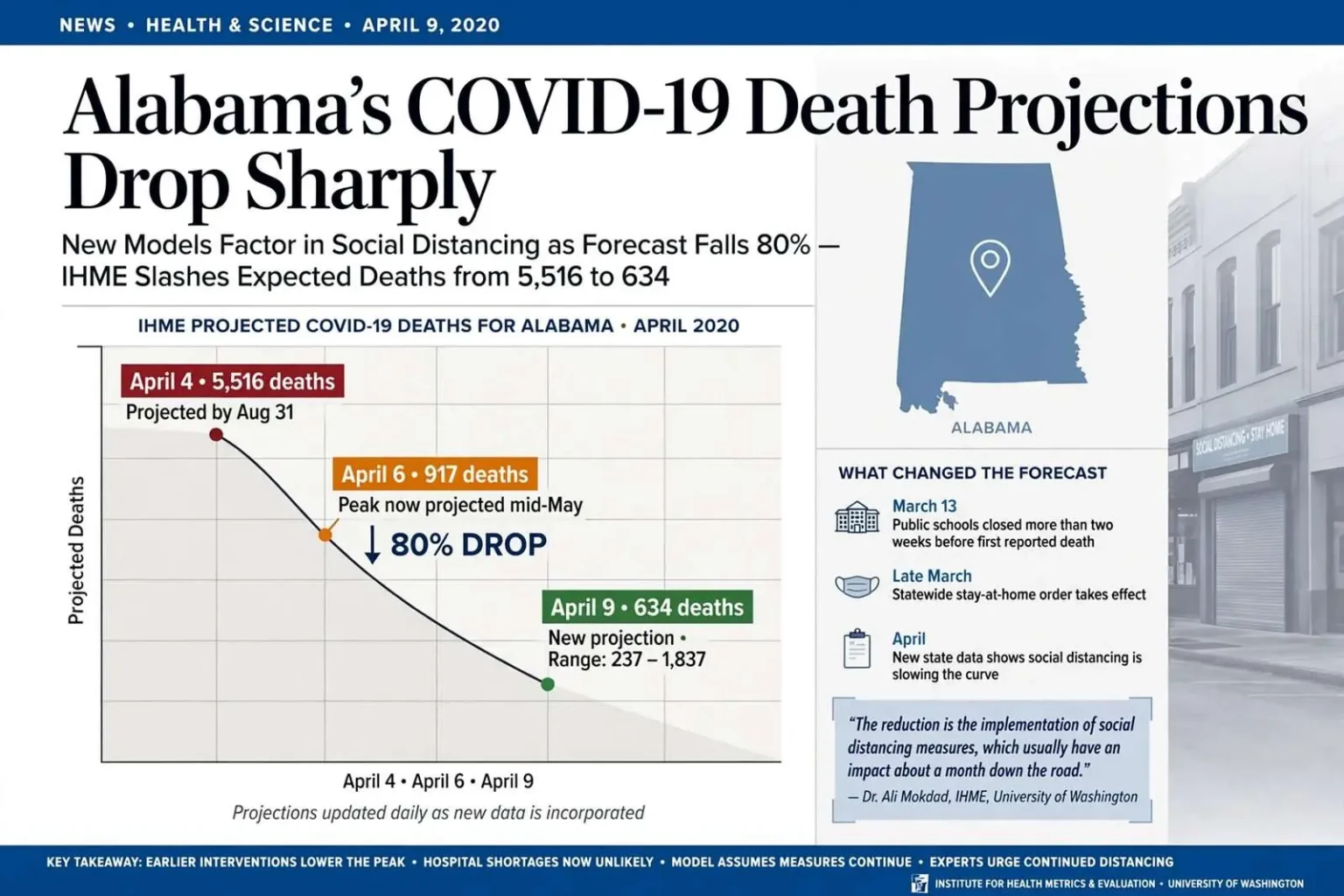
Within a single weekend in April 2020, the nation’s most-watched coronavirus model slashed its projections for Alabama — cutting forecast deaths by roughly 80 percent and erasing predictions of a desperate shortage of ventilators and ICU beds. The swing was one of the sharpest applied to any state during the early weeks of the pandemic, and it transformed the outlook Alabama officials and hospital leaders used to plan for the crisis.
As recently as that Saturday, the model from the Institute for Health Metrics and Evaluation (IHME) at the University of Washington projected Alabama would suffer the fourth-most COVID-19 deaths of any state by the end of August: 5,516 fatalities, with critical shortages of hospital capacity. That projection implied a catastrophe for a state with Alabama’s population, placing it in the same tier of expected losses as the nation’s largest and hardest-hit states and suggesting hospital systems from Huntsville to Mobile could be overwhelmed at the peak.
By Monday morning, two days after Gov. Kay Ivey’s statewide stay-at-home order took effect, the same model was projecting an average of 917 deaths and moved Alabama’s peak to mid-May. A further update on April 9 lowered the projection to an average of 634 deaths, within an uncertainty band of 237 to 1,837. In the span of days, the projected toll fell by nearly five thousand, the anticipated peak shifted weeks later, and the ventilator and ICU shortfalls the earlier runs had predicted disappeared from the forecast entirely.
The revisions mattered practically as well as politically. Projections drive decisions about field hospitals, ventilator purchases, elective procedure postponements and staffing surges, and hospital systems across the state had been preparing against the grimmer early numbers. A forecast that arrived hundreds of deaths lower, with the peak pushed into mid-May, bought time for those preparations to catch up with the disease.
Why the numbers changed
Dr. Ali Mokdad, the IHME professor of health metrics sciences who built the model, said better data drove most of the improvement. Early versions leaned on CDC reports from the first U.S. cases and on outcomes from Italy and Spain; once researchers could add state-specific data in early April, Alabama’s curve looked very different. The early model had been forced to assume Alabama would follow the trajectory of European outbreaks that overwhelmed health systems, a template that state-level data quickly showed did not match what was happening on the ground.
New weight given to social distancing also mattered. “The reduction in projected deaths is the implementation of these social distancing measures, which usually have an impact about a month down the road,” Mokdad said. “This is the result of the appropriate decisions your governor has made.”
He singled out Alabama’s March 13 decision to close public schools — more than two weeks before the state’s first reported death — as likely having a significant effect. “Closing the schools and universities has had a huge impact in Alabama and has saved a lot of lives,” he said, while stressing that a stay-at-home order remained important because school closures alone only change where people gather. Children kept out of classrooms still converge on parks, stores and grandparents’ homes, and the stay-at-home order was designed to address the gatherings school closures could not.
Models run hot — and why that’s no reason to relax
Even the retooled projections ran well ahead of reality on the ground: the Alabama Department of Public Health reported 53 deaths as of April 6, versus an IHME projection averaging 89 for that date — about 87 percent higher. The gap between forecast and actual outcome illustrated the difficulty of modeling a new disease in real time, when every input — how infectious the virus is, how long patients stay hospitalized, how many deaths go uncounted — is itself uncertain.
IHME also acknowledged an error in the “total deaths” figure displayed on its public dashboard, which briefly showed more deaths than the state had reported. The glitch added confusion at a moment when the model’s credibility was already under scrutiny, and it underscored how closely officials, journalists and residents were watching every number the site published.
Mokdad attributed wide margins to live, evolving data that shifts projections day to day, with bands expected to tighten as more information arrives. The uncertainty ranges around the Alabama projections — from a low of 237 to a high of 1,837 in the April 9 update — were wide by design, reflecting the honest range of outcomes the available data could support. In model-building during a pandemic, a narrow but wrong forecast is more dangerous than a wide but honest one.
The experience also fed a broader debate about pandemic modeling. Critics pointed to the downward revisions as evidence that projections overstated the threat; modelers responded that the models had explicitly assumed interventions would be maintained, and that better-than-projected outcomes were the product of those interventions working rather than the projections being baseless. Alabama’s weekend of sharply revised numbers became a case study in that argument.
The warning behind the good news
But Mokdad cautioned against reading the improved outlook as an all-clear. “We shouldn’t be letting our guard down. When something is encouraging, you keep going,” he said. “I’m happy for Alabama and what you’ve done with these measures, but it’s time to stick to them so you can reduce the number of deaths and possibly even reopen your businesses earlier than originally expected.”
The logic he described was straightforward: social distancing measures take effect with a lag of about a month, so the improvements visible in early April reflected decisions made in March, and the weeks ahead would reflect decisions made now. Relaxing too early, before the curve had truly bent, could erase the gains the school closures and stay-at-home order had produced and push the projections back toward their earlier highs.
For Alabama residents, the message cut two ways. The dramatic drop in projected deaths was genuinely good news — a sign that the state’s early actions had changed its pandemic trajectory — but it was also conditional. The model’s lower numbers assumed the distancing measures stayed in place, and the state’s actual toll would depend on whether residents and businesses kept to the practices that had, within a single weekend, rewritten the forecast. As the state looked toward its mid-May peak, the question was no longer whether the projections would hold, but whether the behavior that had lowered them would hold with them.
What the IHME model actually was
The Institute for Health Metrics and Evaluation, a research center at the University of Washington in Seattle, became during the spring of 2020 the single most-quoted source of COVID-19 projections in American public life. Its state-by-state forecasts of deaths, hospital bed use, ICU demand and ventilator needs were cited at White House briefings and used by governors to justify emergency orders, including Alabama’s. That visibility made every revision front-page news, and Alabama’s 80 percent cut over a single weekend drew particular attention because of how starkly it reset expectations for the state.
The model worked by combining observed death data with statistical projections of how the outbreak would progress under current conditions, producing ranges rather than single certainties. Each daily or near-daily update ingested new data from states and hospitals, which is why the projections could move so dramatically in short order — and why Mokdad and his colleagues repeatedly stressed that the numbers were a living estimate, not a settled verdict.
How Alabama’s early decisions shaped the curve
Alabama’s March 13 school closure order came at a moment when the state had few confirmed cases but a chance to act ahead of widespread transmission. Closing public schools more than two weeks before the state’s first reported death put Alabama among the states that moved early on gatherings, and the IHME team’s analysis suggested that head start showed up in the mortality projections a month later, once the lag between intervention and effect had passed.
The stay-at-home order that Gov. Ivey issued later in March extended that approach to the whole population. It took effect just before the weekend in which the model’s Alabama projections collapsed, and the timing was no coincidence in the modelers’ account: the update was the first to fully price in the statewide order’s expected effect. Together, the school closures and the stay-at-home order formed the two-step sequence that Mokdad credited with “saving a lot of lives” in the state.
Hospital leaders across Alabama watched the same revisions with their own calculations in mind. The original projections of critical shortages had driven plans for alternate care sites and rationing protocols; the revised outlook allowed some of that planning to shift toward staffing and supplies for a longer, lower surge rather than a short catastrophic one. Either way, the models’ message to the state’s health systems was the same: prepare for the peak that was coming, now expected in mid-May.
Reading an uncertainty band
The April 9 update’s band of 237 to 1,837 projected deaths spanned nearly a eightfold range, which can look like a failure of precision but is better read as a map of possibilities. The lower end assumed distancing measures held firm and the state’s curve continued to flatten; the upper end allowed for behavior to loosen, data to shift, or the disease to behave worse than the models assumed. Reality, as of early April, was tracking well below even the model’s central estimate — 53 reported deaths against a projection of 89 for the same date.
Mokdad’s advice to Alabamians was to treat that favorable comparison as a reason to continue rather than a reason to conclude. The model’s message was that the state had bought itself a lower peak and possibly an earlier reopening, but only by continuing the measures that had produced the improvement — a bargain he framed in his closing words: keep going, stick to the measures, and the state could “reduce the number of deaths and possibly even reopen your businesses earlier than originally expected.”