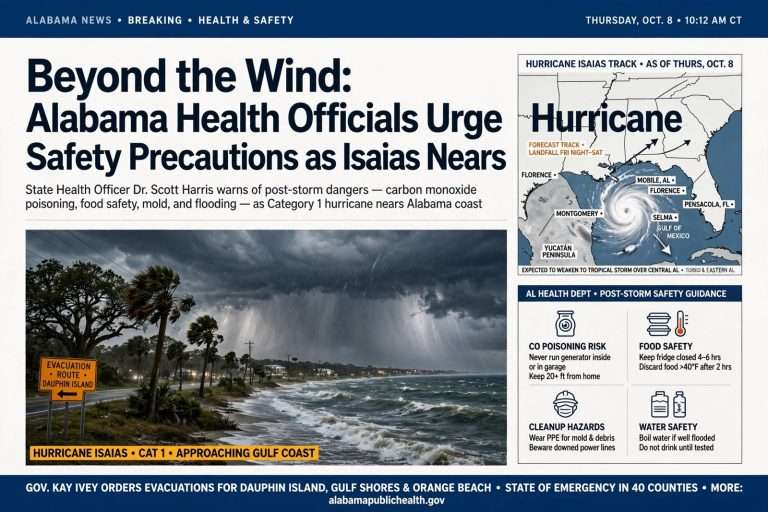
Alabama’s Cyclospora Outbreak Easing as State Tracks 117 Cases This Year
Alabama's cyclospora outbreak has slowed to 117 confirmed cases this year, far below the nearly 10,000 seen in the upper Midwest, state health officials say.
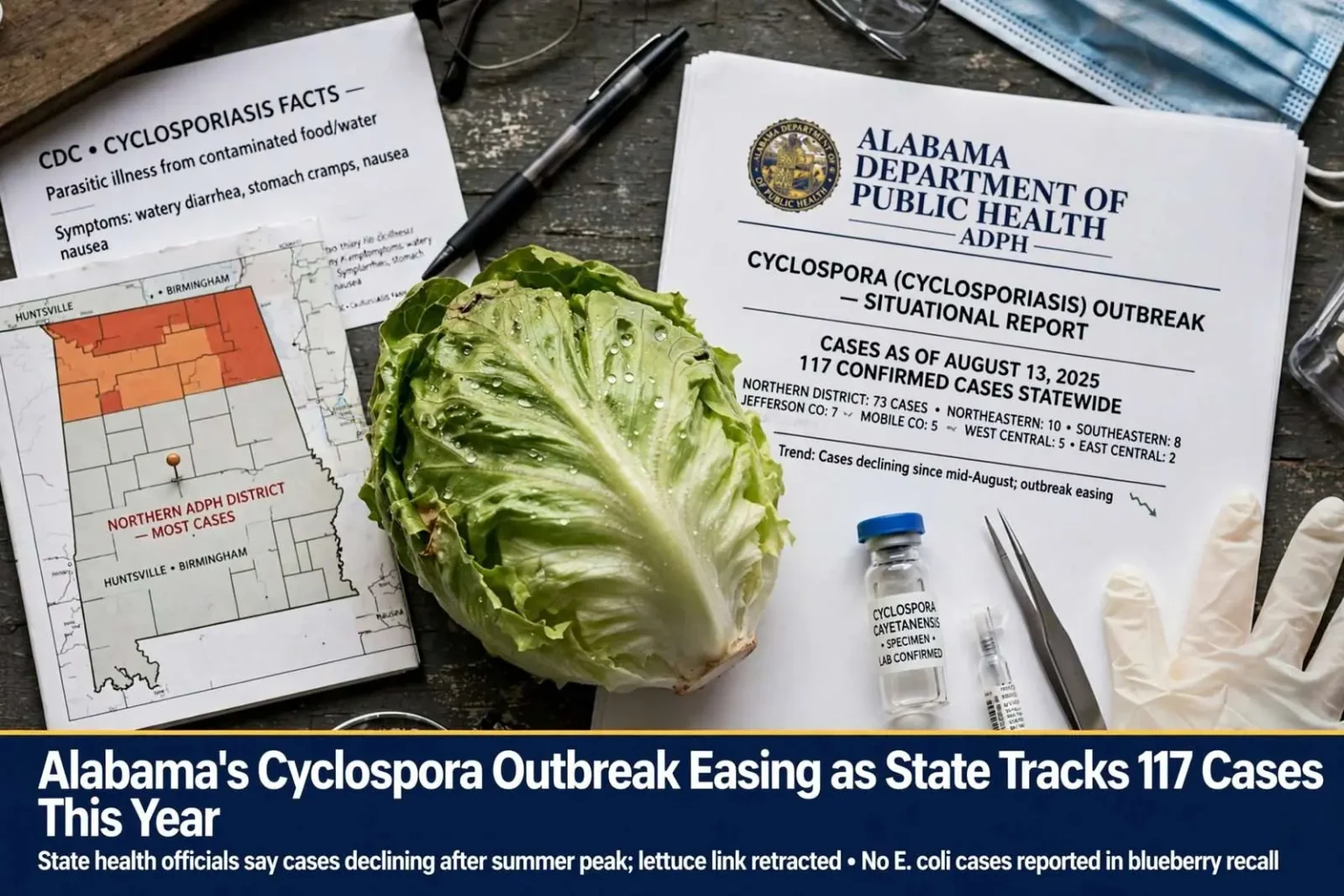
State health officials say the parasitic illness cyclosporiasis, which has sickened thousands of people nationwide this summer, appears to be losing steam in Alabama after tallying 117 confirmed cases so far this year. "The cyclospora outbreak associated with lettuce, mostly we think, has now tallied about 117 cases confirmed in Alabama," said Dr. Scott Harris, the state health officer with the Alabama Department of Public Health (ADPH), speaking Thursday. He noted that figure "pales in comparison" to the upper Midwest, where nearly 10,000 cases have been confirmed and another 16,000 or more are suspected. Alabama's case count this year already outpaces the 21 cases reported in 2025 and the 30 reported in 2024, though it remains below the 139 cases recorded in 2023, according to ADPH data.
A Nationwide Outbreak Centered in the Midwest As of Aug. 13, the U.S. Centers for Disease Control and Prevention (CDC) had confirmed 9,481 cyclospora cases across 17 states, along with two deaths in Michigan and 398 hospitalizations nationwide. The agency has said the true case count is likely higher, since cyclosporiasis often goes underreported. Michigan, where the outbreak has been most severe, has reported nearly 14,000 cases through its own state health department tally, while Ohio has reported close to 5,000. By comparison, Alabama's outbreak has been far more contained. Ryan Easterling, ADPH's director of communications, said Thursday that the state's cases have been concentrated in the northern part of Alabama. Seventy-three cases were reported in the Northern ADPH District, a 12-county region mostly north and northwest of Birmingham.
The Northeastern District reported 10 cases, the Southeastern District eight, and both Jefferson County and the Southwestern District reported seven each. Mobile County and the West Central District each logged five cases, while the East Central District reported two. "Even though that doesn't sound like a lot compared to 20,000, it's a lot for Alabama, so we'll keep tracking that," Harris said. What Is Cyclosporiasis? Cyclosporiasis is caused by cyclospora, a microscopic parasite that infects the intestines. It is typically contracted by eating or drinking something contaminated with the parasite, which is spread through feces. Symptoms include watery or "explosive" diarrhea, nausea and stomach cramps. The illness is not contagious from person to person.
According to the CDC, symptoms can appear within about 10 days of exposure and, without antibiotic treatment, can last anywhere from a few days to a month. About 94% of Alabama's cases have been laboratory-confirmed, Easterling said, and roughly 34% of the state's cases have been linked directly to the broader outbreak. Lettuce Recall Linked, Then Retracted The CDC initially traced the outbreak to iceberg lettuce supplied by Mexico-based Taylor Farms, prompting the company to voluntarily recall several bagged lettuce products and lettuce sold under its Marketplace brand across 31 states. The agency later retracted that link. The best-by dates on the recalled products have since passed.
Separate Concern Over Frozen Blueberries Alabama health officials are also monitoring a separate, unrelated recall of organic frozen blueberries distributed to Publix stores across the Southeast in late July over concerns about E. coli contamination. The Food and Drug Administration (FDA), working with the CDC, upgraded the risk associated with that recall to a Class I designation, meaning there is a reasonable chance the product could cause severe health problems or death if consumed. Despite that upgraded classification, Easterling said Wednesday that ADPH had not received updated guidance from either the FDA or CDC, and noted the FDA's investigation page for the blueberry recall had not been updated since July 30. He added that no E. coli cases tied to the recall have been reported in Alabama.
Background and Context
According to the Mayo Clinic, E. coli symptoms typically begin three to four days after eating a contaminated product and closely resemble those of cyclosporiasis, including diarrhea and stomach cramps, which can make it difficult for people to distinguish between the two illnesses without testing. ADPH has encouraged residents experiencing prolonged gastrointestinal symptoms to consult a physician, who can order testing to confirm whether an illness is linked to either outbreak.
The broader geographic context of this story spans Mobile County, Alabama, a region characterized by its unique blend of coastal ecology, agricultural heritage, and growing suburban development The area's economy has historically been anchored by timber, agriculture, commercial fishing, and tourism, with recent decades bringing industrial diversification including aerospace, shipbuilding, and advanced manufacturing Understanding the interplay between these economic drivers and the region's environmental resources—particularly the Mobile Bay estuary system, the Gulf Intracoastal Waterway, and the extensive longleaf pine forests—is essential to grasping the significance of local policy decisions and
community developments The historical development patterns of coastal and inland South Alabama reveal a region in transition From the indigenous Creek and Choctaw territories through the colonial Spanish, British, and French periods, to the antebellum cotton economy, the timber boom of the late nineteenth and early twentieth centuries, and the post-World War II industrial expansion, each era has left its imprint on the landscape and communities Contemporary growth pressures—particularly along the Gulf Coast corridors of Baldwin and Mobile counties—intersect with longstanding rural character in ways that make planning and preservation
conversations especially consequential for the region's future identity Local government operations in this part of the state typically involve a layered structure of county commissions, municipal councils, and special-purpose districts that together deliver services ranging from road maintenance and solid waste collection to public safety and parks programming Revenue streams rely heavily on a mix of property taxes, sales and use taxes, gasoline taxes dedicated to transportation, and intergovernmental transfers from Montgomery and Washington For residents, the practical effect is that decisions made in county commission chambers and city halls—often
on technically complex matters such as zoning variances, capital improvement programming, and emergency services funding—directly shape daily quality of life, property values, and the long-term desirability of the region as a place to live and do business Civic participation in South Alabama communities frequently centers on neighborhood associations, volunteer fire departments, and faith-based organizations that supplement the formal work of government These grassroots structures often serve as the first point of contact for residents navigating local services, and they play an outsized role in disaster preparedness and recovery given the
Background and Context
region's exposure to hurricanes and severe weather The durability of these networks—strengthened through repeated cycles of response to storms such as Hurricane Sally in 2020 and Hurricane Zeta in 2020—has become a defining feature of regional resilience, reinforcing the social fabric that formal institutions alone cannot fully provide The cultural character of South Alabama blends deep Southern traditions with the distinct influences of Gulf Coast geography Storytelling, music, and foodways rooted in African American, Creole, and European heritages coexist with the contemporary rhythms of a region attracting new residents from
across the country Festivals celebrating everything from bluegrass and seafood to Mardi Gras parades in the Mobile tradition reflect a community that values both continuity and reinvention This cultural richness, alongside the area's natural assets such as white-sand beaches, freshwater rivers, and the biodiverse delta, underpins a quality of life that many residents cite as the primary reason they choose to stay or relocate to the region Transportation infrastructure serves as the circulatory system of the regional economy, linking ports, military installations, manufacturing sites, and tourism destinations Interstate 10 traverses
the northern Gulf Coast, connecting the Mobile area to Pensacola, New Orleans, and beyond, while the Baldwin County corridor has seen sustained investment in widening and interchange improvements to accommodate explosive population growth The proposed Interstate 10 Mobile River Bridge and Bayway project, the expansion of Mobile Regional Airport, and ongoing rail and short-line railroad improvements each represent multi-decade bets on connectivity that supporters argue are essential to maintaining the region's competitive edge Debates over funding mechanisms, tolling, and environmental impact continue to animate public discussion around these large-scale initiatives
Healthcare delivery and educational attainment are increasingly recognized as twin pillars of regional prosperity The University of South Alabama, the University of Mobile, Spring Hill College, and a network of community colleges and career technical schools anchor a developing health sciences and research cluster that complements the clinical care provided by the region's major hospital systems Access to primary care, mental health services, and maternal health support remains uneven across rural counties, prompting investment in telehealth, mobile clinics, and federally qualified health centers Coordinated efforts between K-12 systems, four-year institutions,
and industry partners are producing a more seamless pathway from classroom to employment, addressing long-standing gaps in workforce readiness The military and defense sector provides an outsized economic and cultural footprint across the Gulf Coast Naval Air Station Pensacola, NAS Whiting Field, Eglin Air Force Base, and the Mobile Coast Guard complex collectively account for tens of thousands of active duty, civilian, and contractor positions, while retired service members constitute a significant share of the population along the coastal corridor Defense spending and federal contracting opportunities ripple through local supply
chains, supporting shipyards, aviation services, information technology firms, and construction trades.