
Alabama’s Trump Support Could Pay Dividends as President-Elect Builds Administration
From the I-10 bridge to Austal's shipyard, South Alabama leaders saw potential gains from Trump's 2016 win as Baldwin County posted record turnout.
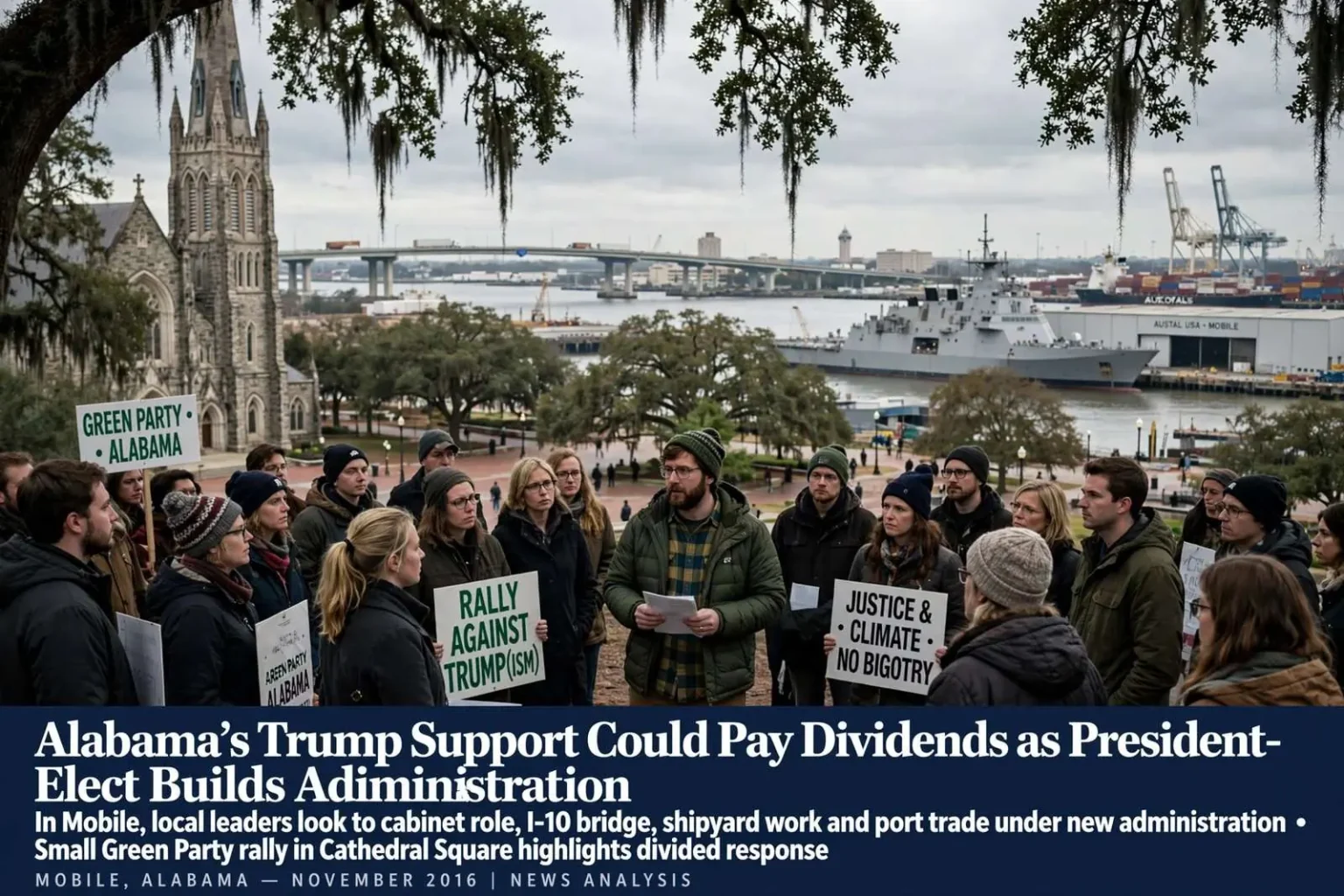
Donald Trump’s surprise victory in the 2016 presidential election drew mixed reactions across Alabama, and in Mobile the response played out on the streets as well as in the corridors of power. A few days after the election, the Alabama Green Party held a ‘Rally Against Trump(ism)’ in Cathedral Square, drawing about 30 people.
A Divergent Electorate
Organizer Tyler Henderson, chair of the Alabama Green Party, said most Alabamians who backed Trump did so because of an economic message, not the rhetoric critics condemned. He called on both supporters and opponents to speak out against bigotry and harassment directed at minorities. The small downtown rally reflected the reality of a state where opposition voices were outnumbered but not silent, gathered in one of downtown Mobile’s most public spaces a short walk from Government Street and the city’s civic core.
Alabama delivered one of Trump’s largest margins of any state in the country, continuing a Republican streak in presidential politics that dated back decades. But the days after the election exposed the range of feeling behind those numbers: celebration among the majority, unease among minorities and immigrants, and a determination among progressive organizers to hold the new administration to account from the first week.
Sessions in the Cabinet Conversation
Meanwhile, local and state leaders signaled that Alabama’s overwhelming support for Trump could translate into tangible benefits. Sen. Jeff Sessions of Mobile was among the first lawmakers to back Trump and was discussed for cabinet posts including attorney general, defense secretary or homeland security secretary. Sessions had been an early and influential surrogate for the Trump campaign, endorsing at a moment when establishment Republicans were still keeping their distance, and his name sat near the top of every transition list of potential appointees.
A cabinet post for Sessions would mark the first time an Alabama senator had been tapped for such a role in modern times, and it would set in motion a special process to fill his Senate seat under Alabama law, with the governor empowered to appoint a successor. For Mobile, the prospect carried both prestige and practical considerations: a senator in the cabinet brings weight to a region’s federal requests, but an empty seat means starting over with a new senator’s seniority.
U.S. Rep. Bradley Byrne said Sessions would be a tremendous asset to the administration and that his appointment would help the Mobile area. Byrne pointed to several ways a Trump White House could aid the region. He said progress on the long-planned Interstate 10 bridge over the Mobile River should continue under a Trump infrastructure push, and that Trump’s call to expand the Navy fleet would sustain the Littoral Combat Ship program that benefits Austal’s Mobile shipyard — with 26 of 52 planned ships built locally.
The Bridge and the Shipyard
The I-10 bridge proposal had been the Mobile area’s top transportation priority for years, aimed at replacing the aging Wallace Tunnel crossing with a new span over the Mobile River to relieve one of the worst truck chokepoints on the Gulf Coast. Federal support is the decisive factor in projects of that scale, and Byrne’s argument was that an administration promising a major infrastructure bill offered Mobile its best opening in a generation.
Austal’s shipyard on the Mobile River had become a cornerstone of the city’s industrial economy through the Littoral Combat Ship program, employing thousands and anchoring a growing cluster of maritime contractors along the waterfront. Navy shipbuilding plans are set in multi-year budgets, so a fleet expansion endorsed by the incoming administration was read locally as job security for the yard and its suppliers deep into the future.
Red Snapper and the Gulf’s Fishing Economy
Byrne also predicted a return to a more normal red snapper season. Federal management of the fishery had shrunk the Gulf’s recreational snapper season to a fraction of its historical length in the years before the election, and the compressed season had become one of the most volatile political issues on the coast. Alabama’s charter fleets, party boats and private anglers argued that the stock was healthy and that the restrictive seasons were devastating businesses built around summer snapper trips out of Orange Beach and Dauphin Island.
A shift in control over the fishery — from federal managers to the Gulf states — had been sought by coastal delegations for years, and the incoming administration’s receptiveness gave Gulf Coast lawmakers hope that seasons might finally stretch back toward their historical span. For the coastal towns that fill with anglers each summer, the issue ranked alongside any infrastructure project in economic importance.
The Port Watches Trade Policy
Jimmy Lyons, president of the Alabama State Port Authority, said some concerns about Trump’s talk of trade protectionism had eased since the campaign ended, a welcome sign for a port city dependent on imports and exports. The Port of Mobile ranks among the nation’s major deepwater ports, handling coal, containers, forest products, steel and aircraft components, and its fortunes rise and fall with the health of international trade.
Campaign rhetoric about tariffs had unnected port officials and the industries that depend on the terminals along the Mobile River, since a trade war tends to shrink cargo volumes before almost anyone else feels it. Lyons’ read — that the rhetoric was moderating now that the votes were counted — reflected the cautious optimism of a port community that had watched the election from a position of exposure.
The port was also in the middle of its own generational expansion, with a new container terminal development at the former ThyssenKrupp steel site in Calvert and continued growth in container traffic through the downtown terminals. Federal relationships matter for the channel deepening and dredging projects that keep a port competitive, another reason local leaders watched the transition closely.
Environmental Advocates Stay Guarded
Environmental groups along the Gulf Coast struck a more cautious tone. Mobile Baykeeper executive director Casi Callaway noted the Gulf’s restoration efforts would continue regardless of federal policy, but said local advocates would keep working to hold both industry and government accountable for the cleanup promises made after the 2010 oil spill.
The restoration framework built after Deepwater Horizon rested on legal settlements and dedicated funding streams that a change in administration could not simply erase, which was the reassurance Callaway offered. But the groups that had spent years policing the settlement’s implementation planned to keep their watch, mindful that enforcement priorities and agency leadership could shift in Washington.
Baykeeper’s work had expanded far beyond spill recovery over the years, encompassing stormwater pollution, sewer overflows, industrial permitting and the health of Mobile Bay itself, all areas where federal rules set the floor. That breadth was exactly why the organization’s posture toward the new administration was vigilance rather than either celebration or despair.
A Week That Set the Region’s Agenda
Taken together, the days after the election mapped out the region’s federal agenda for the years ahead: a potential cabinet seat for Mobile’s senator, an infrastructure opening for the I-10 bridge, a shipbuilding plan that keeps Austal’s bays busy, a snapper season the coast wanted back, a trade policy the port hoped would stay open, and an environmental watchdog that planned to stay at its post. Each item depended on decisions made in Washington, and each had local voices already positioned to make the case.
Byrne’s office framed the opportunity in explicitly local terms — the bridge, the ships, the fish — an argument that Alabama’s lopsided vote had bought the state credibility with the incoming administration and that Mobile’s projects should be first in line to benefit. Skeptics noted that campaign promises routinely outlast their budgets, but the region had learned over decades that access and persistence, not guarantees, are what federal appropriations are won with.
The Streets and the Square
The Green Party rally in Cathedral Square was small against the scale of the election, but it captured something real about the moment: a minority political community organizing openly in a city where the other side had won decisively. Henderson’s message — that Trump’s Alabama voters were motivated by economics and that bigotry should be opposed across party lines — tried to thread a path between concession and resistance, addressing both the new president’s supporters and the neighbors who feared what the victory would mean for them.
Downtown Mobile had seen the campaign up close before the election, when both parties’ surrogates and protesters had passed through during a hard-fought race. The square, ringed by churches and historic homes, had long served as the city’s gathering place for everything from Mardi Gras events to political demonstrations, and its use that week continued a tradition of civic expression in the heart of the city.
What the Transition Meant for Mobile
The transition period that followed the election would test each of the region’s hopes in turn. Sessions’ path to a cabinet nomination would move through Senate confirmation and set off the state’s appointment process for his seat. The infrastructure bill would be drafted in Congress with every region competing for projects. Navy budgets would be written years in advance, giving shipyard workers reason for cautious confidence. The snapper fight would move through federal fisheries councils and Congress. And the port and the bay’s advocates would both keep their watches on Washington.
For Mobile, a city whose economy runs on the river, the bay, the shipyard and the highway that crosses them, the election of 2016 was less about national spectacle than about a checklist of local stakes. The week after the vote showed the community working through that checklist in public — leaders arguing for projects, a port gauging trade winds, an environmental group standing guard, and a small crowd in Cathedral Square insisting that its voice would be heard too.