ALDOT Completes Traffic Signal Overhaul on Airport Boulevard, Dauphin Street
ALDOT, Mobile County and the City of Mobile completed a phased, $11 million traffic signal overhaul, retiming signals on Airport Boulevard and Dauphin Street and adding real-time monitoring capability.
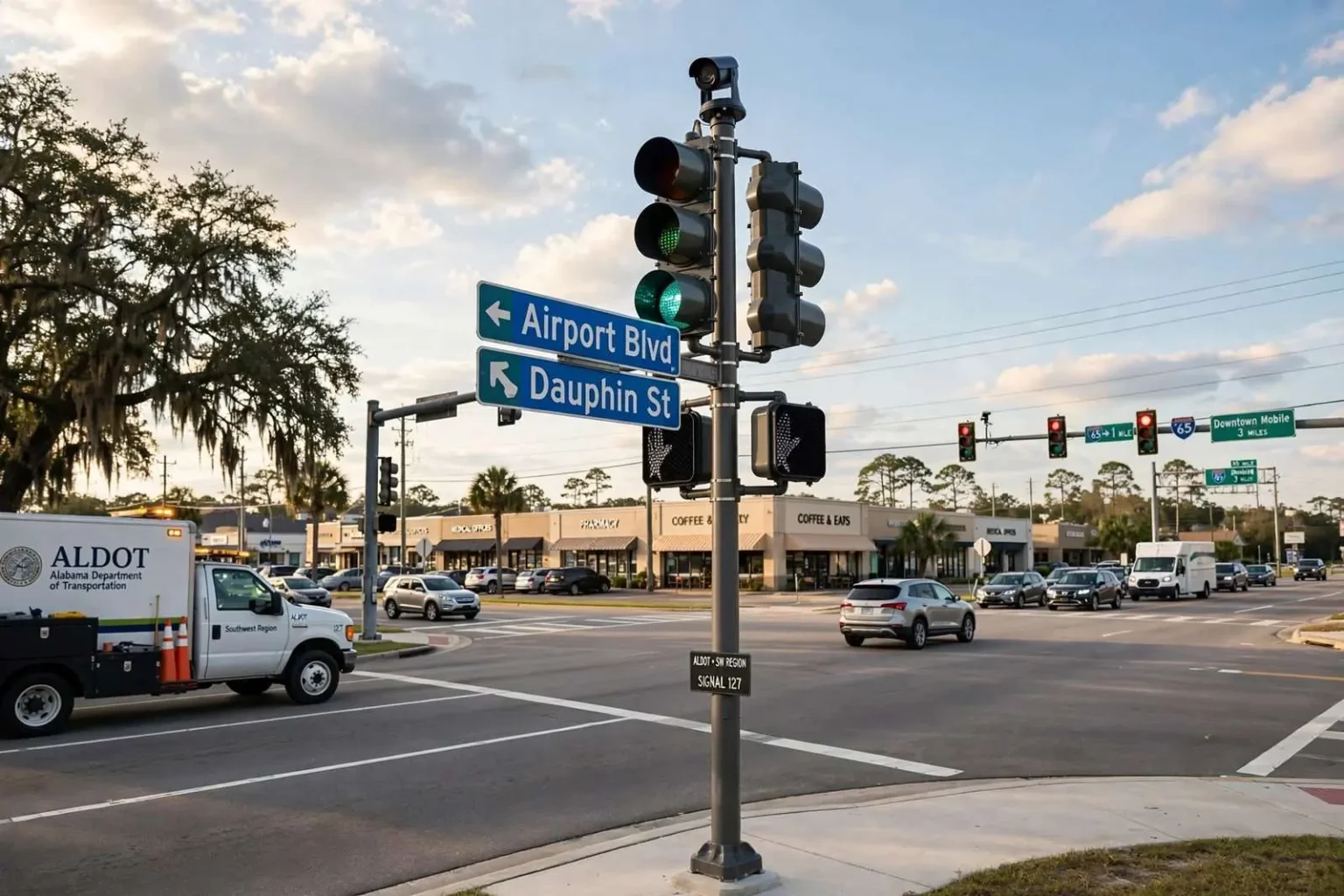
The Alabama Department of Transportation has wrapped up a major traffic signal update in the Mobile metro area, capping a months-long effort to untangle some of the region’s most congested corridors. The project was carried out in partnership with Mobile County and the City of Mobile, and it centered on two of the busiest stretches of road in the city: Airport Boulevard and Dauphin Street. Officials describe the work as both a timing overhaul and a technological upgrade, one intended to improve traffic flow and cut down on congestion at key intersections across the area.
The changes were rolled out in phases beginning in fall 2024, allowing engineers to adjust corridor by corridor rather than flipping every signal at once. The focus throughout was on simplifying how signals operate and giving engineers the ability to monitor conditions in real time. Rather than a sweeping rebuild of infrastructure, the effort concentrated on the fundamentals: how long lights stay green, how signals coordinate with one another, and how quickly problems can be spotted and corrected once they appear.
“We took a ‘back to basics’ approach, focusing on signal timing and real-time monitoring to address problem areas,” said Benjamin Nichols with ALDOT’s Southwest Region. The wording is telling. Modern traffic management often grabs headlines for adaptive systems and expensive new hardware, but ALDOT’s engineers started with the basics of timing and observation, then layered on tools that let them keep adjusting after the project formally ended.
For the department, the work fits a broader mission. ALDOT’s Southwest Region covers the Gulf Coast counties, including Mobile and Baldwin, where growth along the Interstate 10 and Interstate 65 corridors has kept pressure on arterial roads for years. Signals on state routes fall to ALDOT, while city and county engineers manage their own systems, which is why coordination among the three governments mattered for a project that crossed jurisdictional lines and touched roads commuters use every day.
Smoother Commutes on Two Key Corridors
Two of the most heavily traveled corridors in the Mobile area saw direct benefits from the retiming effort. Traffic signals along Airport Boulevard, from University Boulevard to Cody Road, were retimed to improve the flow of traffic. Drivers along that stretch have noticed fewer stops and shorter travel times during peak hours, when commuter and school traffic historically bunched up at successive red lights west of the airport.
The corridor is one of the busiest commercial arteries in west Mobile, lined with shopping centers, restaurants, medical offices and neighborhood entrances that generate constant turning movements throughout the day. Poorly timed signals force drivers through a stop-and-go cycle that wastes fuel and tests patience; a well-coordinated sequence lets platoons of cars move through multiple intersections on a single green wave.
Off-peak and overnight travel along the corridor also became quicker, with reduced delays making trips more predictable for commuters. Predictability matters as much as speed for many drivers. A delivery operator, a hospital shift worker or a parent on the school run plans around how long a trip reliably takes, not just the best-case time, and retiming that trims delay across all hours pays off in every one of those trips.
Dauphin Street signals, from Rimes Road to Sage Avenue, received similar adjustments, with a particular focus on smoothing traffic around the interchange with Interstate 65. That junction has long been one of the pain points of the corridor, where drivers exiting the interstate merge into local traffic and side-street motorists wait through long cycles for a gap in the flow.
The changes were designed to cut down on delays and make it easier for drivers to transition from side streets onto the main road, a persistent complaint for commuters navigating that stretch of Dauphin Street. When a corridor’s signals are timed in isolation from the neighborhoods feeding into it, cars stack up on the collectors and never get a fair shot at a green. Retiming the corridor as a connected system spreads the delay more evenly and shortens the queues that back up into residential areas.
Dauphin Street matters to more than commuters. The corridor links west Mobile neighborhoods to the hospitals and offices near the interstate, and it serves as a relief route when crashes or construction close other east-west roads. Smoother operations there ripple outward, easing pressure on parallel routes like Airport Boulevard and the surface streets residents use to avoid the worst congestion.
Built for Ongoing Management, Not Just a One-Time Fix
Beyond retiming individual signals, the project gave ALDOT engineers new tools to manage the system going forward. Remote adjustment capability now allows engineers to tweak signal timing in real time in response to changing traffic conditions, rather than waiting for a scheduled update. That means a fender bender near an interchange, a sudden downpour during rush hour, or a special event downtown can be addressed from a desk instead of a signal cabinet in the field.
Cameras installed at key intersections give engineers live monitoring capability to track how signals are performing throughout the day. Officials noted that no video is recorded or stored, an distinction aimed at head-off privacy concerns: the cameras exist so engineers can see a problem, not so anyone can review footage after the fact. Live views let staff confirm that a timing change is working as intended and spot equipment failures before they turn into multi-hour signal blackouts.
How Signal Retiming Actually Works
Signal retiming is less glamorous than pouring concrete, but it is one of the most cost-effective tools in traffic engineering. Engineers begin by collecting data at each intersection: traffic volumes by hour, vehicle queues, turning movements, pedestrian activity and travel times along the corridor. From that picture they build timing plans that set green-light duration, the sequence in which intersections release traffic, and the offsets that let a platoon of cars travel through several signals without stopping.
Those plans are then field-tested and refined. A timing scheme that looks right on paper can fall apart when a single intersection’s left turns back up through the adjacent light, so engineers adjust cycle lengths and offsets until the corridor moves as a system. Because traffic patterns change with new development and shifting commute habits, agencies are advised to revisit signal timing every few years, yet the effort is often deferred because the work is invisible until someone measures the results.
The upgrades reflect how signal management has changed across the country. A generation ago, retiming a corridor meant sending technicians out with stopwatches and revisiting the cabinets by hand, so many agencies simply let their timing plans age until congestion forced a redo. Remote connectivity and live monitoring invert that model, turning signal timing from an occasional capital project into routine maintenance that can respond to the region as it grows.
For Mobile commuters, the practical takeaway is simple: the same drive should now take less time at more hours of the day, particularly along the two corridors that were retimed. Fewer stops mean less idling, which trims fuel use and reduces emissions from thousands of daily trips. Congestion that used to build at the worst intersections should clear faster, and drivers shifting onto side streets to dodge the backlog will find the main roads moving again.
There are safety dividends as well. Intersections produce a disproportionate share of urban crashes, and poorly timed signals contribute to red-light running, aggressive acceleration and rear-end collisions in stop-and-go traffic. Coordination along a corridor smooths speeds, while better side-street access reduces the desperate gap-hunting that puts turning drivers at risk. Pedestrians and cyclists also benefit from cycles that account for everyone using the road, not just the heaviest traffic stream.
Officials characterized the project as a foundation rather than a finish line. With remote adjustment and live monitoring in place, ALDOT engineers can keep refining the timings as traffic patterns shift, whether that means new development along the corridors, changes in commuting habits, or the seasonal swings that come with Mobile’s tourism and event calendar. Problems that once lingered until the next study can be identified and corrected within days.
The partnership model is also likely to continue. Mobile County and the City of Mobile manage thousands of additional signals on roads ALDOT does not control, and shared projects let the governments align timings where their jurisdictions meet, which is often exactly where commuters feel the worst delays. Officials pointed to the phased rollout since fall 2024 as a template: pick the corridors with the most documented pain, retime them, monitor the results, and move to the next problem area with the new tools already in hand.
For now, the visible work on Airport Boulevard and Dauphin Street is complete. What remains is the quieter, ongoing part of the effort — engineers watching the live feeds, nudging timings, and keeping the region’s signal system tuned to the traffic it actually carries rather than the traffic it carried when the last study was done.