ALDOT Pipe Replacement on SR-605 Starts Monday, Aug. 24
ALDOT begins replacing two pipes on SR-605 in Rehobeth and Taylor on Monday, Aug. 24, weather permitting, with temporary closures and detours expected.
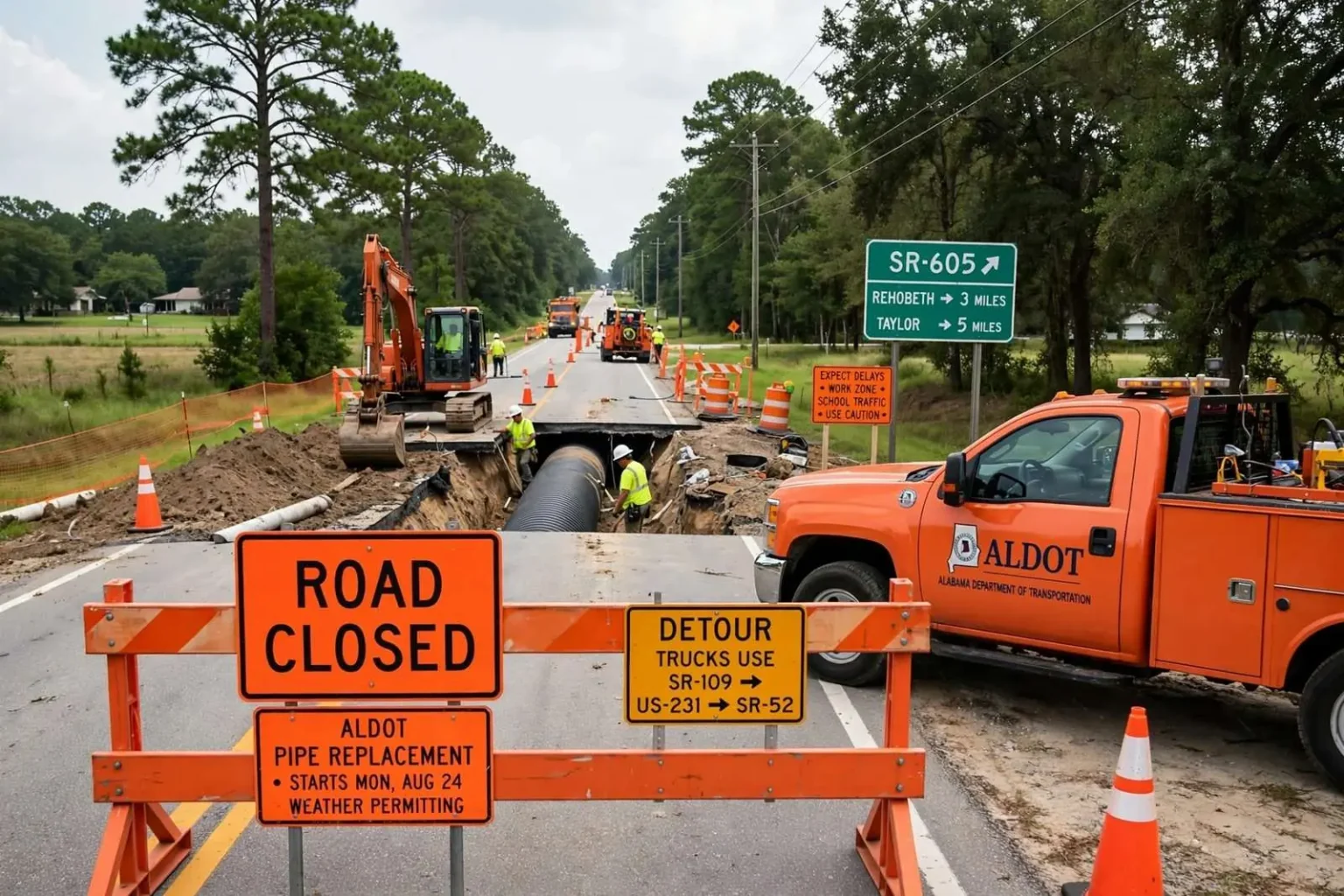
An Alabama Department of Transportation (ALDOT) maintenance project to replace two pipes along SR-605 in Rehobeth and Taylor is scheduled to begin Monday, Aug. 24, weather permitting. The initial work marks the start of a broader maintenance effort along the corridor, with additional pipe replacements on SR-605 planned for later dates. For commuters, school traffic and freight drivers who use the route daily, the project signals a season of temporary closures and detours on one of Houston County’s busier local corridors.
ALDOT said it remains in constant communication and coordination with the Town of Rehobeth, the City of Taylor and the Houston County Board of Education as it prepares for temporary closures needed to safely carry out the replacements. The school district’s involvement matters: SR-605 carries student traffic toward Rehobeth-area schools, and closure timing must account for buses and parent drop-offs that cannot simply reroute without warning.
During closures, trucks must use SR-109, US-231 and SR-52, and local traffic should seek alternate routes. The designated truck detour pushes heavy vehicles onto some of the region’s principal corridors — US-231 in particular, the main artery connecting Dothan to the rest of the Wiregrass — while residents who know the backroads are advised to plan around the closed segments entirely.
Once the entire maintenance project is finished, plans to resurface SR-605 can move forward. The sequencing is deliberate: drainage work first, then paving. Replacing pipes before resurfacing prevents the classic problem of laying new asphalt over failing culverts, only to dig it up again a year later when the road beneath it collapses.
Why pipe replacement comes first
Drainage is the invisible foundation of any road. Culverts and cross-drain pipes carry stormwater beneath the roadway, and when they age, rust or clog, the failure shows up as shoulder erosion, potholes and — in bad cases — the collapse of the roadbed itself. In the Wiregrass, where summer thunderstorms can dump inches of rain in an afternoon, functioning drainage is the difference between a road that lasts twenty years and one that fails in five.
Replacing pipes is disruptive precisely because the work is underground. Crews must cut the roadway open, remove the old pipe, install the new one, backfill and rebuild the road surface on top. The work cannot be done with traffic running over the open cut, which is why ALDOT schedules full temporary closures rather than lane restrictions — and why those closures are short, coordinated and weather-dependent.
Weather permitting is more than boilerplate. Rain delays not only the excavation itself but the compaction and paving steps that follow, and a project that begins Aug. 24 in the peak of the Gulf Coast storm season may see its schedule shift. ALDOT’s updates — posted through its channels and through the two municipalities — are the official word on where and when each closure takes effect.
Coordinating with the communities
The corridor runs through territory where municipal boundaries and county roads interleave. Rehobeth, a growing town on Dothan’s southern flank, and Taylor, its neighbor to the southwest, both sit in the path of rapid residential growth spilling out of the city. SR-605 serves that growth directly, carrying commuters into Dothan each morning and delivering them home each evening — traffic volumes that make even a one-day closure noticeable.
The Houston County Board of Education’s seat at the coordination table reflects the school calendar’s stakes. Buses operate on fixed schedules along fixed routes, and a closed segment of SR-605 can ripple through a morning route if no one adjusts. By coordinating closure timing with the school system, ALDOT reduces the chance that a pipe replacement turns into a fleet of late buses and a car line backed up around the block.
Local governments play their own part. The Town of Rehobeth and the City of Taylor will share schedule updates through their official channels, reaching residents who may not follow state transportation agencies but do follow their town’s social media page. It is a division of labor that has become standard on state projects touching small municipalities: ALDOT handles the engineering and the notices, and local governments handle the neighborhood reach.
The detour picture
The designated truck route — SR-109, US-231 and SR-52 — keeps heavy vehicles on roads built to carry them. US-231 is the region’s north-south spine, connecting Dothan to Montgomery to the north and the Florida line to the south, and it can absorb heavy truck traffic that a two-lane local road cannot. SR-52 and SR-109 fill in the loop, giving through drivers a path around the closed segment without seeking their own way down residential streets.
That last point is where local drivers come in. ALDOT’s advice that local traffic should seek alternate routes is an invitation to use the roads residents already know — the grid of county roads that parallels SR-605 through Rehobeth and Taylor. Every local driver who reroutes smoothly is one fewer vehicle in a work zone where crews are cutting into the roadbed.
Drivers should plan for potential delays and stay alert for workers and equipment throughout the work zone. Work zones concentrate risk: flaggers, heavy equipment backing up, and sight lines blocked by equipment all demand the kind of attention that speeds and distractions erase. Alabama’s stricter work-zone enforcement exists for exactly these conditions, and the presence of crews on or below the roadway makes every closure a safety matter, not just an inconvenience.
Tracking the schedule
Schedule updates listing specific closure locations will be posted by ALDOT, on ALDOT social media channels and through the Town of Rehobeth and the City of Taylor. Because the pipe replacements will proceed segment by segment over the life of the project, each closure’s location and duration will be announced as it approaches — meaning drivers who rely on the road should check the updates regularly rather than assuming any single detour pattern holds.
For real-time traffic updates and more, drivers can download the ALGOTraffic app. The app maps incidents, closures and congestion across the state’s highway network, and during a project like this one it becomes the fastest way to confirm whether a given stretch of SR-605 is open on a given morning. Combined with the posted schedules, it turns a season of closures into a manageable commuting problem.
The work itself is the kind that rarely earns headlines but keeps a corridor alive. Pipes replaced now, before they fail, prevent the emergency closures and road collapses that follow culvert failures — and the resurfacing that comes at the end will hand Rehobeth and Taylor a smoother SR-605 for the growth the Wiregrass keeps delivering to its southern edge.
The SR-605 project also reflects how ALDOT paces maintenance across a district. Pipe replacement programs run continuously through the state’s counties, prioritized by the age and condition of existing culverts, traffic volumes and the consequences of failure. A corridor like SR-605 — growing traffic, school routes and commercial vehicles among them — ranks high on that list, because a failed pipe there would disrupt far more than a farmer’s field access.
For businesses along the corridor, the closures carry a mixed message. Access is preserved during most closure types, but the practical reality of a road cut — customers detouring, delivery windows shifting, visibility reduced by equipment — means some days will be slower than others. The town-level coordination ALDOT emphasizes is designed partly with those businesses in mind, spreading the word in advance so merchants can plan inventory and staffing around the quiet days.
Residents with questions about specific closures have a straightforward path: the ALDOT updates, the municipal pages for Rehobeth and Taylor, and the ALGOTraffic app together cover the who-what-when of each segment. Emergency vehicles, meanwhile, are coordinated separately through the counties’ dispatch systems, which track closures in real time so that fire and ambulance responses are never routed into a work zone by accident.
The economics favor the approach as well. Emergency repairs cost multiples of planned work — a collapsed culvert requires not just the pipe but reconstruction of a roadway that fails without warning, often at night, often in the middle of a storm. By scheduling the replacements in advance and bundling them with a resurfacing plan, the department buys a longer service life for the corridor at a fraction of the crisis price.
Monday, Aug. 24 is the start, not the finish. As additional pipe replacements proceed on later dates, the same pattern will repeat — notices posted, trucks funneled to US-231, SR-52 and SR-109, local drivers rerouted, crews in the cut — until the drainage work is done and the resurfacing begins. When the final lift of asphalt goes down, the corridor’s drivers will have endured a season of detours in exchange for a road rebuilt from the bottom up.