
Amtrak reaffirms plan to launch Mobile passenger rail service in 2022
Amtrak told Gulf Coast transportation leaders it plans to begin passenger rail service between Mobile and New Orleans in 2022, despite freight friction.
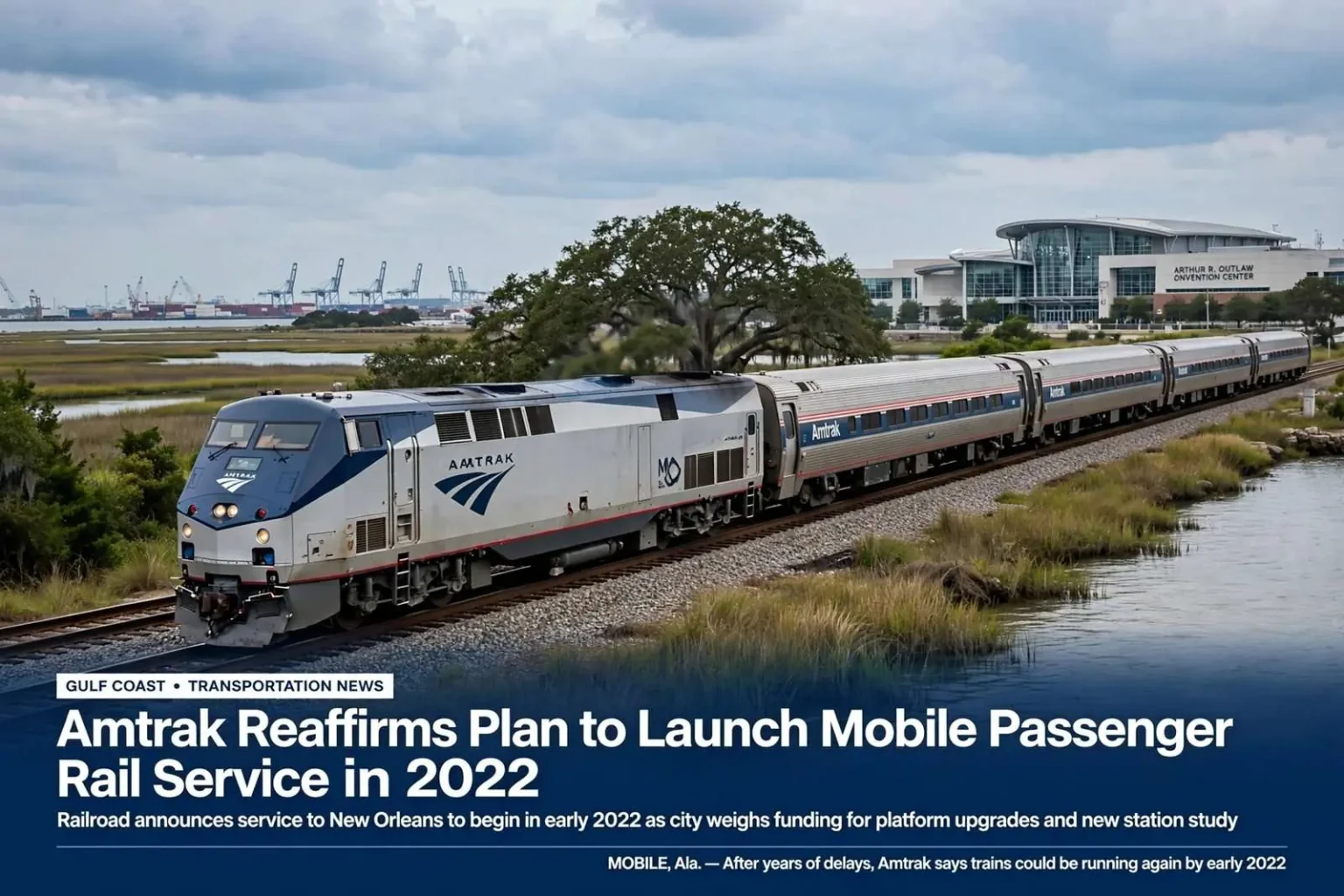
Amtrak is pressing ahead with its plan to restore passenger rail service between Mobile and New Orleans, telling Gulf Coast transportation leaders it aims to start running trains in 2022. The declaration, delivered at a meeting of the Southern Rail Commission on Friday, marks the most concrete timeline the national passenger railroad has offered since efforts to revive Gulf Coast service began in earnest, and it sets up a pivotal stretch for Mobile, the eastern anchor of the proposed route.
At a Southern Rail Commission meeting Friday, David Handera, Amtrak’s vice president of stations, facilities, properties and accessibility, said the focus on returning service to the Gulf Coast means building or repairing passenger platforms, lighting and signage. The work, though unglamorous, is the physical backbone of the restoration plan: stations and platforms along the route must meet modern accessibility standards before a single passenger boards, and the commission’s member communities have been inventorying what each stop needs to be ready.
In Mobile, Amtrak is looking at upgrades to a platform near the Arthur R. Outlaw Convention Center, though Handera said the existing platform would need better accessibility features and the city would most likely pay for those upgrades, along with the “path of travel” from the platform to the parking lot. The distinction matters for the city’s budget planners: Amtrak’s scope covers the rail-side infrastructure, while the walkways, crossings, and connections that link the platform to the street grid and parking fall to the host city, as they commonly do in station agreements across the country.
The convention-center site would put arriving passengers within walking distance of downtown hotels, restaurants, and the waterfront entertainment district, a location transit advocates have long argued maximizes the economic benefit of restored service. Mobile’s passenger rail history runs through the same district; long-distance trains served the city until Hurricane Katrina devastated the Gulf Coast rail corridor in 2005, and the tracks themselves have remained in freight service ever since.
The Study That Wouldn’t Finish
Jim Blair, Amtrak’s senior director of schedule and planning, detailed the friction between Amtrak and the freight railroads over a joint modeling study on the return of Gulf Coast service. The study, begun in 2019, ran into repeated delays, including a software upgrade that made earlier data unusable. The analysis was designed to model how new passenger trains would interact with freight operations on tracks owned and dispatched by the freight companies, a necessary step because Amtrak does not own the corridor it proposes to use.
“We set aside seven months to complete the study and we found ourselves in November and December of last year not progressing,” Blair said. “There were a number of hiccups. We had spent a lot of time and money toward that effort and the fact is it wasn’t getting us anywhere close.” The assessment, delivered publicly to a commission that includes representatives from Louisiana, Mississippi, and Alabama, laid bare how far the joint process had drifted from its original schedule.
The impasse has practical consequences. Without a completed study, the freight railroads have no simulation on which to base their agreements about scheduling, dispatching, and liability for the new service, and Amtrak has concluded that waiting longer serves neither side. The passenger railroad has since told freight companies CSX and Norfolk Southern it intends to move forward, and says it is hiring employees, buying equipment and starting a marketing push.
“We are working hard on implementation to start service early next year,” Blair said. The statement reframed the project from a planning exercise into an operational countdown, with hiring, equipment procurement, and marketing all pointing toward trains running whether or not the modeling work resumes.
Mobile’s Money and the Council’s Doubts
The Mobile City Council’s reaction is uncertain. About a year ago, councilors approved roughly $3 million to operate the service for three years, contingent on the study Amtrak now says it will not finish. That condition, written into the city’s commitment when the study still anchored the project’s timeline, now sits at the center of the local debate: the premise behind the funding has changed, and the council has not yet said whether its pledge changes with it.
The council could also balk at $80,000 to study a new station site for the same reason. The proposed expenditure would examine whether Mobile should plan around the convention-center platform or pursue a different location entirely, and council members who tied the operating contribution to a completed modeling study may view a second study, undertaken while the first sits unfinished, as premature spending on an uncertain project.
The tension illustrates the position of a host city in a multistate rail project: Mobile is being asked to fund local infrastructure and operating support for a service whose schedule, route agreements, and start date are controlled by others. Council members must weigh the visible momentum Amtrak describes, hiring, equipment, marketing, against a record of slipped deadlines that now spans several years.
A Possible New Station at Brookley
John Robert Smith, chairman of Transportation for America and a former Amtrak board chairman, raised the possibility of a new Mobile station at the Brookley Aeroplex, asking Handera whether the railroad would be willing to cover the cost of a platform, signage and lighting there if a site study found Brookley a better location than the downtown site. “I can’t commit to that today,” Handera responded. “It is something we would want to work together on.”
Smith, a former mayor of Meridian, Mississippi, who has spent his post-mayoral career advocating for passenger rail. The Aeroplex, the expanding aviation and industrial campus on Mobile Bay south of downtown, may offer land and connectivity that the constrained downtown corridor may not.
A Brookley station would reimagine the service’s role in the city. The Aeroplex sits minutes from the airport and the growing aerospace cluster that has become one of the region’s economic engines, and a rail stop there could tie the service to employment and development patterns that a downtown-only station cannot reach. The proposal also raises questions about ridership, since most of the projected demand for New Orleans-bound trains comes from downtown travelers and connecting tourists, and any station decision would shape how both markets are served.
The $80,000 study the council is considering would, in effect, weigh those questions with data rather than intuition. Whether the council funds it in the same budget cycle as its operating pledge, or defers both until Amtrak’s plans harden, will signal how the city chooses to play its hand in negotiations that are no longer entirely in its control.
The Regional Stakes
Alabama members of the commission pushed back on abandoning the joint study altogether, arguing that keeping the freight railroads and the Alabama State Port Authority engaged in the process remains essential. Visit Mobile CEO David Clark, a commission member, called walking away from the modeling study a “short-sighted leadership approach.” “To give up on the modeling study altogether is not what right looks like,” Clark said. “To me, common sense says let’s get back to the table.” Still, the momentum inside Amtrak now points toward implementation without one.
“The thing about tourism is it’s not about iconic things that make a destination … often it’s about all the little things,” Clark said. “Amtrak would be a nice piece of the culture, an opportunity to experience coastal communities.” He said he expects growing interest in the story of the Clotilda, the last known ship to bring enslaved Africans to the United States, to draw significant numbers of international visitors to Mobile — travelers who rely more heavily on rail and often stay two to three weeks at a time. Clark estimated the service could eventually bring 15,000 to 20,000 additional visitors a year. “That’s a cool thing,” he said. “That’s 20,000 more people who will stay here, dine here and shop here.” He also called a future Brookley station appealing for multi-modal travel, letting visitors arrive by train and leave by air, or the reverse.
Clark’s argument reflects the tourism industry’s stake in the service: a rail link to New Orleans would plug Mobile into one of the country’s most visited cities without a highway drive, and hospitality leaders along the entire Gulf Coast have treated the restoration as a regional marketing opportunity as much as a transportation project.
The Southern Rail Commission itself exists to make that case. The congressionally established body brings together Louisiana, Mississippi, and Alabama around a shared goal of restoring and expanding Gulf Coast passenger service, and its meetings function as the venue where Amtrak’s planners, state transportation officials, and local governments coordinate, or in this case, air their differences. The commission has championed the Mobile-New Orleans route as the first phase of a longer vision that would eventually reconnect the full Gulf Coast corridor.
For riders, the proposed service would offer roughly a two-and-a-half-hour trip between the two cities, a drive that can stretch considerably longer in traffic or bad weather along Interstate 10. Communities between Mobile and New Orleans, including the planned stops at Bay St. Louis, Gulfport, Biloxi and Pascagoula on the Mississippi Gulf Coast, whose stations have stood quiet since 2005, would regain a connection they lost when the storm ended service and never gave it back.
What Happens Next
The near-term decisions fall to Mobile’s elected officials. The council must decide whether its $3 million pledge survives the collapse of the study condition, whether to fund the station-site study, and how hard to press Amtrak and the freight railroads for certainty before committing local dollars. Amtrak, for its part, has signaled that its hiring, equipment purchases, and marketing will continue on their own schedule, with service targeted for early in the coming year.
What is no longer in dispute is the direction. After years of studies, commissions, and contingent funding agreements, Amtrak has told the Gulf Coast plainly that it intends to run trains, and the open questions now concern station sites, local contributions, and the freight agreements that will determine how smoothly the first trains roll. Mobile, as the route’s eastern terminus, will answer its questions in the council chamber, beginning with the $80,000 study that could reshape where its passengers board.
The economics of the restoration project extend beyond the ticket window. Studies of proposed Gulf Coast service have projected that most ridership would come from tourists and business travelers moving between the region’s major destinations, spending money in the station communities they pass through. Local governments along the route have counted on that flow when justifying their own contributions, from platform repairs in small Mississippi towns to the operating support Mobile pledged. A start date, even a contested one, gives those communities a planning horizon they have lacked since 2005, and the commission’s members are expected to press their own station preparations in the months ahead.