
Amtrak Rolls Through Mobile on First New Orleans-to-Mobile Training Run
Amtrak's first familiarization train ran from New Orleans through Mobile and back, moving Gulf Coast passenger rail service closer to its planned return.
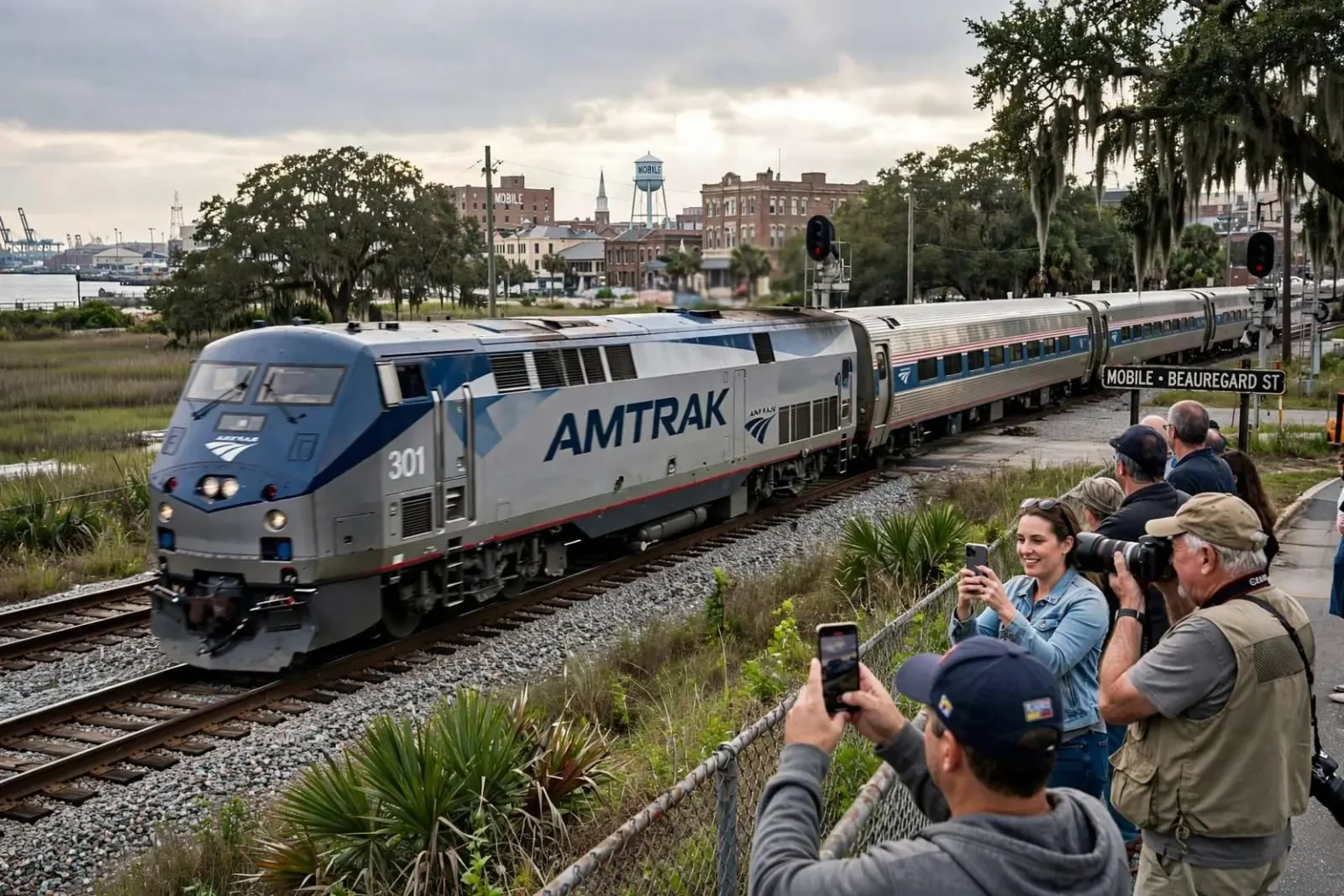
A passenger train rolled through Mobile this week for the first time in years, and Gulf Coast rail advocates are calling it a milestone on the long road to restored service. Amtrak ran its first trip from New Orleans to Mobile and back, sending the train speeding west through Irvington as onlookers captured video of the rare sight. For the communities along the route, the sight of a passenger train where freight and weeds have dominated for nearly two decades was a moment worth recording and sharing.
The Southern Rail Commission describes the run as a “familiarization trip” — a training exercise that lets crews learn the route firsthand and get comfortable operating on the line before paying passengers ever board. These runs are not open to the public, and no tickets were sold. Instead, the trip allowed engineers, conductors and onboard service crews to study the corridor in real conditions, timing the run between stations, noting speed restrictions, and learning the physical character of a line they will operate regularly once service begins.
First trains since Katrina
Passenger rail between New Orleans and Mobile has been absent since 2005, when Hurricane Katrina damaged the track along the Gulf Coast. The storm’s surge and winds wrecked track, bridges, signals and station infrastructure across the Mississippi and Alabama coastline, and the Sunset Limited — the long-distance Amtrak train that had connected the Gulf Coast cities to the national network — never returned east of New Orleans. What had been a continuous passenger rail link across three states became a freight-only corridor for nearly twenty years.
Ever since, officials in Alabama, Mississippi and Louisiana have pushed to bring it back as part of a broader Gulf Coast rail restoration effort. The Southern Rail Commission, a congressionally supported body representing the three states, has championed the cause through years of studies, funding applications and negotiations with the freight railroad that owns the tracks. Local officials along the route have echoed that push, arguing that restored passenger service would support tourism, connect workers to jobs, and give coastal residents a transportation alternative when hurricanes threaten evacuations.
Service between the two cities is scheduled to begin this year, though Amtrak has not announced an official start date. The absence of a firm launch date reflects the complexity of restarting passenger service on tracks owned and dispatched by a freight railroad, an arrangement that requires detailed agreements over scheduling, liability, track access and on-time performance. Those agreements have been the slow-moving pieces of the restoration effort, even as the physical work of preparing the corridor has advanced.
What the route restores
The route would reconnect Mobile with stops along the Mississippi Gulf Coast, giving South Alabama travelers a direct passenger link to New Orleans for the first time in nearly two decades. The corridor ties together a string of Gulf Coast communities whose economies lean heavily on tourism, gaming, military installations and the port economy, and a scheduled train gives residents of each of those places a way to reach the others without driving Interstate 10, a highway notorious for congestion and fog-related crashes near Mobile Bay.
For Mobile specifically, the return of the train restores a connection to a railroading heritage that runs deep in the city. Mobile grew up as a port and rail terminus, and its downtown historic district is anchored by the former Union Depot on Beauregard Street, a turn-of-the-century station that once hosted the trains of multiple railroads before closing in 1974. reviving passenger service puts trains back into the story of a city whose modern identity was shaped as much by the rails converging on its waterfront as by the ships in its harbor.
The familiarization runs are among the final steps before launch: crews must verify track conditions, signals and station procedures along the entire corridor. That means checking every crossing, switch and speed zone between New Orleans and Mobile, confirming that signal systems respond as expected to a passenger trainset, and rehearsing the stop sequences at each station where trains will one day board and discharge passengers. Crews also use the runs to learn the crew-change points, the yard movements and the coordination required with freight dispatchers who control the line.
The process mirrors what railroads have done for generations when introducing service on a new or unfamiliar route. Before an official launch, railroads move equipment over the route repeatedly, run test trains under loaded conditions, and train crews on the specific geography they will operate. On a corridor that has not seen a scheduled passenger train since 2005, there are few if any working crews who have run the route in passenger service, so every engineer, conductor and assistant conductor who will work the line needs supervised trips before the first fare-paying passenger boards.
Why the Gulf Coast push has lasted two decades
The persistence of the restoration effort is itself notable. In the years immediately after Katrina, restoring the service was discussed but largely shelved as the region concentrated on rebuilding homes, businesses and highways. The effort gained momentum as studies quantified the corridor’s potential ridership, and as federal grant programs created new funding pathways for intercity passenger rail projects. The Gulf Coast corridor repeatedly ranked well in those analyses because it links dense, tourism-heavy communities along a straight coastal route with existing active track underneath it.
Alabama’s role in the effort has grown as the launch has drawn closer. Mobile’s position as the eastern terminus makes the city the anchor of the new service, and city and county officials have worked to prepare a station plan and local match funding as their share of the project. The route is expected to run from Mobile’s downtown station area westward through the Mississippi communities of Pascagoula, Biloxi, Gulfport and Bay St. Louis before reaching New Orleans, roughly following the US 90 coastal corridor that predates the interstate.
Each step between the engineering work and opening day has its own constituency watching closely. Tourism officials along the coast see a direct rail link to New Orleans as a way to move visitors between the French Quarter and the coast’s casinos, beaches and seafood kitchens without adding cars to Highway 90 or Interstate 10. Military and shipbuilding communities see connections for workers. Older residents remember when the train ran and tell the stories to a generation that has never seen a passenger train at the Mobile station platform.
The final steps before tickets go on sale
The familiarization trip that passed through Irvington this week is a sign of how close the project has moved to its finish line. A training run means the track is accepted for passenger use, the equipment is on the corridor, and the crews who will staff the trains are learning their territory. Rail backers say each successful trip moves the region closer to the day tickets go on sale. Every mile covered without incident builds the operating record that Amtrak and its partner railroad need before a launch date can be fixed.
Between now and an announced start of service, the remaining work is largely procedural and operational: completing the last of the crew familiarization cycles, finishing station readiness work at each stop, and resolving the final scheduling details with the freight railroad that owns the line. Ridership and revenue projections, marketing plans and ticketing setup all come together in the weeks before a new service’s debut, and none of those steps can be completed until the operating agreements are fully settled.
When service does begin, travelers from South Alabama will board in Mobile and ride west along a corridor that has been rebuilt and upgraded for this purpose over years of construction. The train will slow through the small communities between Mobile Bay and the Mississippi line — places like Irvington, where residents gathered to film this week’s run — before reaching the Mississippi Coast stations. The trip’s duration and schedule are among the details Amtrak has not finalized publicly, and they will shape how useful the train is for day trips versus overnight travel.
For the advocates who have spent years attending commission meetings, writing funding applications and lobbying members of Congress, the sight of a train moving along the route at speed was the point at which two decades of effort became visible. The video taken in Irvington and elsewhere along the corridor circulated among Gulf Coast rail supporters as proof that the project has moved from studies and hearings to trains on the tracks. What remains between this week’s training run and the first departure with passengers is the kind of preparation railroads complete quietly: final sign-offs, safety certifications, and the countdown to the day the doors open in Mobile for paying riders headed west.

