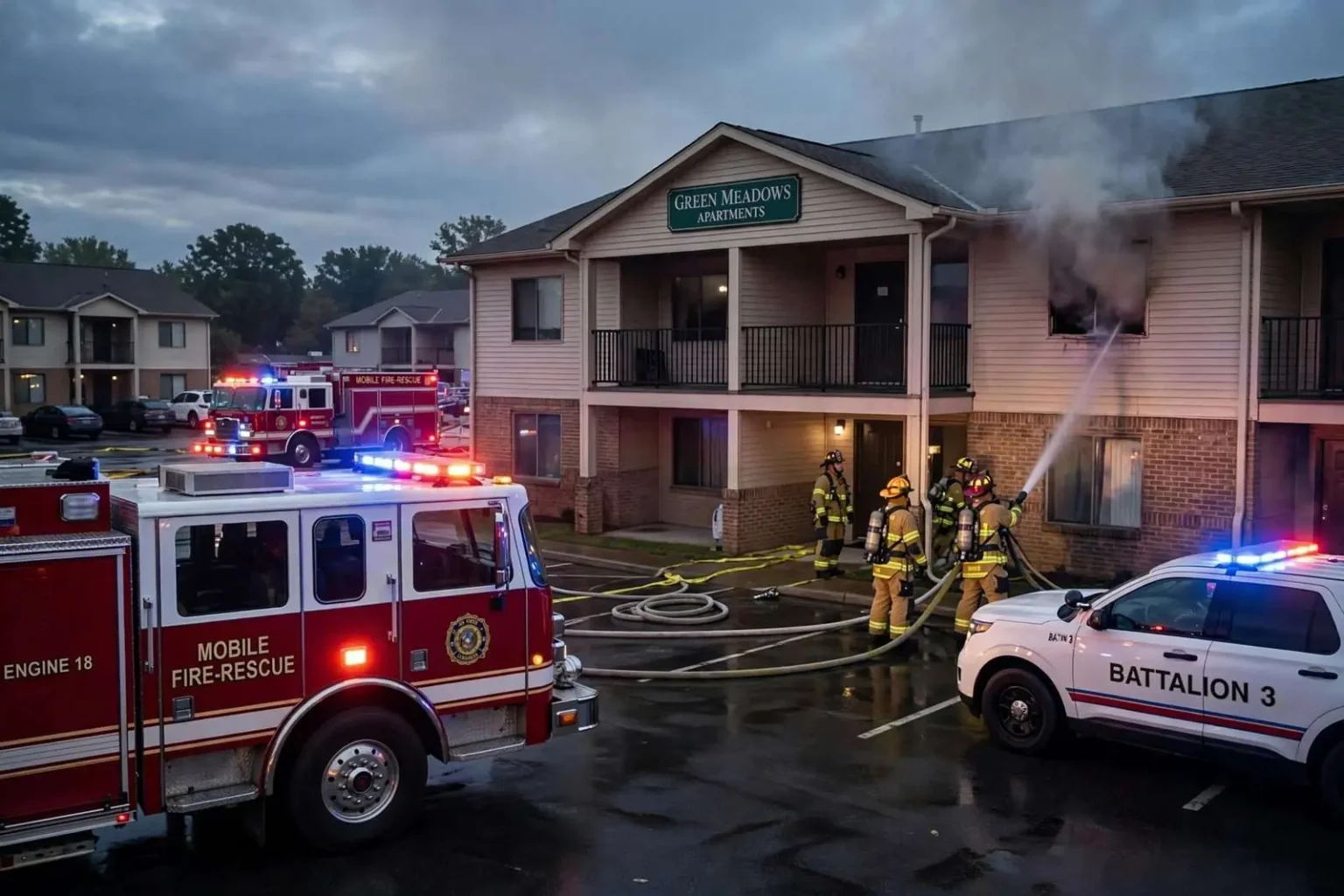
MOBILE COUNTY, Ala. — Mobile Fire-Rescue crews responded to an early morning fire at the Green Meadows apartment complex in Theodore on Friday, May 17, working before sunrise to bring flames under control at the residential property. The call came in just after 5 a.m., dispatching crews to the complex in the unincorporated community south of Mobile.
Firefighters arrived to find flames burning at the complex and immediately began attacking the fire, working to keep it from spreading through the apartment buildings. An update from the department at 6 a.m. — roughly an hour after the first call — confirmed that no injuries were reported in the incident, a significant relief in a residential fire that broke out while most residents were asleep.
Theodore is an unincorporated community in southern Mobile County, located south of Mobile along U.S. Route 90, and the Green Meadows apartment complex serves the residential area of the community. Apartment fires of this kind draw a multi-unit response because of the number of families living under connected roofs, and crews face the twin tasks of knocking down the fire and making sure every unit is evacuated and searched.
Mobile Fire-Rescue has not yet released information about the cause of the fire or the extent of the damage. The investigation is ongoing, and findings — from where the fire started to what ignited it — will come when investigators complete their work at the scene.
An early morning response
Fires that break out just after 5 a.m. present particular challenges. Most residents are asleep, so detection depends on smoke alarms rather than people noticing smoke or flames, and darkness complicates both evacuation and firefighting. Early morning hours are also statistically among the deadliest times for residential fires, which makes the report of no injuries at Green Meadows especially notable. Either alarms worked and residents got out, or the fire’s location allowed crews to reach residents quickly — the investigation’s final report may shed light on which.
The response to an apartment fire typically escalates quickly. First-arriving engines assess the fire’s location and spread, establish a water supply and begin an aggressive interior or defensive attack depending on conditions. Additional units stage for manpower, because dragging hoselines and searching apartment units is labor-intensive. Command officers assign crews to search every unit that could contain residents, while others check the attic and adjoining buildings — spaces where fire travels silently before bursting through. Within an hour of the initial call, the scene at Green Meadows would have involved multiple engines, ladder trucks, medic units and command staff.
Mobile Fire-Rescue and coverage in southern Mobile County
Mobile Fire-Rescue operates fire stations across the city and provides fire and emergency medical services to areas of Mobile County under agreements with the county, including parts of the Theodore area. The department’s coverage of southern Mobile County stretches its resources across a wide geography, and a working apartment fire pulls units from multiple stations at once — leaving other parts of the district covered by neighboring departments until the incident winds down. Volunteer and municipal fire departments in unincorporated Mobile County, including Theodore’s own fire district, routinely assist on such calls, adding tankers, manpower and local knowledge of the streets.
The department’s public updates — an initial dispatch announcement and the 6 a.m. confirmation that no one was hurt — reflect the communication rhythm of a major fire response: first reports are necessarily incomplete, and details about cause, damage and displacement come only after the fire is out and investigators have walked the scene. Residents and neighbors following the incident on social media saw that sequence play out in real time.
What the investigation will examine
Fire investigators work backward from the burn patterns. They will identify the room or area of origin, look for the ignition source, and interview residents and witnesses about what they saw, heard and smelled before the flames showed. Electrical faults, cooking equipment, heating appliances and smoking materials are among the most common causes of apartment fires, and investigators rule through the possibilities methodically. In a multi-unit building, they must also determine whether the fire spread through shared attic space, exterior materials or open doors — findings that can shape both code enforcement and any insurance or legal questions that follow.
The department has not said how many units were damaged or how many residents were displaced at Green Meadows. Displacement is often the longest shadow cast by an apartment fire: families who escape with their lives frequently lose their homes and belongings, and relief in those cases comes from family, landlords’ insurance, the Red Cross of Alabama and Gulf Coast and community donations. As of the department’s last update, the focus remained on determining what happened — and making sure no one was hurt in the process.
Apartment fire safety for Theodore-area residents
A pre-dawn apartment fire is the scenario fire safety educators warn about most. Working smoke alarms are the difference between waking to an alarm and not waking at all, and experts recommend alarms in every bedroom, outside sleeping areas and on every level — tested monthly, with batteries replaced on schedule. Residents of apartment complexes should know two ways out of their building, keep hallway and stairwell doors closed behind them to slow fire spread, and never re-enter a burning building.
Families are encouraged to agree on a meeting spot outside — a mailbox, a landmark in the parking lot — so everyone can be accounted for quickly, and to practice the plan with children who may hide from fire instead of fleeing toward it. In complexes like Green Meadows, where units share walls and attics, a fire in one apartment can threaten dozens of families within minutes, which is why fire departments stress that the alarm you hear belongs to you whether or not the fire is in your unit.
Cooking remains the leading cause of home fires in the United States, followed by heating equipment and electrical distribution problems. The common threads are prevention — never leaving stovetops unattended, keeping space heaters away from curtains and bedding, and not overloading outlets and extension cords — and early detection, which is where the smoke alarm does its silent, essential work.
The community around Green Meadows
Theodore’s residential core along U.S. 90 and the side streets around it mixes single-family neighborhoods, mobile home communities and apartment complexes like Green Meadows, housing families who work in Mobile’s port, shipyards, medical centers and the industrial plants along the nearby corridors. When an apartment fire hits a complex of that kind, the whole community feels it — schoolmates displaced, coworkers collecting donations, churches and neighbors organizing what displaced families need most, from clothes and toiletries to a place to sleep.
As of the latest update from Mobile Fire-Rescue, no injuries had been reported at the Green Meadows complex, the fire was under control, and the investigation into the cause was ongoing. The department has said it will release further information when investigators have determined where and how the fire started. For the residents of Green Meadows, the hours just after 5 a.m. on Friday, May 17 ended as well as a working apartment fire can: crews on scene within minutes, flames knocked down before they could claim lives, and a community spared the loss that so often accompanies a fire in the dark.
How crews keep an apartment fire from becoming a catastrophe
The difference between a damaging apartment fire and a deadly one often comes down to the first fifteen minutes, and the work crews do in that window. Arriving firefighters prioritize life searches over fire attack when reports suggest people may be inside, sending teams through smoke with thermal imaging cameras to find anyone trapped. Meanwhile, hose teams cut the fire off from its easiest paths — hallways, stairwells and attic spaces — to protect the units not yet burning. Ventilation crews open the roof or windows to release heat and smoke, making conditions survivable for both victims and firefighters.
At a complex like Green Meadows, that work happens in the dark, in full gear, with the clock running. The department’s 6 a.m. update, an hour after the initial call, signaled that the fire was being brought under control and that primary searches had turned up no injuries. Reaching that point in an hour on a multi-unit residential fire reflects both the speed of the response and the discipline of the crews working it.
What displaced residents can expect next
Even with no injuries, the days after an apartment fire are hard. Residents of damaged units typically cannot return until investigators clear the scene, utilities are safe and repairs are made, and in the meantime they face immediate needs: lodging, food, medications left behind, and replacement of documents and essentials. The American Red Cross of Alabama and Gulf Coast responds to house and apartment fires across the region, providing emergency lodging, financial assistance and caseworkers who help families plan their next steps. Schools, employers and landlords all play roles in the weeks that follow, and apartment managers are responsible for repairs and for communicating with tenants about timelines.
Insurance questions come early. Renters’ insurance — which many tenants lack — covers belongings and additional living expenses, while the building owner’s policy covers the structure. Advocates urge every renter to carry a policy for exactly this reason; a modest monthly premium can be the difference between a temporary inconvenience and a financial crisis after a fire like the one at Green Meadows.
Until Mobile Fire-Rescue completes its investigation, the facts of the May 17 fire remain what the department has confirmed: a call just after 5 a.m., flames at the Green Meadows apartment complex in Theodore, crews working the scene through the early morning, and an hour later, confirmation that no one was hurt. The cause and the full extent of the damage will be added to that record when the investigation is complete — and for a community that woke to fire trucks on a Friday morning, that no-injury outcome is the headline that matters most.