
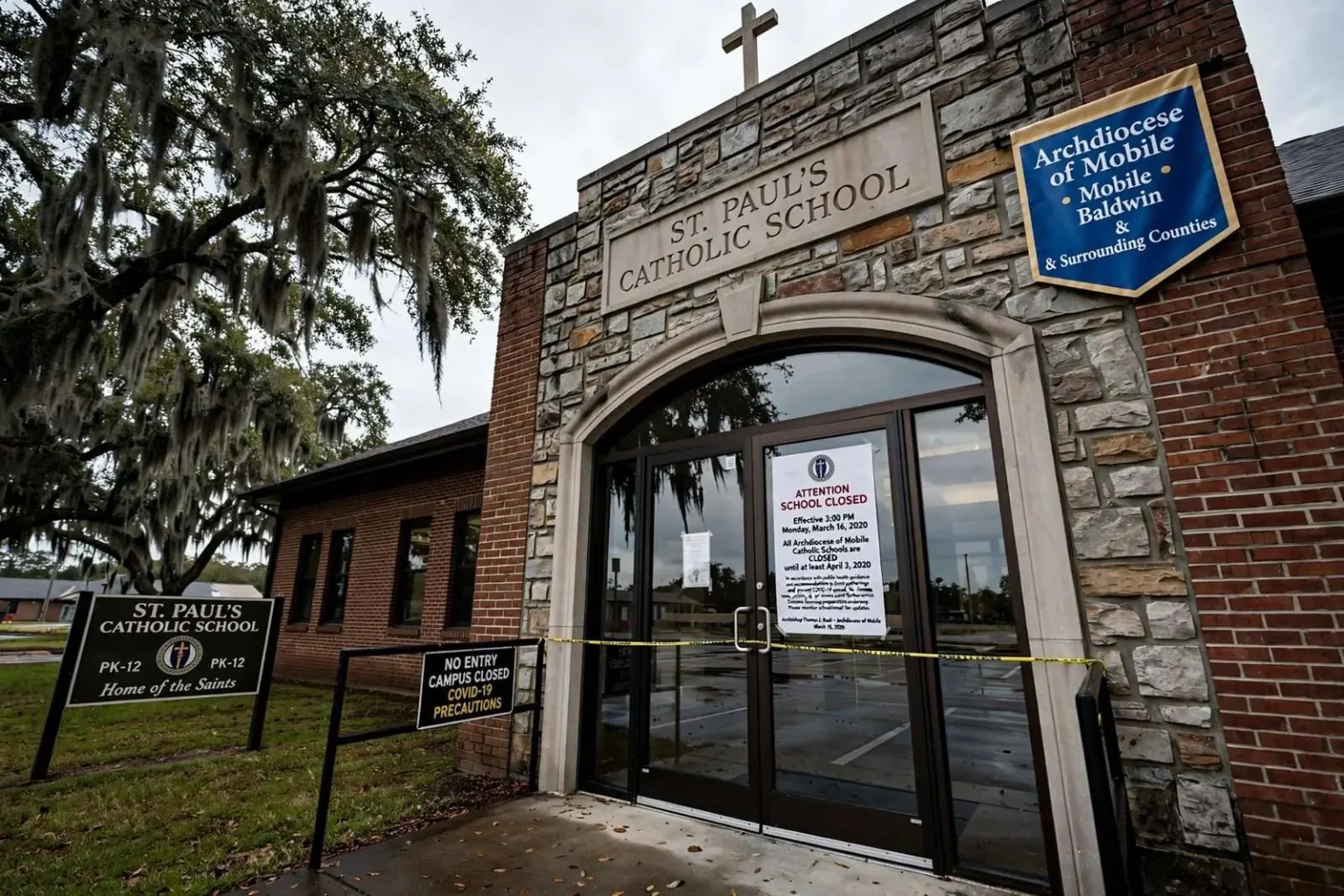
All Catholic schools in the Archdiocese of Mobile closed at 3 p.m. on Monday, March 16, 2020, and will remain shuttered until at least April 3 in response to the growing coronavirus pandemic. Archbishop Thomas J. Rodi announced the closures in a statement issued that afternoon, saying the decision was made in accord with recommendations from the President of the United States, who that same day urged Americans to avoid gatherings of more than ten people and encouraged states to limit school attendance.
The move affected every parochial school across the archdiocese, which serves parishes throughout southern Alabama, including Mobile, Baldwin, and the surrounding counties. Classes across all grade levels and all campuses — from pre-kindergarten programs through the archdiocese’s high schools — were suspended as part of a sweeping effort to slow community transmission of COVID-19, the respiratory illness caused by the novel coronavirus.
A Region Grappling With a Fast-Moving Outbreak
The closures came as school systems across the Gulf Coast and the nation grappled with how to respond to the rapidly spreading virus. Federal health officials had urged that large gatherings be limited and that schools consider temporary closures to slow the spread of disease, guidance that pushed district after district into uncharted territory during what is typically the final stretch of the academic year’s third quarter.
In Alabama, state and local officials were implementing a series of measures aimed at reducing community transmission as confirmed case counts climbed. Public districts in Mobile and Baldwin counties had already announced their own closures, and the archdiocese’s decision brought its schools into line with the broader shutdown that was quickly spreading across the region.
The Archdiocese of Mobile oversees Catholic schools across Mobile, Baldwin, and surrounding counties, serving thousands of students from pre-kindergarten through high school. The closure order applied to all grade levels and all campuses within the archdiocese, meaning families from downtown Mobile to the Eastern Shore faced the same sudden disruption to routines that had been in place for generations.
A Decision Made in Step With National Guidance
Archbishop Rodi’s statement emphasized that the church was acting out of concern for the health of students, families, educators, and the wider community, and in coordination with public health guidance rather than in isolation from it. The reference to the President’s recommendations reflected the extraordinary nature of the moment: a national call for social distancing that same week had already upended professional sports, college campuses, houses of worship, and everyday commerce.
For the schools themselves, the shutdown forced an immediate pivot. Administrators and teachers spent the closure period preparing distance learning plans, distributing materials, and answering questions from parents about how instruction would continue while buildings sat empty. Catholic schools across the archdiocese worked to keep students connected to coursework even as classrooms, cafeterias, gyms, and athletic fields went quiet.
Part of a Broader Wave of Shutdowns
The school closures were part of a broader wave of shutdowns that would eventually extend through the spring and into the summer of 2020. What began as a two-week closure stretched repeatedly as case counts rose and public health officials extended their guidance, a pattern that played out in school systems across Alabama and the nation.
The disruption reached well beyond academics. Spring sports seasons, first communion and confirmation ceremonies, fundraisers, and graduation planning were all thrown into uncertainty by the extended closure. Families that relied on school routines for childcare and meals faced immediate logistical challenges, and parishes that shared campuses with schools had to adjust their own operations as buildings emptied.
Context: The Spring of 2020 on the Gulf Coast
March 2020 marked the moment the coronavirus pandemic arrived in force across the United States, and coastal Alabama was no exception. In the days surrounding the archdiocese’s announcement, Alabama officials reported a growing number of confirmed cases, and municipalities across the region began cancelling public events, closing municipal facilities, and urging residents to stay home.
The archdiocese’s action mirrored decisions being made by Catholic dioceses across the country, many of which closed schools within days of one another as the scale of the outbreak became clear. Nationwide, tens of millions of students were affected by school closures during March 2020, one of the most sweeping education disruptions in American history.
For south Alabama, the closures represented one of the first visible signs that the pandemic would not be a brief disruption. The rapid succession of announcements — from universities and public districts to parochial schools — signaled to families that the region’s institutions were treating the outbreak as a sustained emergency rather than a passing concern.
What Families Needed to Know
The archdiocese said schools would remain closed until at least April 3, with officials pledging to reassess as new information about the outbreak became available. Families were directed to monitor communications from their individual schools for updates on remote learning arrangements, assignments, and plans for making up instructional time.
Archbishop Rodi, who has led the Archdiocese of Mobile since 2008 as the spiritual leader of Alabama’s Catholics south of the Birmingham area, urged the faithful to continue practicing their faith at home during the disruption, even as parish life itself was being curtailed by precautions on gatherings. The school closure announcement came amid parallel decisions affecting Mass schedules and other church activities across the archdiocese’s parishes.
The Archdiocese’s Schools and Their Role in the Region
Catholic education has deep roots in the Mobile area, which hosts the oldest Catholic community in Alabama and one of the oldest west of the Atlantic seaboard. Schools operated by the archdiocese have long served families across the metro area and beyond, blending religious formation with college-preparatory academics, and their closures removed a familiar anchor from daily life for thousands of households.
The schools span a range of sizes and missions, from small elementary campuses in neighborhoods across Mobile and Baldwin counties to larger high schools that draw students from across the central Gulf Coast. Athletic rivalries, service projects, and parish partnerships tie the schools closely to the civic life of the region, which is part of why the closure announcement resonated so widely beyond the families directly enrolled.
The Road to Reopening — and the New Reality
As the April 3 target approached, archdiocese officials joined educators across the state in confronting the reality that the virus would not fade quickly. School systems throughout Alabama ultimately remained closed for in-person instruction for the remainder of the 2019-20 academic year, finishing the year through remote learning and adjusted grading policies.
The spring of 2020 reshaped how south Alabama schools of every kind operate. Distance learning platforms, grab-and-go meal distribution, virtual meetings between teachers and parents, and careful building sanitation protocols all moved from the margins to the mainstream. When campuses eventually welcomed students back for the 2020-21 year, they did so under health guidelines that would have been unimaginable a year earlier — staggered schedules, face coverings, and constant reminders about distancing.
For the archdiocese’s schools, the experience underscored both the challenge and the resilience of a school system built on close community ties. The same small class sizes and engaged parent networks that define Catholic education also helped the schools navigate the transition, as teachers, pastors, and families worked together to keep students learning through an unprecedented spring.
The March 16 closure stands as a marker of how quickly the pandemic transformed everyday life in coastal Alabama. Within the span of a single week, residents saw the suspension of school, restrictions on gatherings, and empty grocery shelves — a sequence that transformed a distant overseas news story into a shared local experience.
Looking Back From a Changed Landscape
In the years since, the closure of the archdiocese’s schools has come to be seen as an early chapter in a much longer story of adaptation. The weeks that followed the announcement brought further restrictions across Alabama, including a statewide health order limiting gatherings and closing non-essential businesses, and the gradual reopening that began later in 2020 proceeded unevenly as case levels fluctuated across the Gulf Coast.
Through it all, the archdiocese’s approach reflected the guidance available at each stage: close when public health officials recommended closure, support families through the disruption, and reopen with safeguards when conditions allowed. The April 3 date in the original announcement proved to be the first in a series of reassessments rather than a fixed endpoint, echoing the experience of school systems across the country.
A Community’s Response
Local parishes and school communities mobilized to support families during the closure period, with teachers checking in on students remotely, school staff coordinating continued communications, and parish communities extending assistance to households facing hardship as the economic effects of the shutdown spread through the region.
The episode also highlighted the interconnectedness of institutions across the central Gulf Coast. Decisions made by federal health officials in Washington and the President’s recommendations on gatherings flowed directly into choices made in Mobile about whether students would report to class that Monday afternoon — a reminder of how quickly national policy translated into local reality during the pandemic’s opening weeks.
For the thousands of students, parents, and educators affected by the archdiocese’s March 16 decision, the weeks that followed were among the most disorienting of their school lives. Yet the closure also became a demonstration of the region’s capacity to adapt, as one of Alabama’s oldest school systems found new ways to fulfill its mission from a distance — and set the template for the disrupted, resilient school years that followed.