
Armed robber hits Thomasville CEFCO gas station
Thomasville Police are searching for a gunman who robbed the CEFCO gas station on Highway 43, taking cash before fleeing on foot. A reward is offered.
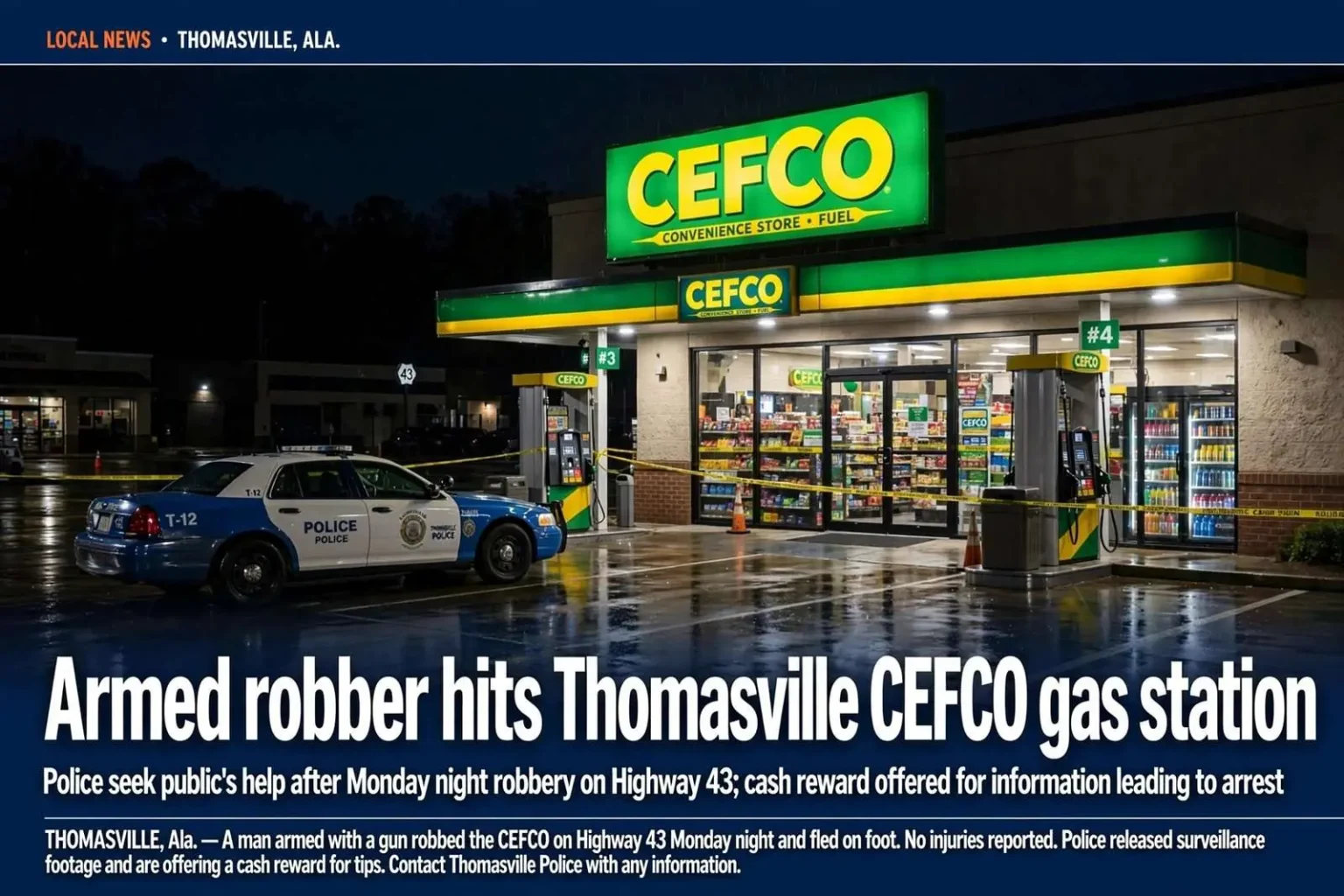
THOMASVILLE, Ala. – A man robbed a CEFCO gas station on Highway 43 Monday night, according to Thomasville Police Chief Mitchell Stuckey. The gunman took cash and ran from the scene on foot. The convenience store is located along Highway 43, the main commercial corridor running through Thomasville, and the robbery happened during evening hours when the store was open and staffed.
The details confirmed by police were limited but clear. A man entered the store armed with a gun, took an undisclosed amount of cash from the business, and left the property on foot rather than in a vehicle. No injuries were reported in connection with the robbery. Because the suspect was caught on the store’s surveillance video, investigators have at least a visual record of the person responsible, and that recording became the centerpiece of the department’s public appeal for help.
Thomasville Police are offering a cash reward for information leading to the capture of the person seen in the surveillance video from the robbery. Anyone with information about the case is asked to contact Thomasville Police. Reward offers of this kind are a standard tool for departments in small Alabama cities, where a single tip from a neighbor, customer, or acquaintance often resolves a case faster than any amount of investigative work alone.
What police confirmed
Armed robbery of a convenience store follows a familiar investigative sequence, and the Thomasville case fits it. The first steps are securing the scene, interviewing the clerk and any customers who were present, and pulling the store’s surveillance footage. That footage typically captures the suspect’s face, clothing, build, and movements inside the store, along with the time of the incident, all of which help investigators establish exactly what happened and what to look for.
In this case, Chief Stuckey confirmed that the suspect was armed with a gun and fled on foot after taking cash. The on-foot escape is a detail with investigative significance: it suggests the suspect may live or frequent locations close to the commercial corridor, because leaving a crime scene on foot limits how quickly someone can cover distance. Patrol units checking the surrounding streets and neighborhoods within minutes of the report are looking for exactly that, a person matching the video walking away from the Highway 43 area.
The amount of cash taken and the full description of the suspect were not released to the public. Departments commonly hold back certain details, such as the exact amount stolen, specific clothing items, or distinctive markings, so that any tipster who volunteers that information can be taken seriously. Withholding those specifics protects the integrity of the reward process and helps investigators separate genuine leads from guesses.
Thomasville and the Highway 43 corridor
Thomasville is the largest city in Clarke County, sitting in the west-central part of Alabama roughly midway between Jackson to the south and the Black Belt towns to the north. With a population of around four thousand people, it functions as the retail and service hub for a wide rural surrounding area. U.S. Highway 43 is the city’s main traffic artery, running north to south through the region and connecting Thomasville to Mobile to the south and the Tuscaloosa area to the north.
That corridor is where the town’s commerce is concentrated. Gas stations, fast-food restaurants, grocery stores, and small businesses line the highway, and the CEFCO store sits among them serving both local residents and the steady flow of highway traffic. Stores located on major routes face a particular security challenge: they are open long hours, they keep cash on hand, and the road offers quick access in and out for anyone inclined toward robbery.
For a community the size of Thomasville, an armed robbery at a busy store is a significant event. The police department is small relative to metro-area agencies, and each serious crime draws on a limited pool of investigators and patrol time. That reality is a large part of why the department moved quickly to publicize the surveillance video and attach a reward to it, effectively turning the town’s residents into extra sets of eyes.
CEFCO and convenience store security
CEFCO is a convenience store chain with locations across the Southeast and Texas, operating under a model familiar to any traveler: fuel islands out front, a store selling groceries, drinks, prepared food, and sundries inside, and long hours of operation. Stores of this type handle a constant stream of small cash transactions, which unfortunately makes them a recurring target for robbery across the industry.
Convenience store operators respond with layered security measures, and most of them were presumably in place at the Thomasville location. Surveillance cameras covering the registers and doors are the most visible, but stores also use drop safes that limit how much cash an employee can access, time-delay locks, good exterior lighting, and clear sightlines from the register to the parking lot so that passing drivers and officers can see in. Employees are generally trained to comply with a robber’s demands, hand over what is asked for, and observe carefully rather than resist.
That training exists because no amount of cash is worth a life, and the outcome in Thomasville, a robbery with no reported injuries, reflects the ordinary success of that approach. The store’s camera system then takes over, converting what would otherwise be a witness’s frightened, incomplete memory into a permanent, reviewable record of the crime.
How reward offers work in cases like this
A cash reward for information leading to a capture is more than a gesture; it is a mechanism with rules attached. Typically the reward is paid only if the tip actually results in the arrest and conviction or capture of the person responsible, and the identity of the tipster is usually kept confidential. In small communities this confidentiality is essential, because people who recognize a suspect from surveillance footage are often acquaintances, and fear of retaliation keeps many of them from coming forward without that protection.
The reward also sharpens public attention. When a department announces that money is attached to a case, residents who might otherwise forget about a news item take a second look at the image, think harder about who they have seen in the area, and talk about the case with family and friends. That ripple effect frequently produces the lead that breaks the investigation, sometimes within days of the announcement.
Anyone with information about the Thomasville robbery is asked to contact Thomasville Police directly. Callers with material information can expect to be asked what they saw, when they saw it, and whether they can identify the person in the video. Even details that seem minor, such as a direction of travel, a vehicle seen nearby before or after the robbery, or a description of clothing, can give investigators the thread they need.
What armed robbery means under Alabama law
Robbery in Alabama is a felony at every level, and the involvement of a firearm places the offense in the most serious category. A conviction for armed robbery carries a lengthy prison sentence, far beyond what applies to simple theft, because the law treats the threat of violence against a person as fundamentally more serious than a crime against property alone. Taking cash from a store while armed with a gun satisfies every element of that offense regardless of whether anyone was hurt.
When the suspect in the surveillance video is identified and arrested, the case will move through the Clarke County court system. Prosecutors will rely on the surveillance recording, testimony from the clerk and any witnesses, and physical evidence from the scene. The clarity of the video and the straightforward nature of the offense, a robbery committed by a single suspect during business hours, typically make these cases easier to present than many other felonies, provided the suspect is caught.
For now, the case remains open, and the department’s message to the public is unchanged: watch the video, think about what you know, and call. In a town where thousands of people drive past the CEFCO every week, the odds that someone recognizes the person on the recording are good, and one phone call could close the case.
Staying alert around late-night businesses
Incidents like the CEFCO robbery are a reminder of the practical realities of nighttime commerce along a highway corridor. Customers and residents can reduce their own exposure with basic habits: favor well-lit stores in busy areas when stopping late, stay aware of who is loitering near the fuel islands, and report anything that looks wrong before walking in rather than after. Clerks, for their part, depend on that same awareness from the public, since an alert customer who notices someone acting strangely outside is often the first line of defense the store has.
The broader lesson for Thomasville is that the community’s eyes and the department’s investigative work are complementary. The surveillance video and the reward give residents a concrete way to help, and past cases in small Alabama towns show that this combination works. Someone in the area knows who appears in that recording, and the department has made it as easy as it can be to turn that knowledge into an arrest.