Artist Spotlight: Katrina Kiefer’s Candid Portraits at Firehouse Wine Bar
Local photographer Katrina Kiefer exhibits candid life portraits at Firehouse Wine Bar in downtown Mobile, including a National Geographic-featured.
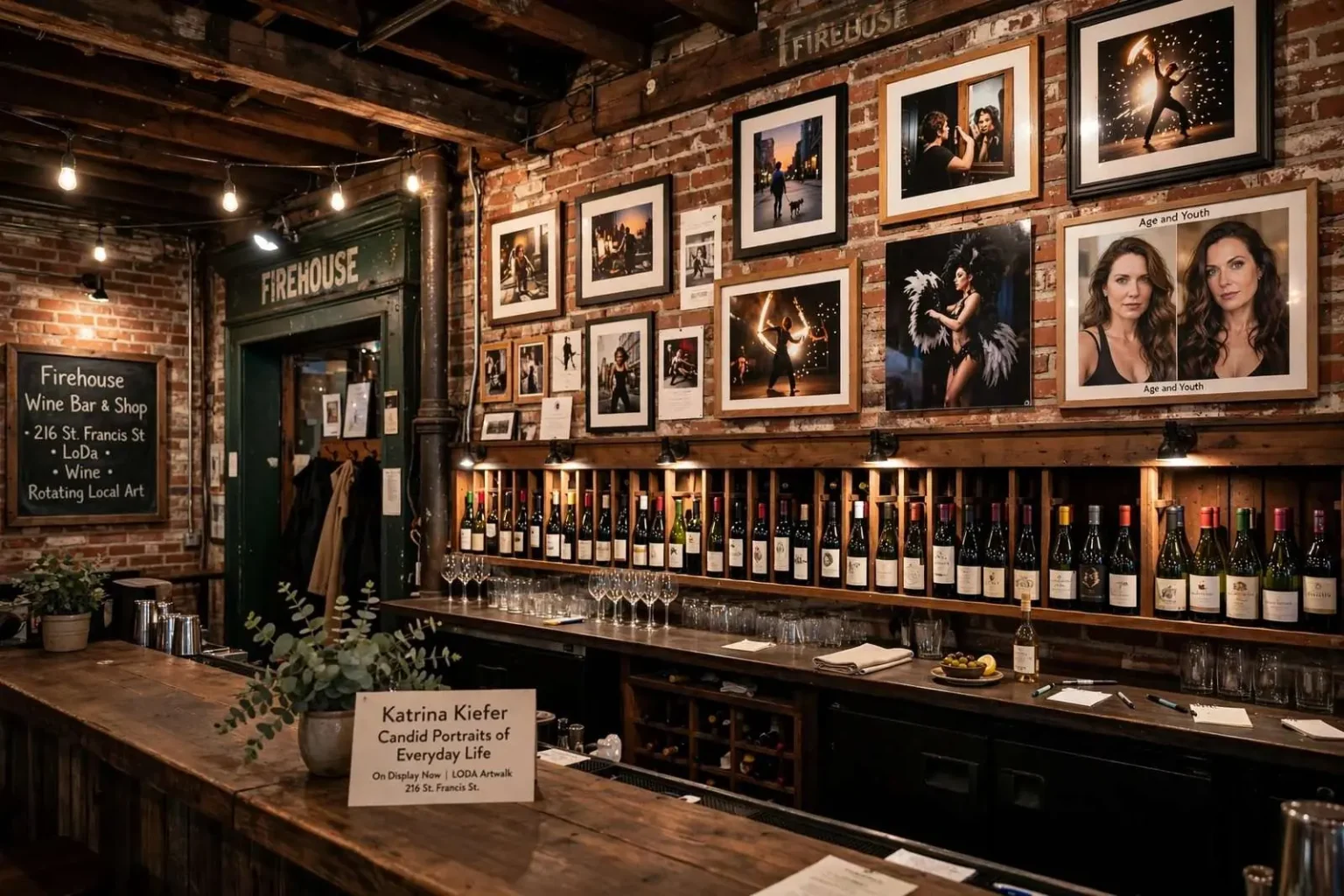
Firehouse Wine Bar & Shop, at 216 St. Francis Street, is currently showcasing a photography collection by local artist Katrina Kiefer, turning the walls of one of downtown Mobile’s most distinctive drinking spots into a gallery for candid portraits of everyday life.
Visitors can browse more than 150 varieties of wine while taking in the images arranged above the long wine racks of the independently owned bar. The venue, housed in a historic firehouse steps from the heart of the LoDa district, has made rotating local art part of its identity, and Kiefer’s photographs now line the space where regulars linger over glasses and first-time visitors wander in from St. Francis Street.
Kiefer, who grew up between Berkeley, California, and Charlottesville, Virginia, moved to downtown Mobile three years ago. She has since become an active part of the Azalea City’s creative community, placing her work in area businesses and building a reputation for portraits that catch people in unguarded moments rather than posed ones. Her path through two coasts before arriving on the Gulf Coast shows in the range of subjects she gravitates toward, from street scenes to stage performers.
Kiefer’s background places her in a tradition of photographers who came to the craft through looking rather than schooling. Berkeley’s documentary photography culture and Charlottesville’s university arts scene are the kinds of environments where self-taught image-makers absorb technique by studying exhibitions, books and the working photographers around them. By the time she reached Mobile, she had both an established style and an appetite for the kind of subjects that established institutions often overlook — performers between sets, pedestrians mid-thought, the small theater of an ordinary afternoon.
Her arrival in downtown Mobile coincided with the district’s post-pandemic revival, when galleries, bars and venues were rebuilding their calendars and looking for local work to hang. Artists who settled into that ecosystem in its recovery years found businesses eager for partnerships, and Kiefer’s portraiture — people-centered, accessible and recognizably local — fit the moment. Three years on, her photographs appear across the district and her name circulates among the collectors and curators who follow the scene.
Candid Portraits of Everyday Life
The collection is a series of life portraits capturing candid moments with everyday people. Scenes range from a person walking a dog to a performer preparing in a mirror, a fire dancer, and a burlesque performance. Many subjects appear lost in thought or focused intently on the moment at hand, unaware of the camera or indifferent to it — the quality that separates candid work from portraiture in the traditional studio sense.
“Hearing someone say, ‘I never saw it that way before,’ or watching them recognize the truth of their own beauty in portraiture is huge for me. Photography keeps everyone honest, if it’s done right,” Kiefer explained. Her approach inverts the usual power dynamic of portraiture: rather than directing subjects to look a certain way, she waits for the moment when they forget the camera entirely, then preserves what was there.
The subjects themselves reflect the worlds Kiefer moves through downtown — performers, artists, dog walkers, bar staff — photographed in the margins of their own routines. In her frames, the everyday moments carry the drama usually reserved for staged work: a performer’s concentration before going on stage, the quiet between a fire dancer’s movements, the small rituals people perform without noticing. Visitors to the wine bar often find themselves studying strangers’ private moments hung above the bottles, a pairing of intimacy and public space that suits the venue.
One standout piece, “Age and Youth,” is a self-portrait within a self-portrait that pairs images of the photographer in the present with herself 30 years earlier. The work folds the artist into the collection on the same terms as her subjects — candid, unguarded, caught in conversation with her own past. Viewers see two women separated by three decades occupying a single frame, each looking at the other and, in a sense, at everyone looking at them.
The work was notable enough that National Geographic published the photograph twice online, chosen from more than 6,700 submissions. For a self-taught photographer working outside the gallery system, the recognition placed her work before one of the largest photography audiences in the world and marked her as an artist whose eye competes at a national level. Prints from the series now hang where diners and wine drinkers can study them at leisure — arguably a more demanding audience than any magazine’s.
Self-portraiture carries particular risks, and “Age and Youth” leans into all of them. Turning the candid lens on herself, the photographer becomes both subject and observer, and the double frame makes that doubleness literal. Viewers at the Firehouse often linger longest on the piece, reading the two faces for the decades between them — the way work changes a person, the way time does, and the way a camera can hold both at once in a single exposure.
A Self-Taught Eye
Though primarily self-taught, Kiefer employs advanced techniques such as delayed flash and slow shutter speeds, methods that blur and illuminate in deliberate combinations to capture motion and mood in a single exposure. The techniques suit her candid style: a slow shutter lets a dancer’s movement smear across the frame while the flash freezes one sharp instant inside it, producing images that feel simultaneous with the moment rather than after it.
The techniques are harder to execute than to describe. Delayed flash requires the photographer to anticipate where a subject will be when the light finally fires, and slow shutter work demands a steady hand and a feel for how long an exposure a scene can absorb before it dissolves into abstraction. Practitioners often spend years developing the timing, and the results — motion and stillness held in a single frame — have become a signature of contemporary street and performance photography.
Some pieces are framed, while others are mounted directly on the wall, all lit to suit an art showing. The presentation choices mirror the collection’s themes — some works presented formally, others installed like fragments of the wall they occupy. The bar’s warm lighting and long sightlines let visitors move from wine list to image and back, the way the artist says she hopes people will experience photography: as part of an evening rather than an errand to a gallery.
Kiefer said events like LODA Artwalk give artists accessible ways to show new work, and that displaying in local businesses lets her reach people who are not necessarily gallery patrons. “I think a vibrant downtown is always the heart of any city, and events like LODA Artwalk present fairly easy ways for artists to show new work,” Kiefer said. The Artwalk, which draws crowds through the LoDa district on scheduled evenings, turns businesses like the Firehouse into temporary galleries and has become a proving ground for Mobile’s working artists.
The Artwalk’s format suits candid work especially well. Crowds move continuously past the walls, and photographs of everyday people reward the passerby in a way that more formal art does not — a visitor recognizes a gesture, a posture, an expression they have seen on the street that afternoon. Artists who show during Artwalk evenings say the conversations that start in front of an image frequently continue at the bar, turning viewers into acquaintances and, occasionally, into subjects.
The relationship between artists and downtown businesses has become one of the quiet engines of Mobile’s cultural growth. Bars, restaurants and shops along Dauphin Street and its side streets routinely host rotating exhibits, giving artists walls and audiences while giving the businesses fresh reasons for customers to return. For a photographer like Kiefer, whose work depends on being seen in person rather than scrolled past, those walls are where careers are built between the bigger opportunities.
Kiefer’s move to Mobile three years ago placed her in a city that has invested heavily in its downtown identity — historic preservation, festivals, and a growing cluster of studios and venues within walking distance of one another. Her collection at the Firehouse, with its portraits of the people who make that downtown move, amounts to a portrait of the district itself: performers and passersby, workers and wanderers, each caught in the honest moment the photographer says she is always looking for.
The setting suits her, and she returns the favor. The Firehouse’s racks hold bottles from small producers alongside familiar labels, and the shop side of the business means visitors can take home the same bottle they enjoyed beneath the portraits. Regulars say the rotating exhibits give them a reason to look up from their glasses, and for the artists each new show converts a room of drinkers into a room of viewers — one pour, and one image, at a time.
The collection remains on display at Firehouse Wine Bar & Shop, 216 St. Francis Street, where visitors can see the work — and the self-portrait National Geographic noticed — any evening the bar is open, a glass of wine in hand.