
As Air Force Tanker Bid Deadline Nears, Mobile’s Jobs Stakes Take Center Stage
As bids came due in the Air Force's aerial refueling tanker competition, Mobile's hopes for an Airbus assembly line at Brookley took center stage.
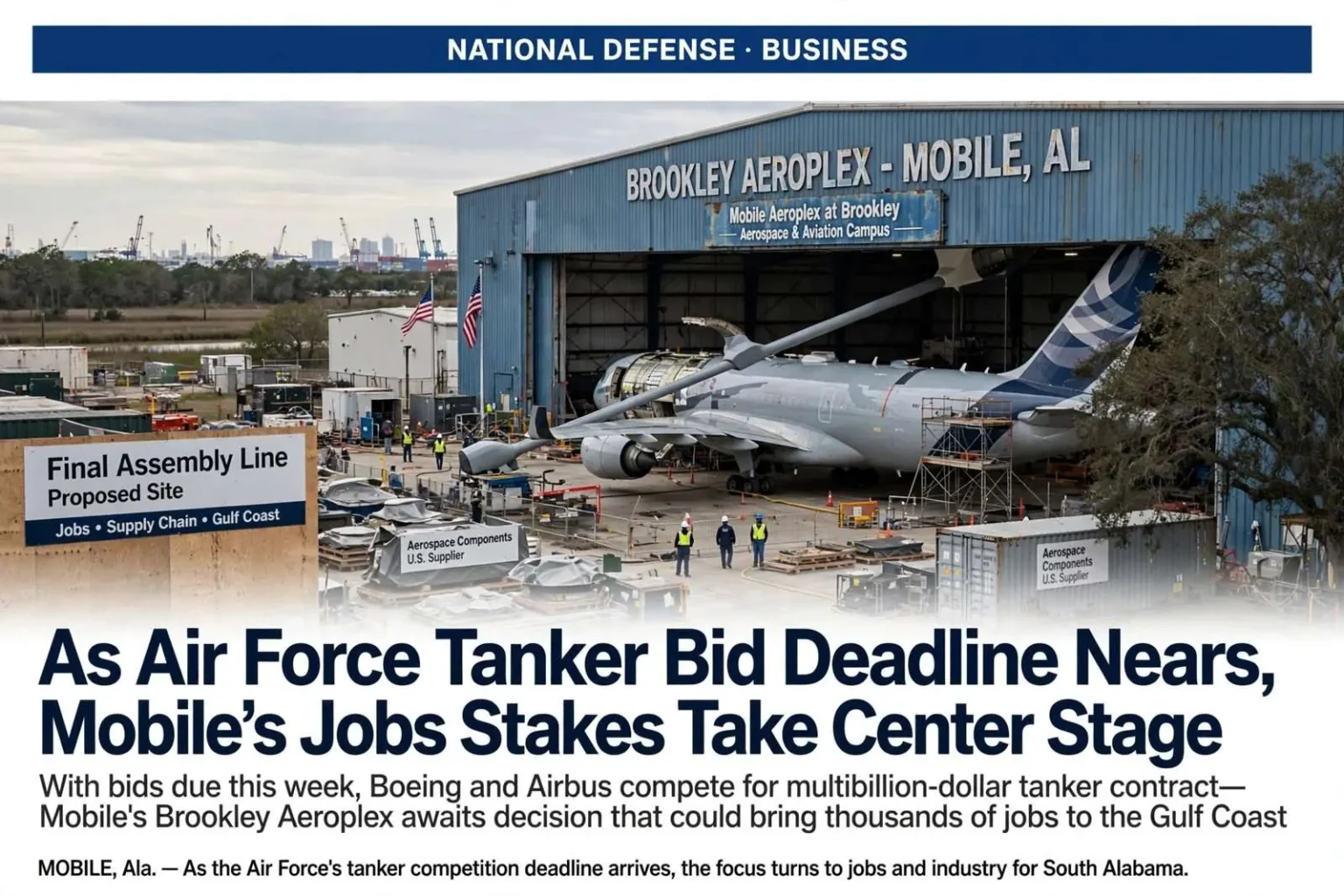
With the deadline for bids in the U.S. Air Force’s long-running aerial refueling tanker competition arriving this week, the debate over which manufacturer would build the next generation of tankers has again turned to a familiar question for South Alabama: how many jobs would actually land in Mobile.
The competition pitted Boeing against a team built around Airbus, the European aircraft maker that has proposed final assembly of its tanker at Mobile’s Brookley Aeroplex. Both companies have leaned on the argument that their aircraft would support more American jobs, and both have released supplier figures meant to bolster that case.
The bidding closes a chapter in a procurement fight that has dragged on for years and has already turned Mobile into a national talking point once before. Every twist in the process — every protest, every rebid, every congressional hearing — has been tracked locally with more attention than almost any other economic development story in the region, because the prize at stake is measured in an assembly line, a workforce and an industrial future.
Two competing jobs arguments
Backers of the Airbus-based bid have argued that a Mobile assembly line would represent new aerospace work for a region that, at the time, had little large-scale aircraft manufacturing presence — in contrast to Boeing’s tanker work, which would largely extend jobs already tied to existing Boeing facilities elsewhere in the country. In that framing, a Mobile win adds net-new capacity to the American industrial base in a place that has never had it, spreading defense work beyond the traditional corridors of the Pacific Northwest and the Great Plains.
Critics of that argument, meanwhile, have pointed to Boeing’s own history of outsourcing on its 787 Dreamliner program, questioning how much of Boeing’s tanker-related work would truly stay domestic. The Dreamliner experience — in which major structural work was parceled out to suppliers around the globe — became an argument-by-analogy in the tanker debate, with Mobile’s supporters using it to question Boeing’s claims and Boeing’s defenders noting the company’s subsequent moves to bring work back in-house.
Both sides have cited supplier lists showing substantial numbers of U.S.-based subcontractors, underscoring how contested and, at times, self-serving both companies’ jobs claims have been throughout the years-long fight. The numbers are engineered as much for the political audience as the Air Force one: tanker decisions move through Congress, and members of Congress count jobs in their districts before they count airplanes.
Why the stakes run deeper than one contract
For Mobile, the stakes have been more than academic. A win for the Airbus-led team was expected to bring a new final-assembly line to Brookley, a former Air Force base the city has spent years trying to redevelop into a civilian aerospace hub. The airfield’s history gives the prospect its particular weight: Brookley was, for decades, one of Mobile’s largest employers before its postwar closure, and the city has worked since to turn the site’s runways, hangars and industrial footprint back into an economic engine.
Local officials and business boosters have treated the tanker competition as a potential turning point for the region’s economy, one that could establish Mobile as a serious player in U.S. aircraft manufacturing regardless of how the underlying jobs math shakes out nationally. Aerospace work pays wages that ripple through the local economy in ways port and shipyard employment alone cannot, and a final assembly line would anchor a supplier chain that reaches deep into the region.
A competition with a contentious history
Nothing about this round has been simple. The Air Force’s effort to replace its Eisenhower-era KC-135 tanker fleet has careened through a leasing proposal that collapsed in scandal, a first competition that ended with a Mobile assembly line selection only to be overturned on protest, and a rebid process that stretched across administrations. Each round has recycled the same core questions — capability, price and, inevitably, jobs — while Mobile has watched a decision that once seemed won slip away and come back around again.
The fleet the competition aims to replace gives the urgency its edge. The KC-135s that have refueled American combat aircraft for more than half a century are aging past any reasonable extension, and every year of delay leaves the Air Force flying a tanker designed in the 1950s. Air Force officials have described the replacement as one of the service’s most pressing acquisition priorities, which is why neither side’s complaints about the process have slowed it for long.
The politics have been as layered as the procurement. Washington-state lawmakers guard Boeing’s commercial workforce; Alabama’s congressional delegation has championed the Airbus bid and the work it would bring to the Gulf Coast; and a European company’s pursuit of a Pentagon contract has raised questions about foreign ownership and national security that the Airbus team has worked to rebut by emphasizing its American workforce and American suppliers. Every jobs figure released this week lands in that charged environment.
What happens after the deadline
The Air Force is expected to evaluate the competing bids in the months ahead, with a contract award still to come. The evaluation will weigh the aircraft themselves — capability, fuel offload, compatibility with the fleet they must support — alongside price and the industrial plans behind each bid. Both companies have spent years preparing for exactly this window, and both have built their Mobile-related claims to survive scrutiny from auditors as much as from competitors.
Whichever team prevails, the outcome will shape not just a multibillion-dollar defense program but also the near-term economic outlook for the Mobile area. A win would mean construction, hiring and a supplier hunt across the Gulf Coast; a loss would send Mobile’s aerospace ambitions back to the drawing board, though the city’s other aerospace assets would remain in place.
For now, the bids are in, the argument is made, and the wait begins. Mobile has been through the waiting before, and the region’s experience with the competition’s false starts has taught residents to hold both possibilities at once — hope for the assembly line, patience for the process. The difference this time is that the deadline is real, the fleet is old, and the Air Force has staked its own credibility on finishing what it started.
Brookley’s second life
The site at the center of Mobile’s hopes tells the story of the city’s industrial past and its ambitions in a single place. Brookley Field was established in the years before World War II and grew into a major Air Force logistics center, employing tens of thousands at its peak and anchoring entire neighborhoods of workers’ homes on Mobile’s south side. The base’s closure in the late 1960s remains one of the most consequential economic blows in the city’s history, and its aftermath — vacant hangars, lost paychecks, a workforce scattered to other cities — shaped how Mobile thinks about economic development to this day.
The redevelopment that followed came in waves. The airfield stayed open as Mobile Aeroplex at Brookley, and aviation companies were drawn to its combination of runways, deep industrial buildings and a waterfront location near the port. Aircraft maintenance and repair firms became the site’s backbone, building on Mobile’s existing strengths and training a local workforce in the peculiar demands of working on large aircraft. That base of experience is precisely what the Airbus team’s proposal builds on: a final assembly line needs the same fundamentals — airfield access, skilled labor, industrial space — that the Aeroplex has spent decades accumulating.
City and county officials have backed the pursuit with infrastructure and incentives, treating the tanker as the anchor tenant that could redefine the site. An assembly line would draw suppliers the way maintenance work never could: parts manufacturers, tooling shops and logistics firms tend to cluster near final assembly, and each supplier that lands in the region multiplies the original job count. That multiplier effect is what local officials mean when they describe the competition as a potential turning point rather than merely a contract.
What jobs figures can and cannot say
The supplier lists both companies have released deserve the skepticism they get. Jobs claims in defense competitions are built to be cited, not audited: counts of subcontractors can include firms supplying a single fastener, and projections of new hiring assume win scenarios that never fully materialize. The Dreamliner precedent cuts both ways here — it shows that a manufacturer’s stated plan for domestic work can shift with economics after the contract is won, and it also shows that supplier networks, once built, tend to persist and grow.
What the figures cannot capture is the qualitative change a final assembly line represents. A region can host a hundred small suppliers without ever touching the core skill of building complete aircraft; landing the assembly work itself moves a place into a category occupied by only a handful of American metros. That distinction — between participating in the aerospace economy and anchoring it — is what Mobile’s business leadership has kept its eye on through years of on-again, off-again competition.
The wait that follows this week’s deadline will be filled with the familiar choreography: analysts scoring the bids, delegations lobbying, and both companies’ local champions keeping the region’s expectations calibrated somewhere between confidence and preparation for another round. Mobile has learned, through every previous turn of the tanker saga, that the only reliable position is readiness — the site prepared, the workforce pipeline planned, the case for Brookley made and remade until the Air Force finally signs.


